I apologize for the silence over the last year. This past February my stepfather passed away after a twenty-month cancer battle. We knew after his first diagnosis that this was the eventual outcome, but the doctors believed he had another 3-5 years. Unfortunately, his illness had other ideas and spread very quickly during those last six weeks. Throughout the ordeal this former Marine never complained and never wallowed in self-pity. He faced death bravely and courageously. You can take the man out of the Marines but you can’t take the Marine out of the man. He spent the last week at home, most of it asleep while his body went about the process of passing. After he passed my mom and I sat with him for an hour and I was filled with nothing but overwhelming gratitude for a man who gave so much to so many. A man for whom obligation, duty and responsibility were not trivial matters. He could be ornery and cantankerous and didn’t suffer fools gladly (or at all), but he cared deeply and gave freely. A truly great man. My family was immeasurably blessed when he married my mom 15 years ago. I am grateful for our Redeemer who made death but a step towards immortality. We miss him, but we will see him again.
As we rotated late night shifts during that week of hospice, I stumbled into the pro-Book of Abraham YouTube algorithm. In recent years, Latter-Day Saints have become a truly formidable force in the world of online apologetics. It’s impressive how many young people are actively involved. These young people do a fantastic job. The hosts and presenters are charismatic, genial, intelligent, well-informed and well-spoken. To their credit, they don’t shy away from difficult topics. But like any apologist, their goal is to defend the “Restoration” and all it encompasses.
This is a difficult proposition when it comes to the Book of Abraham, the church’s most controversial book. Much, if not all, of the discussion surrounding the Book of Abraham in these videos focuses on the papyri we have, the alleged additional papyri we don’t have (the “Missing Scroll Theory”), the Egyptian alphabet, and the translation method. You’ll find papyri-centric videos with titles like “NEW Research Proves the Critics Wrong,” “Egyptian Kolob,” “This Changes Everything,” and “Evidence for the Book of Abraham” This is an interesting line on inquiry because when the Church released the Book of Abraham essay it acknowledged,
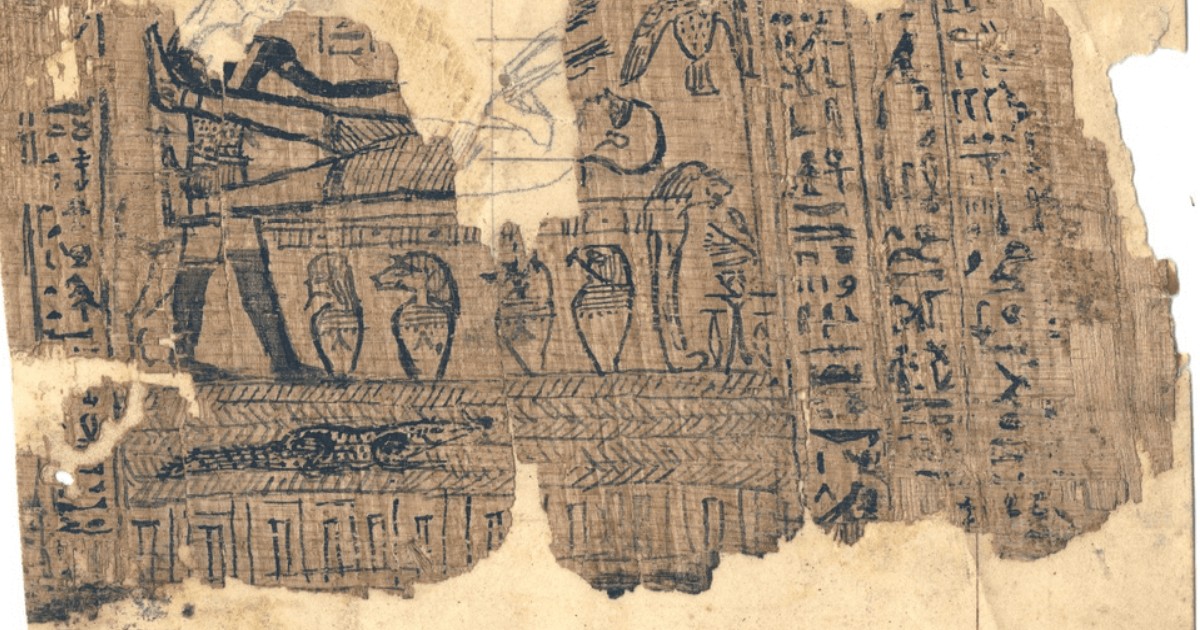
“Latter-day Saint and non-Latter-day Saint Egyptologists agree that the characters on the fragments do not match the translation given in the book of Abraham, though there is not unanimity, even among non-Latter-day Saint scholars, about the proper interpretation of the vignettes on these fragments. Scholars have identified the papyrus fragments as parts of standard funerary texts that were deposited with mummified bodies. These fragments date to between the third century B.C.E. and the first century C.E., long after Abraham lived.” (Emphasis added).
Indeed, the papyri Joseph Smith bought from Michael Chandler in 1835 are a well-known category of Egyptian texts called Books of Breathing. These funerary texts were buried with the deceased in the belief that the spells and incantations written therein would assist them in navigating the afterlife. Some of missing papyri used in the creation of the Book of Abraham, thought to have been destroyed in the 1871 Chicago Fire, were found in the Metropolitan Museum of Art in 1966. Hugh Nibley wrote of these papyri, “Upon their publication in 1967, the Joseph Smith Papyri Nos. X and XI were quickly and easily identified as pages from the Egyptian ‘Book of Breathings.’ The frequent occurrence of the word snsn provided a conspicuous clue, and, though the last page of the book (the one that usually contains the title) was missing, its contents closely matched that of other Egyptian writings bearing the title sh‛ (sh‛i, sh‛.t) n snsn, commonly translated ‘Book of Breathing(s).'”
Since the discovery of the missing papyri, the Church has been in the unenviable position of defending a text whose source material doesn’t match the alleged translation. Out of necessity, apologists created a new hypothesis, formerly endorsed by the Church in its 2014 essay, called the “catalyst theory.” This hypothesis (it’s not a theory in the scientific sense of the word because it’s not testable, repeatable, nor verified by evidence), proposes,
“Joseph’s study of the papyri may have led to a revelation about key events and teachings in the life of Abraham, much as he had earlier received a revelation about the life of Moses while studying the Bible. This view assumes a broader definition of the words translator and translation. According to this view, Joseph’s translation was not a literal rendering of the papyri as a conventional translation would be. Rather, the physical artifacts provided an occasion for meditation, reflection, and revelation. They catalyzed a process whereby God gave to Joseph Smith a revelation about the life of Abraham, even if that revelation did not directly correlate to the characters on the papyri.” (Emphasis added.)
If the Book of Abraham is a fabrication instead of translation, as the case appears to be, then it’s a severe blow to Joseph’s prophetic reputation and some of the church’s biggest truth claims. As I’ve written many times now, the church painted itself into a corner very early in its history by making Joseph Smith, and not the Book of Mormon, its foundation. Despite repeated warnings in “the most correct book” about “trusting in the arm of flesh,” the church and its defenders have had to create new and inventive ways of harmonizing and explaining Joseph’s evolving doctrines and failed prophecies. If Joseph goes down, the entire church goes with him.
Instead of accepting the fact that the Book of Abraham is a fraud, the Church offers another approach: “The truth and value of the book of Abraham cannot be settled by scholarly debate. Its status as scripture lies in the eternal truths it teaches and the powerful spirit it conveys. Each of us can study its teachings and pray for confirmation from the Holy Ghost that its message is from God.” While questions surrounding the papyri and translation are interesting (but mostly unproductive), the most important part of the Book of Abraham is the text. I agree with the Church’s suggestion that “….in many ways, our questions about the process [of translation] are less important than the question of whether God revealed new scripture to Joseph Smith.” Is the Book of Abraham a true revelation? How can we know? What does the text actually tell us? Can the Holy Spirit testify to the “truthfulness” of a fraudulent book?
There are several converging lines of inquiry that we’ll review in this post to give us insight to the text: the Divine Council motif in its Ancient Near Eastern setting; the second-temple development of Hebrew Angelology; and the emergence of Michael in LDS thought (we can thank Sidney Rigdon). Lastly, the Book of Abraham’s depiction of Jesus Christ ultimately reveals the fraud. The Book of Abraham Jesus and the Book of Mormon Jesus are irreconcilable. We’ll demonstrate this using only the text. If the Book of Abraham is a true revelation from God, then the Book of Mormon necessarily false and vice-versa.
I welcome any challenge or counterargument to the information presented. You can leave a comment, or email me at matt_lohrke@yahoo.com or matt.lohrke@gmail.com.
THE BOOK OF ABRAHAM TEXT
Before asking whether or not the Book of Abraham was inspired by God, we’d be wise to do the work of studying what we’re asking about. When it comes to scripture, or more appropriately, “religious writings,” I am a textualist. By that I mean I give primacy to the text rather than interpretations or apologetic defenses. Joseph Smith’s involvement with the Book of Abraham has no bearing on its truthfulness. It rises or falls on its own merits according to its own words.
The first step in investigating the Book of Abraham is identifying the individuals in the text rather than assuming we know who they are. In chapter 1 we are introduced to the Lord God:
“And his voice was unto me: Abraham, Abraham, behold, my name is Jehovah, and I have heard thee, and have come down to deliver thee, and to take thee away from thy father’s house, and from all thy kinsfolk, into a strange land which thou knowest not of…Behold, I will lead thee by my hand, and I will take thee, to put upon thee my name, even the Priesthood of thy father, and my power shall be over thee. As it was with Noah so shall it be with thee; but through thy ministry my name shall be known in the earth forever, for I am thy God.” (v. 16, 18-19, emphasis added.)
In Chapter 2, the Lord God is again identified as Jehovah:
“For I am the Lord thy God; I dwell in heaven; the earth is my footstool; I stretch my hand over the sea, and it obeys my voice; I cause the wind and the fire to be my chariot; I say to the mountains—Depart hence—and behold, they are taken away by a whirlwind, in an instant, suddenly. My name is Jehovah, and I know the end from the beginning; therefore my hand shall be over thee.” (v. 7-8, emphasis added. Joseph appears to borrow here from Helaman 12:13: 13: “Yea, and if he say unto the earth—Move—it is moved.”)
The Lord God twice identifies Himself as Jehovah, the personal or covenant name of the God of Israel transliterated as LORD in the Hebrew Bible. It is the combination of the tetragrammaton YHWH and the vowels of “Adonai,” Hebrew for “my Lord” or “my master.” According to the Documentary Hypothesis, a redactor (or redactors) merged several extant documents into the Torah we have today. The “J” source (the Yahwist), living in the south kingdom of Judea, used YHWH to refer to God. The “E” source (the Elohist), living in the northern kingdom of Israel, used the informal noun, “Elohim.” When speaking of the God of Israel, or the One True God, “Elohim” is always singular despite the plural –im ending. We see the usage of both in Exodus 20:2: “I am the LORD (Yahweh) thy God (ĕlōheḵā ), which have brought thee out of the land of Egypt, out of the house of bondage.” The Hebrew ĕlōheḵā (“your God”) is the construct form of Elohim with a second-person suffix, showing possession rather than a distinction between “the LORD” and “God.” This is important because in LDS theology “Elohim” is interpreted as “God the Father” while “Jehovah” is Jesus Christ the Son. We read on LDS.org, “God the Eternal Father, whom we designate by the exalted name-title ‘Elohim,’ is the literal Parent of our Lord and Savior Jesus Christ, and of the spirits of the human race” (“The Father and the Son: A Doctrinal Exposition by the First Presidency and the Twelve,” in James E. Talmage, The Articles of Faith, 466, emphasis added). In the Hebrew Bible, however, YHWH and Elohim both refer to the same God. Jehovah is the personal name and “God” is his title. This is perhaps most explicitly expressed in Exodus 3:15:”And God (Elohim) said moreover unto Moses, Thus shalt thou say unto the children of Israel, The LORD (Yahweh) God (Elohe) of your fathers, the God of Abraham, the God of Isaac, and the God of Jacob, hath sent me unto you: this is my name for ever, and this is my memorial unto all generations.”
The Book of Mormon affirms that Jehovah is Jesus Christ. When He came to Bountiful He said to those gathered, “feel the prints of the nails in my hands and in my feet, that ye may know that I am the God of Israel, and the God of the whole earth, and have been slain for the sins of the world” (3 Nephi 11:14). Later He added, “Marvel not that I said unto you that old things had passed away, and that all things had become new. Behold, I say unto you that the law is fulfilled that was given unto Moses. Behold, I am he that gave the law, and I am he who covenanted with my people Israel; therefore, the law in me is fulfilled, for I have come to fulfil the law; therefore it hath an end.” (3 Nephi 15:3-5, emphasis added).
The LDS church’s entry for Jehovah in the Guide to the Scriptures reads, “The covenant or proper name of the God of Israel. It denotes ‘the eternal I Am’ (Ex. 3:14; John 8:58). Jehovah is the premortal Jesus Christ and came to earth as a son of Mary” (Emphasis added). The Church’s essay on the Book of Abraham states, “This book, a record of the biblical prophet and patriarch Abraham, recounts how Abraham sought the blessings of the priesthood, rejected the idolatry of his father, covenanted with Jehovah…” We are all in agreement that Jesus is Jehovah, therefore Jesus speaks to Abraham in chapters 1 and 2.
We then move to the Divine Council scene in chapter 3, which Joseph produced in 1842, some seven years after beginning work on the Book of Abraham. Jehovah presides over the Divine Council and at no point in chapter 3 is a god superior to Jehovah introduced. Joseph likely drew inspiration from Psalm 82, which begins, “God (Elohim) standeth in the congregation of the mighty (El); he judgeth among the gods (Elohim).” This is a very difficult passage because “El,” translated as “mighty” in the KJV, is singular and can’t refer to the “mighty.” It would better read, “God stands in His court,” or “The Most High stands in the congregation of God.” To further complicate things, the Cambridge Bible commentary suggests that “Elohim” in Psalm 82 was “[o]riginally no doubt Jehovah, for which the Elohistic editor has substituted Elôhîm. standeth] Or, taketh his stand: solemnly takes His place as president.” Textual evidence suggests that the Second Book of Psalms (42-83), were edited by the Elohist, who favored the noun “Elohim” when referring to God rather than the personal name of YHWH. The Psalm might even be better translated as, “Jehovah takes his stand in the congregation of God,” which supports the idea that Jehovah is the Most High God. He takes His rightful place as head of the congregation and chastises the “Elohim,” who contextually are other beings in the assembly. There’s no consensus on the identity of the Elohim, but whomever they are (human rulers, Divine beings, angels, or foreign gods), Jehovah stands supreme over them all.
The Divine Council or Divine Congregation was a common motif in the Ancient Near East. Ugaritic texts (modern Syria, 14th–12th century B.C.) preserve Canaanite myths in which the high god El presides over a divine council of lesser gods. (“El” is the same Semitic term for “God” found in passages such as Isaiah 40:18 and 43:12, where it is used as a title for YHWH.) The Baal Cycle depicts the gods deliberating, assigning cosmic roles, and deciding the outcomes of battles. In the Mesopotamian creation myth Enuma Elish (18th century B.C.), Marduk, the god of order and creation, defeats Tiamat, the primordial goddess of salt waters and chaos. After his victory,
“The great gods assembled, They exalted the destiny of Marduk and did obeisance. They invoked a curse on themselves and took an oath with water and oil, and put their hands to their throats. They granted him authority as King of Kings, They confirmed him as lord of the gods of heaven and netherworld. Anšar gave him his exalted name, Asalluhi. At the mention of his name, let us show submission! When he speaks, let the gods heed him, Let his command be superior in upper and lower regions. May the son, our avenger, be exalted, Let his lordship be superior and himself without rival.”
The Hebrew Divine Council draws on that shared cultural tradition. It’s important to remember that the Psalms are liturgical, not necessarily revelatory or prophetic. The Gospel writers adapted some passages from the Psalms (2, 22 and 110, for example) and applied them to Jesus, but in their original context they aren’t Messianic. They are interpretations and applications, not divine revelation.
Deuteronomy 32:8-9, which is part of the “Song of Moses,” presents another view of the Divine Council. In the KVJ we read, “When the Most High (El Elyon) divided the nations to their inheritance, when he separated the sons of Adam, he set the bounds of the people according to the number of the children of Israel. For the LORD’S (YHWH) portion is his people; Jacob is the lot of his inheritance.” Read at face value, it appears that Jehovah (the allottee) is subordinate to the Most High God (the alloter) and receives Israel as His inheritance. But this passage, too, is problematic and one of the more contested passages in Biblical studies. The Masoretic Text, the source text of our modern Hebrew Bibles, reads “children of Israel,” but the Septuagint (the Greek translation of the Hebrew Bible) reads “angels of God,” and Dead Sea Scrolls read, “sons of God.” The distinctions are crucial. If the original reading is “sons of God,” which the majority of scholars affirm, then it is reasonable to conclude that YHWH is one of the sons of the Most High who receives Israel as His portion. Some apologists, however, argue that the text doesn’t require separating El Elyon and YHWH. The Masoretic editor(s) may have attempted to smooth over the polytheism of the earlier tradition by changing “sons of God” to “children of Israel.” Whatever the case, Deuteronomy 32 likely preserves an older strata of Canaanite tradition that eventually faded as YHWH assumed the role of Most High reflected in Isaiah 40-55. Hebrew theology was never perfectly consistent, nor was exclusively monotheistic at various points in history. Much like Mormonism, it developed over time. I believe this is why Nephi’s vision of Christ–and his knowledge that He is the Eternal God–is so important. His vision served as a theological reset, a clear foundation on which the Nephites could build. But as we’ve discussed before, Joseph was much more sympathetic to the Ancient Israelite religion and traditions and we see that influence in Abraham 3:
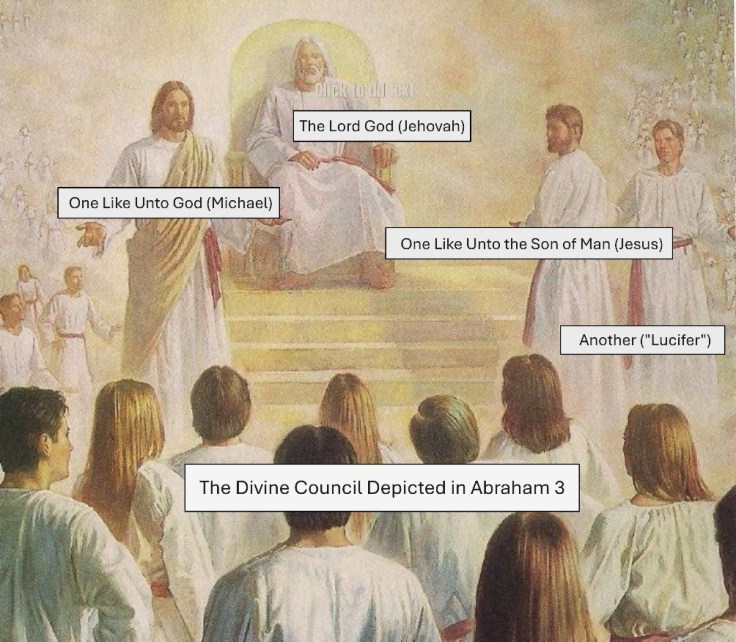
“Now the Lord (Jesus) had shown unto me, Abraham, the intelligences that were organized before the world was; and among all these there were many of the noble and great ones; And God (title) saw these souls that they were good, and he stood in the midst of them, and he said: These I will make my rulers; for he stood among those that were spirits, and he saw that they were good; and he said unto me: Abraham, thou art one of them; thou wast chosen before thou wast born. And there stood one among them that was like unto God, and he said unto those who were with him: We will go down, for there is space there, and we will take of these materials, and we will make an earth whereon these may dwell; And we will prove them herewith, to see if they will do all things whatsoever the Lord (Jesus) their God (title) shall command them; And they who keep their first estate shall be added upon; and they who keep not their first estate shall not have glory in the same kingdom with those who keep their first estate; and they who keep their second estate shall have glory added upon their heads for ever and ever” (v. 22-24, Emphasis added).
Here we are introduced to two of the “noble and great”: one that was “like unto God” (v. 24) and one “like unto the Son of Man” (v. 27). They are distinct individuals. To properly navigate this theological minefield, we need to determine who they are. In the LDS essay on the historicity of the Book of Abraham we read,
“The book of Abraham clarifies several teachings that are obscure in the Bible. Life did not begin at birth, as is commonly believed. Prior to coming to earth, individuals existed as spirits. In a vision, Abraham saw that one of the spirits was ‘like unto God.’ This divine being, Jesus Christ, led other spirits in organizing the earth out of ‘materials’ or preexisting matter, not ex nihilo or out of nothing, as many Christians later came to believe” (Emphasis added).
If you consult the footnote for “one” associated with the one “Like unto God” (24a) you will find “Jesus Christ, Firstborn.” This is an important footnote because it indicates that Jesus Christ is subordinate to God. He is like God, but he is not God. The Pearl of Great study guide adds, “Abraham learned additional things about Jesus Christ. For example, Jesus Christ was the One who created the earth upon which the spirit children of Heavenly Father would dwell (see Abraham 3:24). He was also chosen and sent to earth to be the Savior (see verses 27–28; see also Moses 4:1–4).” You can read Abraham 3:27-28 and you won’t find any mention of Jesus being “chosen” to be the Savior. We do find a similar passes in Moses 4:2 in which the Lord God (Jehovah) says to Moses: But, behold, my Beloved Son, which was my Beloved and Chosen from the beginning, said unto me—Father, thy will be done, and the glory be thine forever.” Here, too, Jesus is distinct from and subordinate to Jehovah.
We are also presented to one “like unto the son of man,” who is also very clearly Jesus. I don’t know why Joseph chose these two titles instead of using their names. My feeling is that he wanted to sound more sophisticated, but that’s speculation. Joseph borrowed “one like unto the son of man” directly from the Revelation of John: “And in the midst of the seven candlesticks one like unto the Son of man, clothed with a garment down to the foot, and girt about the paps with a golden girdle” (1:13, KJV, emphasis added). Unsurprisingly, this is also a very problematic translation. The KJV translators revealed their biases by capitalizing “Son,” probably to conform with the Gospels. The original Greek, however, reads, “one like a son of man,” simply meaning a human-like figure. “Son of man” isn’t an honorific or title in the Revelation, it’s a description of a human being. In the Book of Abraham, the one “like unto God” and “one like unto the Son of Man” are very clearly different individuals, but both are routinely identified as Jesus in LDS publications. We now have three Jesuses in the Divine Council if we attempt to harmonize various LDS doctrines.
MICHAEL THE ARCHANGEL
If Jesus is Jehovah and oversees the Divine Council (and the “one like unto the Son of Man” is Jesus), then the one “like unto God” must be someone else. That someone else is Michael the Archangel. The anglicized “Michael” comes from the Hebrew Miyka’el: miy and (the prefix derivative from) kiy and ‘el; who (is) like God?.” Michael literally means “Who is Like God?” The Wikipedia entry for “Michael” reads,
“Hebrew: מִיכָאֵל; Aramaic: ܡܝܟܐܝܠ, romanized: Mīkhāʼēl) is a common masculine given name usually thought to be from the Hebrew rhetorical question מי כאל (mī kāʼēl), “Who [is] like [the Hebrew god] El?”, thus being a theophoric name whose answer is “there is none like El”, or “there is none as famous and powerful as God.” This question is known in Latin as Quis ut Deus? Paradoxically, the name is also sometimes interpreted as “One who is like God.” LIkewise, the entry for “Michael” at lds.org reads, “In Hebrew means ‘Who is Like God.'”
Robert Millet, one of Mormonism’s foremost scholars, recognized Michael’s presence in the Divine Council,
“Michael was directly involved in the preparation of the physical world in which he and his posterity would undergo a mortal probation. Elder Bruce R. McConkie of the Quorum of the Twelve wrote: ‘Christ and Mary, Adam and Eve, Abraham and Sarah, and a host of mighty men and equally glorious women comprised that group of ‘the noble and great ones,’ to whom the Lord Jesus said: ‘We will go down, for there is space there, and we will take of these materials, and we will make an earth whereon these may dwell.’ (Abr. 3:22–24)” (Emphasis added.).
The Lord Jesus didn’t say this, Michael did. McConkie continues,
“This we know: Christ, under the Father, is the Creator; Michael, his companion and associate, presided over much of the creative work; and with them, as Abraham saw, were many of the noble and great ones.’ The Prophet Joseph Smith thus taught that ‘the Priesthood was first given to Adam; he obtained the First Presidency, and held the keys of it from generation to generation. He obtained it in the Creation, before the world was formed, as in (JST) Gen. 1:26, 27, 28″ (emphasis added).
McConkie, too, apparently understood Michael’s presence in the Divine Council, but he also demoted Jesus from the Eternal God of the Book of Mormon to “companion and associate” of Michael, whom the LDS believe became “Adam.” McConkie wrote in Mormon Doctrine that “Christ is Jehovah; they are one and the same Person…To Abraham the Lord said: ‘I am the Lord thy God. … My name is Jehovah.’ (Abra. 2:7-8.) ” (p. 282). McConkie can correctly identify Jesus as Jehovah in Abraham 2, but also identify “One Like unto God” as Jesus, even though the latter is clearly distinct from and subordinate to the former in Abraham 3. ln a strange turn, we read in the Book of Mormon, “But behold, I will show unto you a God of miracles, even the God of Abraham, and the God of Isaac, and the God of Jacob; and it is that same God who created the heavens and the earth, and all things that in them are. Behold, he created Adam, and by Adam came the fall of man (Mormon 9:11-12). If Jesus and Michael are “companions,” and Michael presided over much of the creative work, it sounds a bit odd for Jesus to create Michael’s human form in the person of “Adam.” (“Adam is the Hebrew word for “man.” I think this is the sense of how Mormon 9:11-12 uses it.)
THE DEVELOPMENT OF MICHAEL IN LDS THOUGHT
Michael began to rise to prominence in LDS theology in late 1833. There are, however, several difficulties placing him in the premortal Divine Council. Primarily, he doesn’t appear in any Hebrew literature until about 200 B.C. There are no named angels in the Hebrew Bible prior to the Exile. There are no named angels in the Book of Mormon, either. Prior to the Exile, angels were simply called “malʾakh YHWH,” or “messenger of the LORD.” This is where we get the name “Malachi,” which means “my messenger.”
Where, then, does Michael come from? While not all the Hebrews were exiled in 597 B.C., a significant number were. Those carried to Babylon remained until Cyrus the Great of the Achaemenid Empire (Persia) conquered Babylon in 539 B.C. Cyrus’ Edict allowed the Hebrews to return to their homeland and rebuild the Temple, but they were not an autonomous state. Judah became a Persian province known as Yehud and remained under Persian rule until Alexander the Great of the Macedonian Empire took Babylon in 322 or 331 B.C. During this two-century Persian period, the Hebrews came into sustained contact with Persian religious ideas, including Zoroastrian concepts of divine intermediaries and cosmic dualism. Zoroastrianism featured a highly developed hierarchical angelology. At the top stood the supreme deity Ahura Mazda, who presided over a ranked order of divine beings. First, the Amesha Spentas (“Bounteous Immortals”), who were exalted, quasi-angelic emanations representing various aspects of Ahura Mazda. The Amesha Spentas were tied to various aspects of creation: Vohu Manah (animals), Asha Vahishta (fire), Spenta Armaiti (earth), Haurvatat (water), Ameretat (plants). Below them were a broader heavenly host known as Yezata, who acted as messengers and guardians. Opposed to Ahura Mazda was Angra Mainyu and his host of demons called daevas.
Zoroastrian angelology naturally influenced the Israelites’ theology and worldview, giving rise to archangels and a heavenly hierarchy, always subordinated to YHWH. Not long after the end of the Persian period we begin to see named angels in Hebrew writings. Michael (“Who is Like God?”) and Gabriel (“God is my strength”) appear for the first time in the Book of Daniel, composed during the Maccabean period (2nd century B.C.). Michael is presented as a cosmic defender and Prince of Israel who wages battle against the gods of other nations. Uriel (“God is my light”) appears in 1 Enoch 9 (3rd–2nd century B.C.), and Raphael (“God heals”) appears in the Book of Tobit (3rd–2nd century B.C.) Other angels, including Raguel (“Friend of God”), Sariel (“Friend of God”), Phanuel (“Face of God”), and Remiel (“Mercy of God”), also appear in 1 Enoch. Early Christians naturally inherited Jewish angelology, with “Gabriel” announcing Jesus to Mary. I don’t doubt an angel appeared to Mary, but identifying that angel as Gabriel is the result of an entrenched cultural tradition rather than objective fact.
I hate to be the bearer of bad news, but these named arch angels don’t exist. It is true that Michael appears in the Revelation of St. John, but that work is a mythic poem, not a chronology of end-time events. The Revelation falls into the category of Apocalypse (which means “unfolding or “revelation”). John Walton explains that an apocalypse,
“is [an] interpretation of events in the author’s present or near-present. In this sense, apocalyptic functions very similarly to historiography, in that it serves to explain the author’s present circumstances. What historiography conveys through describing and interpreting past events, apocalyptic conveys through symbol and metaphor. In a history, the authority of the interpretation comes from the experience and expertise of the historian who serves as interpreter. In an apocalypse, the authority comes through the cosmic being relaying the vision, not so much from the (typically pseudonymous) author. Additionally, Aune argues that apocalypses are normally produced specifically by communities undergoing oppression or crisis. The purpose of the apocalypse, therefore, is to describe how the particular crisis of the community is connected to God’s work, and also what God plans to do to resolve it” (Demons and Spirits in Biblical Theology: Reading the Biblical Text in Its Cultural and Literary Context, p. 53, emphasis added).
For “Daniel,” the crisis was the Maccabean Revolt. For John it was Roman persecution. For Nephi, whose vision qualifies as an apocalypse, it was the wickedness in Jerusalem and flight into the wilderness. Please don’t read the Revelation as a “prophecy” of real world or chronological “end-time” events. Armageddon, the beast of the sea, the dragon, and the 144,000 are no more “real” than the great and spacious building, the mists of darkness, the iron rod and the tree of life of Nephi’s vision are “real.”
There are more than linguistic reasons to identify Michael as the one “Like Unto God” as Michael. It’s no secret that the trajectory of LDS doctrine drastically shifted when Sidney Rigdon arrived in December 1830. What was once a fairly straightforward, Protestant-adjacent religion suddenly became a “Restoration Movement” with priesthoods, temples, and a literal Zion.
The only pre-Rigdon reference to Michael I could find was in D&C 29 (September 1830), which reads, “Michael, mine archangel, shall sound his trump, and then shall all the dead awake, for their graves shall be opened, and they shall come forth—yea, even all.” The Archangel Michael, from what I’ve been able to tell, was not a particularly important figure in Christianity during Joseph Smith’s lifetime. He is only mentioned in the Book of Daniel, Jude, and the Revelation. But as the Joseph Smith Papers editors write, “In 1835 the notion [that Michael is Adam] came into even greater usage in revelations, blessings, and church periodicals,” the same general time period Joseph began work on the Book of Abraham, and I believe this was due primarily to Sidney Rigdon’s influence.
In December 1833 Rigdon published the first installment of his series on the “Millennium” in The Times and Seasons. On January 1, 1834 Oliver Cowdery, who had just returned to Kirtland from Missouri, wrote a letter to John Whitmer,
“Brother Joseph says, that the item in his letter that says, that the man that is called, etc., and puts forth his hand to steady the ark of God, does not mean that anyone had at the time, but it was given for a caution to those in high standing to beware, lest they should fall by the shaft of death as the Lord had said.Since I came down I have been informed from a proper source that the angel Michael is no less than our father Adam and Gabriel is Noah. I just drop this because I supposed that you would be pleased to know.”
Considering that Cowdery refers to Joseph by name, it stands to reason that his “proper source,” who is unnamed, is Sidney Rigdon. Phelps would then publish this information in the Messenger and Advocate, calling it “new light.” I believe this is the first known reference to Adam being Michael. Recall that David Whitmer wrote,
“Rigdon was a thorough Bible scholar, a man of fine education, and a powerful orator. He soon worked himself deep into Brother Joseph’s affections, and had more influence over him than any other man living. He was Brother Joseph’s private counsellor, and his most intimate friend and brother for some time after they met. Brother Joseph rejoiced, believing that the Lord had sent to him this great and mighty man Sydney Rigdon, to help him in the work..Rigdon would expound the Old Testament scriptures of the Bible and Book of Mormon (in his way) to Joseph, concerning the priesthood, high priests, etc., and would persuade Brother Joseph to inquire of the Lord about this doctrine and that doctrine, and of course a revelation would always come just as they desired it” (An Address to All Believers in Christ, 1887. p. 53. Emphasis added.).
I believe Rigdon would explain certain concepts, like priesthood, temples, Zion, and in this case “Michael,” to Joseph and then Joseph, acting as “prophet” would dictate a “revelation” based on Rigdon’s doctrines. The revelations “always came out as they desired it” because Joseph was simply regurgitating and codiifying RIgdon’s doctrines as “revelation.” They weren’t actually revelations, which is why they so frequently contradict the Book of Mormon. I haven’t yet figured out the logic behind the Noah/Gabriel connection, however. Denver Snuffer expressed his opinion that John the Baptist is Uriel, but I reject that considering these named angels don’t exist.
In May 1834 Sidney Rigdon published part V of his series,
“In the 24 chapter of Isaiah, and 23 verse, the prophet, after having described one of the greatest desolations ever pronounced on the head of any generation of men, says, ‘Then the moon shall be confounded, and the sun ashamed, when the Lord of hosts (Jesus) shall reign in mount Zion, and in Jerusalem, and before his ancients gloriously.’ We have before seen that this reign was to last a thousand years; and his ancients, before whom he was to reign in mount Zion, and in Jerusalem, gloriously, were all the redeemed from among men, of every tongue, language, kindred, and people.
“According to Daniel, he was to come to the ancient of days: here he is said to reign before his ancients, that is, all the saints from our father Adam, down; for who could the ancient of days be but our father Adam? surely none other: he was the first who lived in days, and must be the ancient of days. And to whom would the Savior come, but to the father of all the race, and then receive his kingdom, in which he was to reign before, or with his ancients gloriously? Let it here be remarked, that it is said to be in mount Zion, and in Jerusalem, where the Lord is to reign before his ancients gloriously” (Emphasis added).
Isaiah 24-27 is sometimes referred to as “The Apocalypse of Isaiah,” though there is debate over whether or not it meets the criteria of a traditional apocalypse and questions regarding the authorship itself. (Many scholars consider it to be a later insert, but part of the Isaiah school.) Rigdon, living in an apocalyptic time period, would have understood it as an apocalypse and thus connected it to Christ’s alleged millennial reign. Ridgon’s exegesis of Isaiah 24 and Daniel 7 lays the groundwork for the LDS doctrine that Jesus will come to “Adam” in the valley of “Adam-ondi-Ahman” in the last days. Again, I again hate to break it to you, but this gathering is never going to happen because the idea is built on a series of misinterpretations and misunderstandings of scripture. It’s easy to track and Rigdon’s exegesis of these passages, but he’s just very wrong about it. In fairness, it’s all his fault. “Ancients” is an unfortunate translation in Isaiah 24:23. Modern translations correctly render the Hebrew “zaqen” as “elders.” Zaqen “function[s] both as an adjective describing advanced age and as a noun signifying a recognized office of community leadership. Scripture presents old age not merely as chronology but as a God-given season for wisdom, counsel, and covenant service. It shares the same root that we find translated as “elders” in the “Elders of Israel” (Exodus 3:16).
Rigdon’s second mistake was the conflation of Jesus with the “son of man” from Daniel 7. In fairness to Rigdon, this was the standard interpretation at the time. Adam Clarke’s Commentary, which we know Joseph used, says of Daniel 7:13, “One like the Son of man came with the clouds of heaven – This most certainly points out the Lord Jesus, בר אנש bar enosh, the Son of miserable man; who took our nature upon him that he might redeem us unto himself. To prove himself to be the Messiah he applies, before the high priests, these words of the Prophet Daniel to himself Matthew 24:30″ (emphasis added). Matthew Henry’s commentary for the same verse reads, “The Messiah is here called the Son of man; he was made in the likeness of sinful flesh, and was found in fashion as a man, but he is the Son of God. The great event foretold in this passage, is Christ’s glorious coming, to destroy every antichristian power, and to render his own kingdom universal upon earth (emphasis added).
Daniel 7:13, however, just like Isaiah 24.23, is the victim of an unfortunate translation. As the Cambridge Bible Commentary notes,
“The rendering of A.V. (KJV), ‘the Son of man,’ is quite untenable: the expression of the original is indefinite, and denotes simply, in poetical language (cf. Numbers 23:19; Psalm 80:17; Isaiah 51:12; Isaiah 56:2), a figure in human form (comp. Revelation 1:13; Revelation 14:14, R.V.). What the figure is intended to represent can be properly determined only after the explanation in Daniel 7:16 ff. has been considered…If the terms of Daniel 7:18; Daniel 7:22 b, 27 are to be taken as deciding the question, it would seem that it must describe the ideal and glorified people of Israel (emphasis added).
“Son of man” isn’t a real person, Jesus or otherwise, in Daniel. It is the corporate representation of the Saints of the Most High. Cambridge adds, “In the Book of Daniel itself there is nothing which lends support to the Messianic interpretation. In the explanation of the vision which follows (Daniel 7:15 ff.) the place occupied by the ‘one like unto a son of man’ is taken, not by the Messiah, but by the ideal people of God:” Much in the same way that the Isaiah’s “Servant of the Lord” is the corporate representation of Israel, the “one like the Son of man” represents the Saints of the Most High (v.18). John J. Collins, the world’s leading authority on apocalyptic literature, argues that the “son of man” isn’t necessarily the personification of the Saints of the Most High, but their heavenly doppelganger. The Ancient Near East worldview presupposed that what events on earth had a heavenly counterpart and the “son of man” was the Israelites’. Whatever the case, the “son of man” in Daniel isn’t Jesus.
The “Ancient of Days” likewise suffers from a problematic translation. The Ancient of Days is God, not Adam. There is no disagreement (that I could find) on this outside of Mormonism. We are previously introduced to “Ancient of Days” in Daniel 7:9: “I beheld till the thrones were cast down, and the Ancient of days did sit, whose garment was white as snow, and the hair of his head like the pure wool: his throne was like the fiery flame, and his wheels as burning fire.” Cambridge explains, “The expression does not mean what the English words seem to imply, one who had existed from the days of eternity; it means simply an aged man; and the R.V. (Revised Version), one that was ancient of days, is meant to indicate this.” The KJV translators again revealed their biases by adding “the” and capitalizing “Ancient.” It’s descriptive rather than titular and should read, “one ancient of days” or “one ancient in days,” which may be the representation of God in this vision rather than God himself. I suspect there’s a parallel to Nephi’s vision in which he saw the Spirit of the Lord in the form “of the man.” The Holy Spirit isn’t a personage, but is presented as man in the vision for symbolic purposes. When it comes to apocalyptic literature, we should always assume symbolism, simile, and metaphor unless explicitly stated otherwise.
Over the next few years Michael becomes more frequently mentioned. In 1834-35, D&C 27 was revised to include “Michael, or Adam, the father of all, the prince of all, the ancient of days.” D&C 107:54, which was written in late winter or early spring of 1835 reads, “And the Lord appeared unto them, and they rose up and blessed Adam, and called him Michael, the prince, the archangel.” Also in 1835, Joseph revised a blessing given to his parents in 1833 to contain similar lineal priesthood language to D&C 107 and to added: “And the Lord appeared unto them, and they rose up and blessed Adam, and called him Michael, the Prince, the Arch angel. And the Lord administered comfort unto Adam, and said unto him, I have set thee to be at the head: a multitude of nations shall come of thee, and thou art a Prince over them forever.” Joseph then adds, that his father “shall be called a prince over his posterity, holding the keys of the patriarchal priesthood over the kingdom of God on earth, even the Church of the Latter Day Saints; and he shall sit in the general assembly of patriarchs, even in council with the Ancient of Days when he shall sit and all the patriarchs with him— and shall enjoy his right and authority under the direction of the Ancient of Days (“Adam”).” The Joseph Smith Papers editors note “over eighty percent of the text of JS’s [1835] blessing for his father and mother is not found in the earlier [1833] journal version.” Joseph Smith, Sr. passed away in 1840.
In 1836 Joseph allegedly had a vision of the Celestial Kingdom in which he “saw father Adam, and Abraham and Michael and my father and mother, my brother Alvin that has long since slept.” This vision was later edited to remove “Michael” in current published versions for obvious reasons. (There is some controversy regarding the authorship of this vision. To be fair, I will file it under “to be determined.”)
In 1844 Joseph donated 38 books to the Nauvoo Library, including John Brown’s 1824 “Dictionary of the Bible.” Brown’s entry for Michael reads, “Who is Like God.”
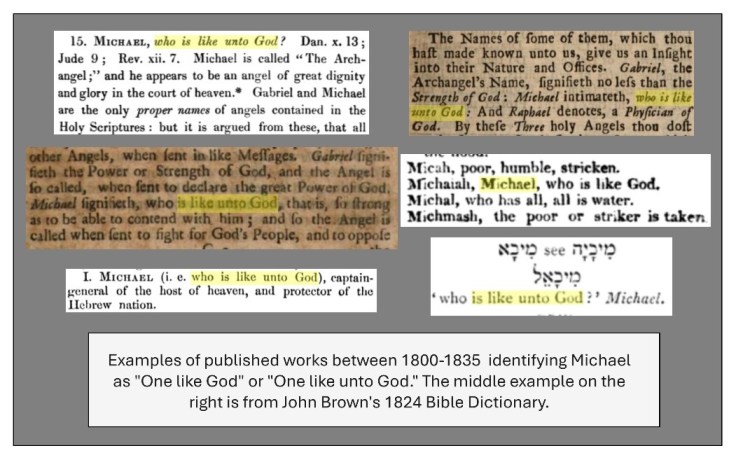 By the time Joseph began work on Abraham 3 in March of 1842, the Adam/Michael tradition was firmly entrenched and he had plenty of available material to draw from. It was general knowledge that Michael meant “Who is Like God?” or “Who is like Unto God.” Given all the evidence presented to this point, I am confident in asserting that the Divine Council Scene places Jesus and Michael as princes and co-equals subordinate to Jehovah the King. Given that Jesus is Jehovah, this is an impossible scenario and demonstrates that Joseph Smith didn’t really know who Jesus was.
In Abraham 3, Jehovah asks, “Whom shall I send?” “One like unto the son of man” (Jesus) quotes Isaiah 6:8 and says, “Here am I, send me.” This is radically different from what the Book of Mormon teaches. The Book of Mormon variously refers to Jesus as “The Eternal God,” The King of Heaven,” “The Most High God,” “The Everlasting Father,” “God Himself,” and “The True and Only God.” If there is only one God, as the Book of Mormon affirms, Jesus must necessarily be God, not subordinate to God. There can be none higher than “the most high” and none greater than the King. But Joseph Smith demoted Jesus from Eternal God to volunteer. This turns the entire Book of Mormon message on its head. For example, on the eve of His condescension he said,
“Lift up your head and be of good cheer; for behold, the time is at hand, and on this night shall the sign be given, and on the morrow come I into the world, to show unto the world that I will fulfil all that which I have caused to be spoken by the mouth of my holy prophets. Behold, I come unto my own, to fulfil all things which I have made known unto the children of men from the foundation of the world, and to do the will, both of the Father and of the Son—of the Father because of me, and of the Son because of my flesh. And behold, the time is at hand, and this night shall the sign be given” (3 Nephi 1:13-14, LDS).
That “God Himself” (Mosiah 15) would come into mortality to atone for sins of mankind was always the plan. There was never another plan. God didn’t send a representative, emissary or proxy, He came Himself. That is the central message of the Book of Mormon. We might wonder why Joseph Smith didn’t know what Lehi, Nephi, Jacob, Abinadi, Alma, Amulek, Nephi the disciple, Mormon, Moroni and the Brother of Jared all knew: Jesus Christ is God. (I have a lot more to say about this, but I’ll save it for its own post.)
One of the more interesting things about Abraham 3 is that someone on the scripture committee apparently realized the problem of Jesus and Jehovah being distinct beings. The footnote Abraham 27a (“The Lord”) reads, “TG God the Father, Elohim.” At no point in Abraham 3 is a God superior to “The Lord God” introduced. We previously noted that “Elohim” is just the noun for God, not a title and certainly not “God the Father.” This footnote is basically a deus ex machina moment (no pun intended) designed to resolve an intractable problem, but what other choice did they have?
CONCLUSION
The Book of Abraham is a fraudulent as both a translation and a revelation. The source material doesn’t support the translations. It fails a revelation because it depicts Jehovah and Jesus as two ontologically distinct beings, even though they are one and the same. It presents Jesus and Michael as co-equals, even though Jesus is the Most High God. Based solely on the text, one could argue that Michael might even be slightly superior position to Jesus, as he has taken charge of the assembly. My challenge to Book of Abraham defenders is to explain why Jehovah and Jesus are presented as distinct beings. How does Joseph Smith, the prophet of the restoration and “man held in reserve for the last days” make this catastrophic of an error? Sidney Rigdon’s Lectures on Faith, produced around the same time that Joseph began work on the Book of Abraham, correctly identify Jesus as Jehovah. D&C 110 (January 1836) records a vision of Jehovah (Jesus) in the Kirtland Temple (Joseph again borrows the langauge of the Revelation to describe Jesus). The LDS Bible Dictionary identifies Jesus as Jehovah. The Book of Mormon identifies Jesus as Jehovah. Why does Joseph Smith get it wrong in the Book of Abraham? And the Book of Moses, for that matter.
I understand the logic of assuming that if the Book of Abraham is a fraud, then the Book of Mormon is necessarily a fraud, despite their contradictory Christologies. Had I grown up outside the faith, I would most certainly come to the same conclusion. I think we, as inheritors of the LDS traditions, have an obligation to reject the Book of Abraham as scripture. We can let it go. We don’t have to defend it because it is not true. Continuing to do so only makes us look stubborn, unintelligent and cultish. Truth exists independent of Joseph Smith. The Book of Mormon is or false on its own merits, not Joseph Smith’s. We should never assume that something “Joseph Smith said” or “Joseph Smith taught” is axiomatically true because he was a flawed man, just as we all are. Whether Joseph Smith was consumed by his pride or succumbed to mental illness in setting himself up as the prophet of this “dispensation” I can’t say, but the damage this man has done to the Book of Mormon is incalculable and likely unsalvageable.
As always, if I’ve gotten anything wrong, please let me know.


Matt, Your works are erudite, voluminous, and edigy so many.
Watching the fall of democracy,
fall of the rule of law,
fall of the economy ( $ 40 trillion dollars in debt due to tax breaks for the wealthy for 44 years ),
the fall of the environment,
fall of morality,
We are proven in fantastic days,
Isaiah 24: 1-6, KJV, and whole chapter
D&C 45: 28 – 33,
D&C 29: 18 – 23,
etc., etc., etc.,
are at the door,
Restoration back to the House of Israel,
after the gentiles first reject the fullness in the last days:
proven today is :
Monogamy,
&
law of consecration, ( one can prove in less than a minute that D&C 119,
is impossible to be any “lower law “,
but is irrefutably the law of consecration, which was never rescinded. )
&
unpaid full time ministry, ( only the admin of the storehouse, those Aaronic priests living the same as the rest of the Church. )
Thank You so much for Your exquisite expounding over now many years,
edifying countless saints !
LikeLike
Matt apologize, couldn’t figure out how to delete the first 2 replies,
that had my email address, instead of just wanting my name.
Figure You know how to delete the first 2.
LikeLike