[Note: if you haven’t read the post on Isaiah’s Servant Songs and part one of the Second Comforter Heresy, please begin there.]
I apologize for the delay in finishing this post. For whatever reason, it’s been difficult to muster up the enthusiasm to hunker down and get it done. There are many other topics I want to address, so I need to get this one out of the way. Just as a refresher, in part one we took a deep dive into the historical, cultural and doctrinal background of John 14 and the Holy Spirit. In this post, I want to discuss the introduction and development of the Second Comforter doctrine in Nauvoo, the idea of man coming into the presence of God, what the Book of Mormon has to say about it, and especially its resurgence about twenty years ago. There’s a lot of info here, so I appreciate you taking the time to read it.
HISTORICAL CONTEXT
The Nauvoo period was a notoriously volatile chapter—civically, socially, ecclesiastically, and theologically—in Latter-Day Saint history. The expulsion from Missouri, failed business ventures, crippling debt, internal dissention, and religious and legal persecution threatened to collapse Joseph’s movement. However, while Joseph was imprisoned at Liberty Jail in the spring of 1839, a successful (and likely unscrupulous) land speculator named Isaac Galland heard about the plight of the Mormons and proposed the sale of Commerce, Illinois and 20,000 of the 119,000 acres of land in Iowa known as the “Half-Breed Tract, land designated via an 1824 treaty between the United States government and the Sauk and Meskwaki tribes for children of European and native American parents. Under the original treaty, these children were free to live on the land but could not buy or sell it.
However, in 1834 the government rescinded the treaty and claim jumpers, including Isaac Galland, moved in. Joseph initially deferred the decision to acquire the land church leaders in Quincy with a request to submit their decision to him for approval. But on March 22 Joseph wrote Galland personally from Liberty Jail and stated, “the church would be wise in making the contract” and asked him to reserve that land. Joseph then wrote an epistle to the church, advising them that “it would do well to secure to themselves the contract of the Land which is proposed to them by Mr. Isaac Galland and to cultivate the friendly feelings of that gentleman in as much as he shall prove himself to be a man of honor humanity and a friend to humanity.” Galland, for his part, joined the church in 1839, transcribed Joseph’s revelations, and ultimately left the church in 1842 after “he came to the conclusion that the prophet’s claim to supernatural powers was a fraud.”
Given the questionable legality of the deeds (overlapping claims, encumbered titles, poor land surveys, etc.), the Saints ended up with approximately 1,000 acres in Iowa, later named “Zarahemla,” and Commerce, Illinois, which they christened “Nauvoo.” Taken from the rare Hebrew word נָּאו֨וּ (“beautiful,” Isaiah 52:7), Nauvoo promised another new beginning. This time, however, with the presumed imminence of the Second Coming and a millennial Zion in Independence fading into the background, a new Gnostic Mormonism emerged. During these pivotal last five years of his life, the church suggests Joseph “exhibited an increasing spiritual maturity as he led the Saints to new and higher gospel insights.” Much of the Mormonism we know today crystallized in Nauvoo, including “[c]oncepts of God and Man, Man in the World, Salvation for the Dead, Eternal Nature of Priesthood Covenants, Temple Ordinances for the Living, Celestial and Plural Marriage, and Eternal Progression.” And, of course, the Second Comforter.
Though I remain a strong believer in measuring doctrines on their own merits, when it comes to the Nauvoo period, I think we can safely discard everything. As we discussed in a previous post, I believe Joseph was a mentally unwell man from about 1837 to the end of his life. It’s admittedly speculative on my part, but I think Liberty Jail may have been the breaking point and if so one can understand why. While I believe the extent of plural marriage has been grossly overestimated, I’m fairly certain he began exploring it as a larger part of the restoration of “the ancient order of things.” His behavior became more erratic and militaristic in Nauvoo. He became General Smith of the Nauvoo Legion, donned military clothing and put canons in his yard, causing Universalist minister George Moore from nearby Quincy to write in his journal after visiting Nauvoo, “What a return in this to Judaism, nay to Judaism, but to barbarism?” As he consolidated all civic, ecclesiastic, judicial and military power in himself, his doctrines deviated more and more from the simplicity of the New Testament and Book of Mormon. Even his doctrine of the Second Comforter contradicted one of his previous revelations. We’ll turn our attention to some of these theological developments in the future, but for now let’s dive into the Second Comforter.
THE INTRODUCTION AND DEVELOPMENT OF THE SECOND COMFORTER
In June and July of 1839, Joseph Smith delivered a series of discourses to the Quorum of the Twelve Apostles and the Quorum of the Seventy in preparation for their missions to England. According to the editors of the Joseph Smith Papers (JSP), these discourses addressed “several ‘keys of the Kingdom of God,’ including the discernment of spirits, the spirit of prophecy and revelation, humility and cooperation, and the doctrines of election and salvation.” Wilford Woodruff recorded these discourses in his Book of Revelations. Willard Richards, who had been in England since 1837, apparently copied them from Woodruff’s book into his Pocket Companion, which became one of the major sources of Teachings of the Prophet Joseph Smith.
Sometime between June 26 and July 2, 1839, Joseph gave instruction on faith, repentance, baptism, and the holy ghost to the 12 and then elaborated on John 14:12-27. Wilford Woodruff recorded the following, with the relevant parts italicized for emphasis,
“The other Comforter spoken off is a subject of great interest & perhaps understood by few of this generation. After a person hath faith in Christ, repents of his Sins & is baptized for the remission of his Sins & recieves the Holy Ghost (by the laying on of hands,) which is the first Comforter then let him continue to humble himself before God hungering & thirsting after righteousness & living by every word of God, & the Lord will soon say unto him Son thou shalt be exalted, &c. When the Lord has thoroughly proved him & find that the man is determind to serve him at all hazard then the man will find his calling & Election made sure then it will be his privilege to recieve the other Comforter which the Lord hath promised the Saints as is recorded in the testimony of St. John in the XIV ch from the 12 to the 27 vers note the 16-17-18-21:23 verses. Now what is this other Comforter it is no more or less than the Lord Jesus Christ himself & this is the sum & substance of the whole matter that when any man obtains this last Comforter he will have the personage of Jesus Christ to attend him or appear unto him from time to time Even he will manifest the Father unto him & they will take up there abode with him & the visions of the heavens will be opened unto him & the Lord will teach him face to face.” (Original spelling and grammar.)
And thus, the Second Comforter doctrine was born. The JSP editors write that “in the summer of 1839, JS spoke extensively about the ‘other comforter.'” Alongside this emerging doctrine, Joseph began to redefine the very nature of the Holy Ghost. William Clayton recorded a sermon between June 26 and August 4, 1839 that Joseph said,
“It is a privilege to receive the Son of Man himself, he dwelleth with you and shall be in you. I will not have you commfortless. <His spirit shall be in you.> I will come to you, abide with you forever, seal you up to eternal life. Yet little while and you shall see me no more but ye see me. He that hath my commandments and keepeth them he it is that loveth me &c. I will manifest myself to him; if he does not he has not told the truth. I will put promise in your hearts that will not leave you, that will seal you up…There are certain characters that walked with God— saw him, conversed about heaven &c.; but the comforter that I will send (not the other comforter) shall teach you all thing— who? he that loveth me &c. This shall bring all things to your remembrance whatsoever thing I have said unto you; he shall teach you until you come to me and my Father.” (Emphasis added. Original spelling and grammar.)
James Mulholland made an entry in Joseph’s journal on September 22, 1839, that Joseph “spoke on the <other> comforter” and William McIntyre recorded in March 1841,
“Ebenezer Robinson spoke on the other Comforter in the 14 & 16 of John1 & that to all mankind for he shall prove the world of sin & Righteous & of Judgment &c. Joseph said he would correct in the translation. It ought to read thus, ‘and he shall remind the world of sin & of Righteous & of Judgment’ and this comforter reminds of these things through the servants of the Lord—But the other Comforter spoken of By John is Jesus himself that is to come & take up his aboad with them.” (Emphasis added.)
In John 16:8 (KJV) we read that the Holy Spirit (parakletos) would “reprove the world of sin.” “Reprove,” meaning “to blame or censure,” is a perfectly acceptable translation, but it doesn’t quite carry the force of the original elenchó (ἐλέγξει), which means primarily “to scrutinize or examine carefully, bring to light, expose, set forth” and secondarily “to bring a person to the point of recognizing wrongdoing, convict, convince someone of something” (William Danker, A Greek-English Lexicon of the New Testament, p. 278). I like that second definition because it suggests the Holy Spirit’s role in repentance, conversion and rebirth. Almost all modern translations use “convict.” Joseph’s “translation” isn’t necessarily wrong, but “reprove” is fine for its time.
In February of 1841 Joseph taught the Godhead “was Not as many imagined—three Heads & but one body.” Rather, “the three were separate bodys, God the first & Jesus the Mediator the 2d & the Holy Ghost” (Emphasis added). The August 15, 1842 issue of Times and Seasons published an editorial which reads in part, “But the grand sequel of the whole matter is, that all the saints from Adam down to 1842, having a knowledge of things past, present, and to come, by the gift of the Holy Ghost, even the other Comforter which the world can not receive, because it knoweth him not…”(Emphasis added.) Joseph is listed as the editor of Times and Seasons, but this was almost certainly written by W.W. Phelps, who was a much better writer than Joseph and had a much better understanding of the scriptures than Joseph ever did. I don’t know if Phelps was aware of Joseph’s new interpretation of the “comforter.” In January 1843 Willard Richards recorded that Joseph said, “the Holy Gh[o]st is a personage in the form of a personage.— does not confine itself to form of a dove.— but in sign of a dove.”
William Clayton recorded an April 2, 1843 sermon in which Joseph said, “The appearing of the father and the son in John c 14 v 23 is a personal appearing, and the idea that they will dwell in a man’s heart is a sectarian doctrine and is false.” (This was later canonized by Orson Pratt as D&C 130:3). In that same address Joseph said, “The Holy Ghost is a personage, and a person cannot have the personage of the H. G. in his heart. A man may receive the gifts of the H. G, and the H. G. may descend upon a man but not to tarry with him” (Emphasis added). The JSP editors’ footnote for Clayton’s entry notes, “In Adam Clarke’s prominent early nineteenth-century biblical commentary, which JS was known to consult, this verse was interpreted to mean that God would ‘make his heart our temple, where God the Father, Son, and Spirit, shall rest, receive homage, and dwell to eternity.’ (Clarke, New Testament, 1:593.)” Again, this is the interpretation the text demands.
I have long been of the belief that one of Mormonism’s fatal flaws is that it lacks a consistent theology and the Holy Spirit is a good example. During the early years of the Church, the Holy Spirit was explicitly referred to and codified as the “other Comforter.” A December 1832 revelation instructed the Saints to sanctify themselves because “the days will come that you shall [God]; for he will unveil his face unto you” (D&C 88:68. My sense is that Joseph’s drawing from Matthew 5:8, in which Jesus says, “Blessed are the pure in heart, for they shall see God.” This is a Hebraism that means the pure in heart will perceive, recognize or come to know God, not see Him with their eyes. The revelation begins with the Lord, allegedly, saying,
“Wherefore, I now send upon you another Comforter, even upon you my friends, that it may abide in your hearts, even the Holy Spirit of promise; which other Comforter is the same that I promised unto my disciples, as is recorded in the testimony of John. This Comforter is the promise which I give unto you of eternal life, even the glory of the celestial kingdom” (v. 3)
You can immediately see the problem. To the credit of the JSP editors, they acknowledge the issue, but don’t offer an explanation. In the historical background note of Wilford Woodruff’s report of Joseph’s 1839 address to the twelve they write, “A revelation JS dictated in 1832 identified the other Comforter as the ‘holy spirit of promise’ and connected this Comforter with the promise of salvation and eternal life. However, the revelation did not indicate the other Comforter was Jesus Christ; JS clarified the doctrine in this 1839 discourse” (Emphasis added).
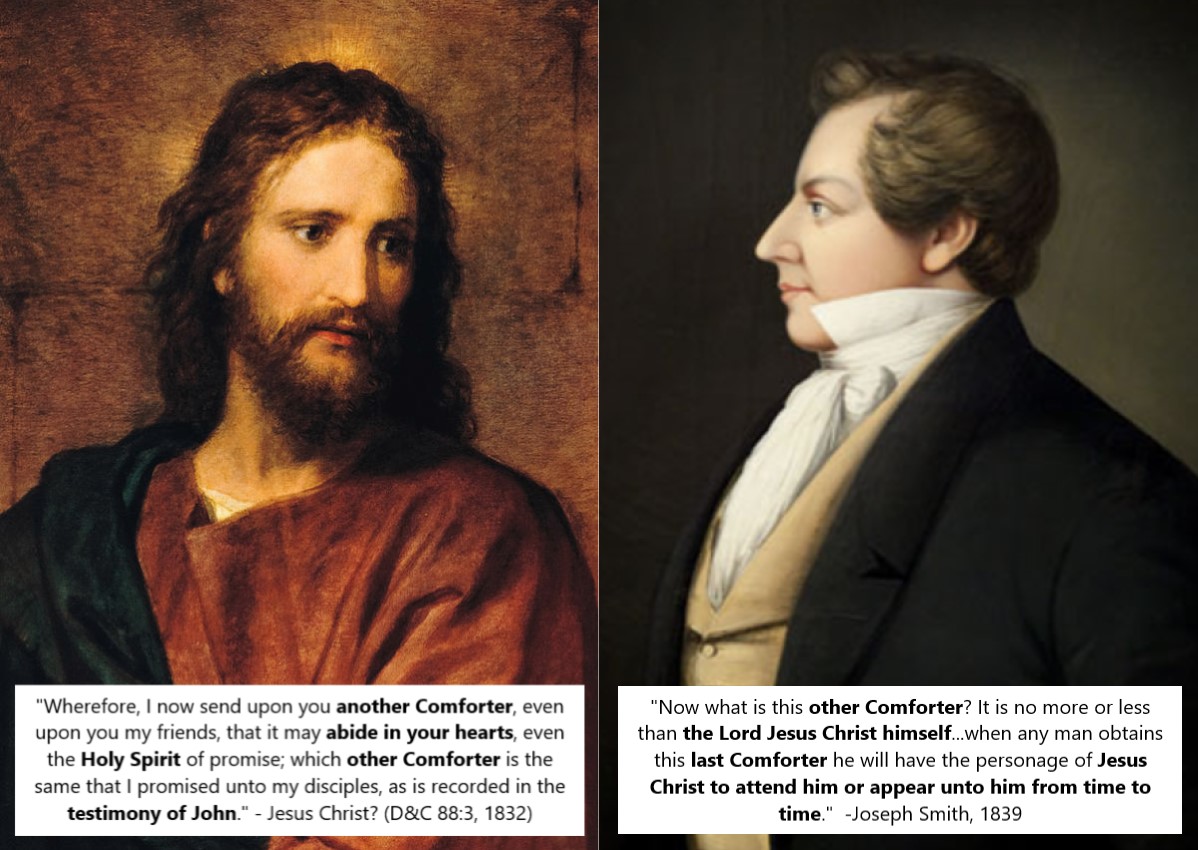
This was much more than a “clarification.” Joseph’s claim that Jesus was the other comforter was a redefinition of the “other comforter” and a rejection of his own alleged revelations. (This, unfortunately, is a common feature of his revelatory corpus. Revelations were frequently revised to suit new circumstances and developments or to accommodate Joseph’s evolving theology.) Nevertheless, we can use D&C 88 and its identification of the “other comforter” as the Holy Spirit as a baseline when examining other revelations from this time period. D&C 21, 28, 31, 36, 39, 42, 47, 50, 71 and 79 all correctly use “Comforter,” to describe the Holy Spirit or as a synonym for it. If one believes Joseph Smith was a prophet and that his revelations are divinely inspired, is D&C 88 true or is his 1839 doctrine of the Second Comforter true? It must be one or the other. Whatever the case, the idea of man coming into the literal presence of God was not new to Mormonism.
JESUS CHRIST COMES TO KIRTLAND?
In Nauvoo Joseph taught that God and Jesus would appear to man personally, but for most of church’s early years God’s presence, literally or symbolically, was exclusive to the temple. The first of Joseph’s revelations to mention a temple is D&C 36, dated December 9, 1830, days after Sidney Rigdon entered Joseph’s orbit: “And I will lay my hand upon you [Edward Partridge] by the hand of my servant Sidney Rigdon, and you shall receive my Spirit, the Holy Ghost, even the Comforter.” According to this revelation, Rigdon was able to give Partridge the Holy Ghost without the priesthood, which wasn’t introduced until the summer of 1831. The revelation ends with “I am Jesus Christ, the Son of God; wherefore, gird up your loins and I will suddenly to my . Even so. Amen” (A clear reference to Malachi 3:1. Emphasis added). I can make a compelling argument that Sidney Rigdon—who was much more than Joseph’s right-hand man, co-visionary and confidant—was the true founder of “Mormonism” as we know it today. Joseph Smith was a very green 24-years-old when the church was organized. The elder Rigdon (aged 37 in 1830), as Steven Shields wrote, “brought a refined understanding of the Bible and theology” to Joseph’s fledgling church. David Whitmer wrote in And Address to All Believers in Christ that Rigdon, “had more influence over [Joseph] than any other man living” and noted that after Rigdon’s arrival “[he] would expound the Old Testament scriptures of the Bible and Book of Mormon—in his way—to Joseph, concerning the priesthood, high priests, etc., and would persuade Brother Joseph to inquire of the Lord about this doctrine and that doctrine, and of course a revelation would always come just as they desired it.” It should be fairly obvious that these “revelations” weren’t revelations from God. Rather, Joseph took Rigdon’s doctrines and presented them as revelations. Smith and Rigdon apparently had no qualms about changing or revising the revelations as needed. And they freely changed the Bible and Book of Mormon as needed. (Denver Snuffer has also changed several passages in the Book of Mormon to reflect his theology. More on that later.)
Before joining Mormonism, Rigdon was a prominent member of the “restoration” movement founded by Barton Stone and Thomas Campell. The Stone-Campbell movement sought to unify all denominations and “restore” primitive Christianity. The second generation of restorationists—Sidney Rigdon, Alexander Campbell (prominent cessationist and Book of Mormon critic) and Walter Scott—were known as “Three Witnesses to the Restoration of the Ancient Order of Things.” It was Sidney Rigdon who instigated the “Law of Consecration”; who introduced two orders of priesthood into the church; who incorrectly identified Adam as Michael; and who wrote Lectures on Faith, which blasphemously present Jesus as “a saved being.” I’m fairly certain Sidney Rigdon made the changes to 1 Nephi 13-14 in the 1837 Kirtland Book of Mormon, which demoted Jesus from Eternal God to God’s son. And, as Shields adds, it was Sidney Rigdon who “laid the foundations for what has become, for some denominations in the movement, essential temple ritual.“
Joseph never built a traditional Christian meetinghouse during his lifetime, even though the revised Law of Consecration was established “…for the purpose of purchasing lands for the public benefit of the church, and building houses of worship, and building up of the New Jerusalem which is hereafter to be revealed—That my covenant people may be gathered in one in that day when I shall come to my temple. And this I do for the salvation of my people” (D&C 42:36-36, February 1831, about two months after Sindey Rigdon arrived.) I was under the impression that the work of salvation was completed on the cross, though this may refer to Joseph’s belief in the imminent end of the world and the necessity of gathering the righteous to “Zion” to survive the coming calamities. Whatever the case, this was the beginning of Joseph’s singular focus on the temple. “By seizing upon the temple rather than the church for a center of worship,” Richard Bushman wrote, “Joseph put aside Christian tradition in favor of ancient Israel” (Rough Stone Rolling, p. 216).
Five months later, Independence, Missouri was revealed as the location of the New Jerusalem: “Wherefore, this is the , and the for the city of Behold, the place which is now called Independence is the place; and a spot for the is lying westward, upon a lot which is not far from the courthouse” (D&C 57:1-2, July 1831). “Zion” has evolved in meaning over the years, but in the D&C, “Zion” is Missouri and nowhere else. A September 1832 revelation declared, “Verily this is the word of the Lord, that the city New Jerusalem shall be built by the gathering of the saints, beginning at this place, even the place of the temple, which temple shall be reared in this generation. For verily this generation shall not all pass away until an house shall be built unto the Lord” (D&C 84:4-5, emphasis added. The Independence temple remains unbuilt 200 years later).
With the temple came promises that the Elders of the church would come into the presence of God: “And the day cometh that you shall hear my voice and see me, and know that I am (D&C 50:45, May 1831); “…inasmuch as you yourselves from and , and yourselves before me, for ye are not sufficiently humble, the shall be rent and you shall me and know that I am” (D&C 67:10, November 1831); “… yourselves that your become to God, and the days will come that you shall him; for he will unveil his face unto you” (D&C 88:68, December1832. Notice the voice shift to third person). Then a May 6, 1833 revelation expanded that promise to “every soul who his and cometh unto me, and on my name, and my voice, and keepeth my commandments, shall my and that I am” (D&C 93:1). BYU professor Casey Griffiths writes of D&C 93:1, “These promises can be applied not only after our death and resurrection but also in this life and the promise to truly know Christ through receiving the Second Comforter (D&C 88:3–4; 68:12).” With respect to Brother Griffiths, we just read D&C 88:3 and there is no reference to the personal appearance of Christ in those verses.
In the midst of the Missouri difficulties, a December 1832-Janauary 1833 revelation instructed the Saints to “establish a , even a house of prayer, a house of fasting, a house of faith, a house of learning, a house of glory, a house of order, a house of God” in Kirtland. (D&C 88:119). A June 1, 1833 revelation allegedly revealed the dimensions of new temple to be built in Kirtland,
“And the size thereof shall be fifty and five feet in width, and let it be sixty-five feet in length, in the inner court thereof. And let the lower part of the inner court be dedicated unto me for your sacrament offering, and for your preaching, and your fasting, and your praying, and the offering up of your most holy desires unto me, saith your Lord. And let the higher part of the inner court be dedicated unto me for the school of mine apostles, saith Son Ahman; or, in other words, Alphus; or, in other words, Omegus; even Jesus Christ your Lord. Amen.” (D&C 95:14-17)
I don’t want to get too sidetracked, but here we encounter a few of Joseph Smith’s neologisms. The term “Son Ahman” was first introduced in a March 1832 document titled “A Sample of Pure Language.” According to Joseph Smith, “Ahman” is the name of God in “pure language.” “Son Ahman” is Jesus. And angels in “pure language” are “Ahman angl—men” (I don’t know, guys. I just don’t know). “Alpha” and “Omega” are the first and last letters of the Greek alphabet and Jesus refers to Himself as “alpha and omega” four times in the Revelation of Saint John (1:8, 1:11, 21:6, 22:13). This appellation was and is well known in Christianity, yet Joseph appears to Latinize it (see: Marcus Aurelius, Julius Ceasar, Flavius Josephus, Herodotus, Maximus, etc.). I queried “Alphus” and “Omegus” in Google’s Ngram viewer, ChatGPT, Grok, and Early English Books Online and they are not found in any extant Greek, Hebrew, apocryphal, gnostic, or early or contemporary Christian texts. They are pure Smithian. Joseph frequently used what he considered to be the language and cadence of revelation, but in almost all instances the results carry only the thinnest veneer of authenticity. La Roy Sunderland, an early critic of Mormonism, noted that the D&C was “filled with these miserable attempts to imitate the scripture style” and listed several “vulgarities” of the text (Mormonism Exposed, p. 60. 1842 edition).
But language wasn’t the only problem. As he moved forward with his doctrinal ambitions, Joseph adopted the mantle and persona of Moses, acting as leader of “Israel” and covenant mediator between God and the Saints. George Mitton writes that Joseph “reveal[ed] temple functions and rituals, many of which mirror the lives of ancient prophets — especially Moses.” Part of those functions and rituals was leading the Saints into the presence of God. Where Moses failed, Joseph believed he would succeed. Steven C. Harper writes, “Joseph had learned from section 84 (September 22-23, 1832) that the only way into the presence of God was through the temple. Yet, like Moses, he worried that Latter-day Saints would harden their hearts and provoke the Lord’s wrath (see Doctrine and Covenants 84:24)” (Emphasis added). This is an incredible statement. D&C 84 was recorded twelve and a half years after the alleged First Vision and 1-3 months after the first known written account in Joseph’s journal. If Joseph saw God and/or Jesus in the Sacred Grove in 1820, he would have learned through first-hand experience that the temple isn’t the only way into the presence of God. And Joseph never claimed or suggested that the Second Comforter required a temple. Harper continues, “Joseph worked hard to get the Saints to see the importance of the momentous revelation and to understand the temple and ultimate blessings. Like Moses, he wanted to usher his sometimes-shortsighted people into the presence of the Lord” (Emphasis added). Joseph’s “people?”
Aside from the revelations Joseph continued to plant seeds of expectations in the years leading up to the Kirtland dedication. In a January 11, 1833 letter to W.W. Phelps, who was then in Independence, Joseph wrote, “You will see that the Lord commanded us in Kirtland to build an house of God, & establish a school for the Prophets, this is the word of the Lord to us, & we must yea the Lord helping us we will obey, as on conditions of our obedience, he has promised <us> great things, yea <even> a visit from the heavens to honor us with his own presence” (Emphasis added).
It’s hard to imagine any expectation surpassing the appearance of Jesus Christ. In June 1833, in the midst of their great poverty, the Saints dedicated their time, talents and money towards construction of Joseph’s temple. A sawmill was built near Newel Whitney’s ashery. Granite was chiseled from Gildersleeve mountain, roughly four miles away. The church purchased 16 acres of old growth forest and floated lumber down the Chagrin River to Kirtland. Leonard Arrington estimated the cost at $40,000, or nearly $1.5 million in 2025, but the cost in time and effort was exponentially higher.
Construction was delayed due to Zion’s Camp, formally known as “Camp of Israel,” in the spring and summer of 1834. After the failure of Zion’s Camp, a new revelation dictated in Missouri instructed the Saints to return to Kirtland and complete the temple because the redemption of Zion “cannot be brought to pass until mine are with power from on high. For behold, I have prepared a great endowment and blessing to be out upon them, inasmuch as they are faithful and continue in humility before me” (D&C 105:11-12). One might wonder why God sent the Saints to Missouri without this “great endowment” in the first place.
To the Saints’ credit, they constructed a magnificent Gothic-style temple, but Zion was never redeemed. I have tremendous respect and admiration for those who sincerely believed they were doing the right thing and dedicated their time, efforts, and talents to build it. It stands as a testament to their faith. For all its architectural grandeur, the most fascinating and striking aspect of the Kirtland Temple, in my opinion, was the veil. John L. Brooke writes,
“The interior details was a richly carved Greek Revival, and the columns and piers hid rope-and-tackle systems that controlled cloth ‘veils’ that could be unrolled from the ceiling to cover either set of pulpits or to divide the room into four compartments. Such compartment dividers had parallels in Quaker meetinghouses, but the pulpit veils had the contemporary analogues in Royal Arch Masonic symbolism and had legendary origins in the veils in Solomon’s temple” (The Refiner’s Fire, p. 220. Notice the veil at the top of the image.)
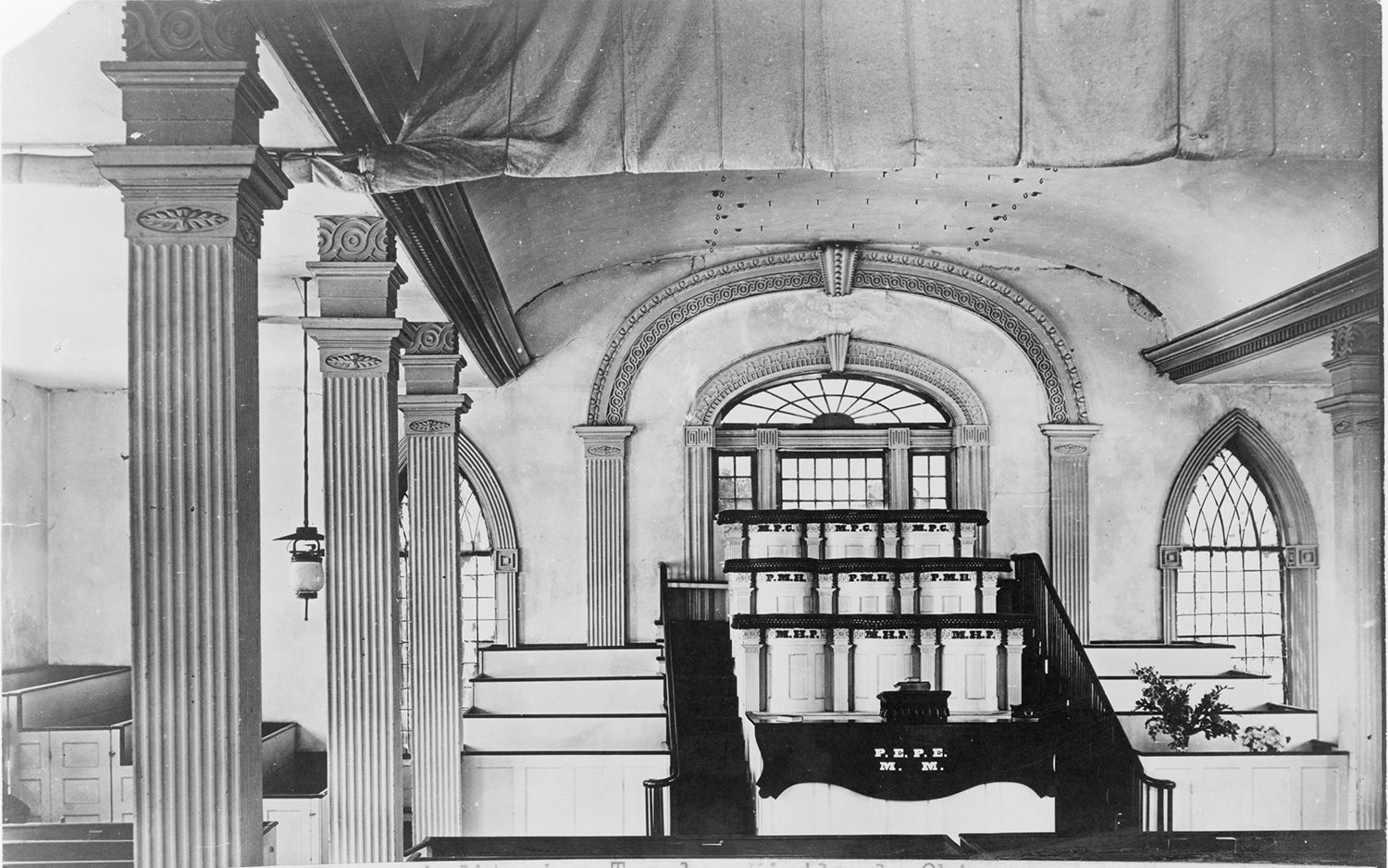
I don’t believe Royal Arch Masonry influenced Joseph, but Solomon’s temple most certainly did. It once again raises the question that if the rending of the veil of the Jerusalem temple signified the end of God’s presence in a particular location, and John “saw no temple” in the New Jerusalem, why would Jesus command the Saints to build a temple with a veil? There is no record of a post-resurrection Christian temple, nor the command to build one, in either the New Testament or the Book of Mormon. Yet the veil would play an important role during the Solemn Assembly prior to the temple’s dedication and continues to play a major role in the modern endowment ceremony. There is an interesting parallel worth noting. Apparently, there was a cloth veil between Joseph and Oliver during the Book of Mormon translation, creating a “holy of holies” for Joseph as he read. Was this deliberate or incidental? The critic will suggest it was part of Joseph’s deception, but was it God’s way of communicating to Joseph the sacredness of the task in a way familiar to him? I don’t know.
In November 1835, as the endowment, temple dedication and solemn assembly approached, Joseph gave a sermon and said to those gathered, “I feel disposed to speak a few words more to you my brethren concerning the endowment, all who are prepared and are sufficiently pure to abide the presence of the Saviour will see him in the solemn assembly.” I take this claim at face value. Joseph promised those gathered they would see Jesus.
On January 21, 1836, Joseph convened a meeting where he and many church leaders “attended to the ordinance of washing our bodies in pure water…we also perfumed our bodies and heads.” Oliver Cowdery wrote, “those named in the first room were annointed with the same kind of oil and in the manner that were Moses and Aaron, and those who stood before the Lord in ancient days” (Emphasis added.) Exodus 30:19-21 instructed “Aaron and his sons” when entering the tabernacle of the congregation to “wash with water that they die not.” Verses 23-25 instructed Moses to make an “oil of holy ointment” comprised of myrrh, cinnamon, calamus, cassia and olive oil. Joseph only had cinnamon. Joseph Smith Sr. then pronounced a blessing on his son where he “sealed upon [him] the blessings, of Moses, to lead Israel in the latter days, even as Moses led him in days of old.—also the blessings of Abraham, Isaac and Jacob” (Emphasis added.) Richard Bushman made the astute observation that “as preparations were made [for the endowment], Joseph was preoccupied with the right order of everything. Church councils had to follow the order of the ancients” (Rough Stone Rolling, p. 309). Mormonism was and is a religion of structure, order, procedure and hierarchy modeled on ancient Judaism, a stark contrast from the Nephite church where “meetings were conducted by the church after the manner of the workings of the Spirit, and by the power of the Holy Ghost; for as the power of the Holy Ghost led them whether to preach, or to exhort, or to pray, or to supplicate, or to sing, even so it was done” (Moroni 6:9, emphasis added).
After the washing and anointing, Joseph had a vision, known today as D&C 137. This revelation, like most of Joseph’s revelations, is fraught with problems. It reads in part, “I saw…the blazing throne whereupon was seated the Father and the Son,— I saw the beautiful streets of that kingdom, which had the appearance of being paved with gold— I saw father Adam, and Abraham and Michael, and my father and mother, my brother Alvin that has long since slept.” First, there is no scriptural precedent for seeing “the Father and the Son” as two distinct beings in a vision or in person (Stephen’s account in the Acts is at best second-hand and “standing at the right hand of God” is a figure of speech denoting a place of prominence). Jesus is the Father and Son, the Eternal God (Ether 3:14, Mosiah 15:3-4, 3 Nephi 1:14-15). Secondly, in 1835 Joseph Smith approved the publication of the Doctrine and Covenants, which included the revised version of The Articles and Covenants of the Church of Christ (D&C 27), which references “Michael, or Adam, the father of all, the prince of all, the ancient of days.” Are Michael and Adam the same person as referenced in D&C 27, or are they separate people, as referenced in Joseph Smith’s 1836 vision? “Michael” was deleted from the published version of the revelation when it was added to the D&C in 1981.
Joseph was also puzzled by the appearance of Alvin in the Celestial Kingdom, having passed “before the Lord had set his hand to recover Israel a second time,” to which the Lord allegedly responded, “all who have died with[out] a knowledge of this gospel, who would have received it, if they had been permitted to tarry, shall be heirs of the celestial kingdom of God— also all that shall die henceforth, with<out> a knowledge of it, who would have received it, with all their hearts, shall be heirs of that kingdom.” If the desire of the heart determines salvation, then why did Joseph institute proxy baptism five years later? Further, this was already revealed in the Book of Mormon (see 2 Nephi 9:25-26, which states “all those who have not the law given them…are delivered from that awful monster, death and hell”). Joseph’s journal entry for the days reads, “The vision of heaven were <was> opened to these also, some of them saw the face of the Saviour, and others were ministered unto by holy angels.” He doesn’t tell us who saw the Savior that night nor am I aware of anyone who explicitly claimed the experience. Oliver Cowdery and Edward Partridge both recorded that many individuals present saw visions, but there are no claims of seeing Jesus.
On March 27, 1836, the temple was dedicated. In the dedicatory prayer we read, “For thou knowest that we have done this work through great tribulation; and out of our poverty we have given of our substance to build a house to thy name, that the Son of Man might have a place to manifest himself to his people. (D&C 109:5). Later in that same prayer we read, “Now these words, O Lord, we have spoken before thee, concerning the revelations and commandments which thou hast given unto us, who are identified with the Gentiles” (v. 60, emphasis added). This is significant because the LDS and all those of European descent, are Gentiles, or not the House of Israel.
Joseph’s journal reads that on March 30 another meeting was held and “that it was expedient for the brethren to tarry all night and worship before the Lord in his house I left the meeting in the charge of the 12 and retired at about 9 o clock in the evening; the brethren continued exhorting, prophesying and speaking in tongues until 5 o clock in the morning— the Saviour made his appearance to some, while angels minestered unto others.” Like before, he doesn’t tell us who and I’m not aware of any reports from individual members of the 12 that they saw Jesus.
On April 3, 1836 Joseph convened a Solemn Assembly. The JSP editors write,
“JS helped other members of the church presidency distribute the sacrament of the Lord’s Supper to the congregation that had assembled in the lower court of the House of the Lord. After the sacrament, the curtains were dropped, dividing the court into four quarters. According to Stephen Post, who participated in the day’s meetings, the presidency then went to the pulpits for ‘the confirmation & blessing of the children.’ At some point during the meeting, more veils were lowered, enclosing the west pulpits and dividing them into their four levels. JS and Cowdery ‘retired to the pulpit’—apparently the top tier, which was reserved for the presidency—where they bowed ‘in solemn, but silent prayer to the Most High.'”
It was then Joseph claimed Jesus Christ appeared to him and Oliver Cowdery behind the veil, away from the eyes of the congregation. “For behold, I have accepted this house, and my name shall be here,” Jesus reportedly said, “and I will manifest myself to my people in mercy in this house. Yea, I will appear unto my servants, and speak unto them with mine own voice, if my people will keep my commandments, and do not pollute this holy house. Yea the hearts of thousands and tens of thousands shall greatly rejoice in consequence of the blessings which shall be poured out, and the endowment with which my servants have been endowed in this house. (D&C 110:7-8).” The language here is unambiguous. The “servants” referred to here include more than just Joseph and Oliver as many were endowed. However, since no one besides Joseph and Oliver ever claimed to see Jesus in the Kirtland temple, we must conclude that the Saints “polluted this holy house” or this was a false revelation. Moses, Elias and Elijah also allegedly appeared to give Joseph “keys” (I still don’t know what “priesthood keys” are.) Elias reportedly conferred the “Gospel of Abraham,” whatever that is. These “keys” according to the revelation, were to let Joseph “know that the great and dreadful day of the Lord is near, even at the doors” (v. 16). It’s been 189 years, or 69,000 days, since this allegedly happened. How near is “near?” Despite the difficulties with Section 110, Steven C. Harper writes,
“Section 110 fulfill the Lord’s conditional promise to the Saints that if they would move to Ohio and build him a holy house, he would endow them with power in it (see sections 38, 88, 95). It fulfills section 88’s great and last promise that the sanctified would come into the presence of the Lord. Indeed, Joseph promised the Saints that ‘on conditions of our own obedience,’ the Savior had promised ‘a visit from the heavens to honor us with his own presence’.”
Harper also noted that, “Section 110 communicated temple knowledge and power. It came in the temple, behind a veil, was recorded but not preached, and acted on but not publicly explained.” Why would Joseph keep such an event from the Saints after years of promises? The obvious answer, at least to me, is that it didn’t happen. Richard Bushman, seemingly perplexed, added,
“What could this staggering experience have meant to Joseph and Cowdery? Unfortunately, Joseph’s detailed Ohio journal ends with Warren Cowdery’s entry. The long run of reports abruptly halts, not to be resumed for two years. We have no idea what Joseph and Cowdery said when they came from behind the veil, or how widely they shared the account. The vision was not included in editions of the Doctrine and Covenants published during Joseph’s lifetime (it wouldn’t have been because no editions of the D&C existed between 1836 and his death in 1844), and no manuscript copies exist save Warren Cowdery’s and the one Willard Richards copied into Joseph’s history for the church newspaper in 1843 (but not published until 1852). Joseph never mentioned the event in his other writings. There is no evidence he told the Kirtland Saints…The episode behind the veil is mysteriously suspended at the end of the diary without comment or explanation, as if Joseph was stilled by the event…”
Or it didn’t happen and Joseph was embarrassed by his failure after years of promise.
“Besides marking the completion of the temple, the April 3 vision signified the coming of incommunicable revelations. The frequency of announced revelations slowed in ensuing years. Doctrine came through sermons, offhand comments, letters, and reports on revelations rather than full revelations themselves. An air of mystery and reticence rises around the prophet. He had conscientiously worked to install the order of heaven in Kirtland as rapidly as new light came to him, introducing washings and anointings and ceremonial order. After the temple dedication, he confidently informed the church he had completed the organization of the Church and given them all the instruction they needed. Zion could now be built…” (Rough Stone Rolling, p. 320-321. Emphasis added).
The alleged appearance of Jesus in Kirtland in some ways mirrors the First Vision. Both of these momentous events were mostly unknown during Joseph’s lifetime. The account of the vision (D&C 110) was originally written in the third person by Joseph’s scribe, Warren Cowdery, and then rewritten in the first person by Orson Pratt for publication in the 1876 D&C. Aside from Jesus Christ, the vision reports that Moses, Elias, and Elijah. This, too, is problematic. Elias and Elijah, as many have noted, are the same person. Elias is the Greek and Elijah the Hebrew. They couldn’t have appeared separately. Elijah reportedly said, “Behold, the time has fully come, which was spoken of by the mouth of Malachi—testifying that he [Elijah] should be sent, before the great and dreadful day of the Lord come…Therefore, the keys of this dispensation are committed into your hands.” (v. 14, 16). However, in his October 1840 Instructions on Priesthood, four and a half years after Elijah reportedly came, Joseph wrote, “Elijah was the last Prophet that held the keys of this priesthood, and who will, before the last dispensation, restore the Authority and delive[r] the keys of this priesthood in order that all the ordinan[c]es may be attended to in righteousness” (Original spelling and grammar. Emphasis added. These instructions were recorded on the back side of uncut “Kirtland Safety Society and Anti-Banking” notes). If Elijah came in 1836, why does Joseph speak as though he has yet to come? And if Elijah were the last to hold these “keys,” what about Isaiah, Jeremiah, Ezekiel and all the other Hebrew prophets that followed him? Did they not have this “priesthood?” What about Lehi, Nephi, Jacob, Alma, Mormon and Moroni? What about John the Baptist and Jesus’ disciples in Jerusalem and Bountiful? Did Jesus not give them these apparently imperative “keys” so they could perform the “ordinances in righteousness”? What a tangled web.
Despite Joseph’s silence, the myth of Jesus’ appearance at Kirtland grew over time and claims were widely circulated in Salt Lake City after the move west. Karl Anderson noted in his book The Savior in Kirtland,
“[I]n 1884, George Q. Cannon (b. 1827), first counselor in the First Presidency firmly established that large numbers of early Saints saw the Savior. While still a youth, George met many of the Kirtland witnesses of Christ. Speaking of Joseph Smith and Oliver Cowdery beholding the Savior in the Kirtland Temple he said, ‘These witnesses are also supplemented by hundreds of others who have beheld in vision and otherwise, glorious personages in these last days…There are men alive who have beheld the Son of God, who have heard His voice, and who have been ministered unto by Him in this our day and generation. In the face of these testimonies, which cannot be impeached successfully, is it any wonder that faith grows in the hearts of the people of God, the Latter-Day Saints?” (p. 133-134, emphasis added).
David Whitmer, upon hearing that the Utah church was promoting these heavenly manifestations as fact, called the Solemn Assembly “a grand fizzle” and “a trumped-up yarn.” (The Des Moines Daily News, Oct. 16, 1886). He was seated in the temple on “this veritable day of Pentecost,” but saw nothing. Despite Cannon’s “hundreds” of witnesses claim, Anderson notes that “only about twenty-three from Kirtland” claimed to see Jesus during the entire period (1831-1836) (p. 134). Some reported “the glory of God,” “angels,” “cloven fire,” “speaking in tongues,” “the armies of heaven,” and the like during the temple events in 1836, but other than Joseph and Oliver (D&C 110), there are no first-hand accounts of people claiming to see God and/or Jesus in the temple, despite Joseph’s assurances that those who were prepared would see Him. Were they not sufficiently pure? I will concede that there probably were people who experienced the presence of God through the Holy Spirit that day. I can’t believe in a God who doesn’t honor those who come to Him in humility and with pure intent, but the Holy Spirit isn’t the same as the bodily manifestation of Jesus.
So, what happened? Had Jesus appeared, I see no reason for Joseph and Oliver not to boldly declare it. Imagine the headline: JESUS CHRIST COMES TO KIRTLAND! His promises and revelations would be validated and his position as “prophet” secured. Yet he never spoke of it. This is the enigma that is Joseph Smith. Dan Vogel suggested Joseph was a “pious fraud,” but I disagree. Misguided as he was, Joseph was a true believer, bordering on fanatic. It strikes me as improbable that Joseph would go through the effort of building the temple, including quarrying granite with his own hands, participate in washing and anointing, sit in the temple and wait for Jesus, then preside over a solemn assembly, then go behind a veil as some sort of elaborate ruse or long con, especially considering his silence on Jesus’ alleged appearance. Were it a con, I suspect he would have emerged from behind the veil and immediately relayed the vision. The silence is deafening and speaks to failure. Instead of taking the courageous route and admitting he had been wrong, Joseph quietly let it slip into obscurity. He had to know on some level that the jig was up. As Bushman noted, after the Kirtland events, the revelations slowed considerably. Those that do exist, such as D&C 111 (the failed Salem revelation), D&C 118 (the false tithing revelation), D&C 124 (another money-making scheme), and D&C 132 (plural marriage) are full of problems and false doctrines. Whatever potential Joseph’s movement had effectively ended in April 1836.
In Nauvoo Joseph began another temple. A January 1841 revelation instructed the Saints to “build a house to my name, for the Most High to dwell therein,” so Jesus could “reveal unto my church things which have been kept hid from before the foundation of the world, things that pertain to the dispensation of the fulness of times” (D&C 124:24, 41). I don’t know why Jesus needed a temple for this. Unfortunately, Joseph and Hyrum were murdered in Carthage in June 1844. The Nauvoo temple wasn’t completed until 1845. Brigham Young sold it in 1847 for $5,000 ($197,000 in 2025). Most of Joseph’s Nauvoo doctrines went West with the Saints and formed the foundation of New Mormonism, but the Second Comforter lingered in relative obscurity.
THE AFTERMATH
In the years since his death, LDS academics and apologists have grappled with Joseph’s problematic claims, doctrines and revelations. We’ve seen some of the creative ways they’ve tried to harmonize the First Vision accounts. We’ve seen the “catalyst theory” introduced to explain the Book of Abraham. The Second Comforter doctrine has proven to be a problem, too. For example, when we consult the Encyclopedia of Mormonism’s entry for “The Holy Spirit of Promise,” we find,
“The Holy Spirit of Promise is one of many descriptive name-titles of the Holy Ghost and refers to a specific function of the Holy Ghost. In John 14:16, the Savior, who had been a comforter to his disciples, assured them that after his departure into heaven they would receive another comforter: ‘And I will pray the Father, and he shall give you another Comforter, that he may abide with you for ever.” The next verse speaks of this Comforter as ‘the Spirit of truth, who ‘dwelleth with you, and shall be in you’ (verse 17). The Lord subsequently identified this promised Comforter as the Holy Ghost (verse 26).”
However, the same Encyclopedia of Mormonism gives us this entry for the “Second Comforter,”
“The term ‘Second Comforter’ refers to Jesus Christ in his role of ministering personally to his faithful followers (John 14:21-23; D&C 93:1;130:3). Jesus taught his disciples that the Holy Ghost was a comforter (John 14:26), but he also spoke of a second comforter (John 14:16-21). Latter-day Saints have been given additional understanding about the Second Comforter by the Prophet Joseph Smith…” (Emphasis added)
In 2013 the scripture committee removed the reference to the Second Comforter in the footnote for John 14:16,

This change came at the time the Remnant Movement was gaining significant traction and naturally caused a lot of consternation among those involved. Denver Snuffer responded to the controversy, stating that when his book, The Second Comforter: Speaking with the Lord Through the Veil, was written in 2002,
“…it was understood that ‘the second Comforter’ referred to Christ. The footnotes in LDS scripture confirmed John 14: 16, 18 and 23 were referring to Christ. They were Christ’s promise that He would appear to His disciples. In the latest revisions to the LDS scriptures, the reference was changed and redefined to mean the Holy Ghost, and not Christ.”
This may have been understood, but it was also incorrect. It was Joseph who first redefined John. He continues,
“The LDS Church has not yet changed, altered or deleted the explanation to John 14:23 in the D&C. That volume of scripture still states: “John 14:23—The appearing of the Father and the Son, in that verse, is a personal appearance; and the idea that the Father and the Son dwell in a man’s heart is an old sectarian notion, and is false.” (D&C 130: 3.)
This is true, but this, too, is incorrect. In part one we reviewed Alma’s statement that “the Lord hath said he dwelleth not in unholy temples, but in the hearts of the righteous doth he dwell…” (Alma 34:36). Clearly this isn’t “an old sectarian notion” and “false.”
“The elimination of the footnotes was not inadvertent. The LDS Church no longer teaches that it is possible for a faithful Latter-day Saint to receive the Second Comforter. As recently as June 13, 2015, LDS assistant historian Richard Turley and church apostle Dallin Oaks traveled to Boise, Idaho, and while there denounced the idea of church members having spiritual experiences that go ‘entirely against all the rules of order that we have talked about.’ Turley, quoting President Spencer W. Kimball, warned that this kind of experience ‘may not come from God. I am sure that there may be many spectacular things performed because the devil is very responsive.'”
I agree that the elimination of the footnote was deliberate. It was also the correct thing to do. The “other comforter” was, is, and always be the holy spirit. Joseph once understood this, as evidenced by D&C 88:3-4 and the other early revelations. Snuffer, however, errs in suggesting the church no longer teaches the second comforter. The footnotes for John 18:18b and 18:21c still read, “God, privilege of seeing.” The Second Comforter is found in the Bible dictionary and Topical Guide and New Testament teacher’s manual. It is true that the doctrine is not currently taught, but it is still a part of Mormon doctrine.
The Second Comfort doctrine may not be prominent because no LDS church president since Joseph Smith has publicly claimed to have seen Jesus. There are apocryphal accounts, such as Orson Whitney, who claimed to witness the events of Gethsemane in a dream or vision. There is a story of Lorenzo Snow seeing Jesus, but that is a second-hand account from his granddaughter. When I was in the MTC in April 1993, Richard G. Scott came to speak to us. At the end of his talk said, “I know that Jesus Christ lives. And it’s not by faith that I know.” A hush fell over the crowd. I turned to the sister missionary sitting next to me and we have both had the same look: “Did he just say what I think he said?” Whatever Elder Scott’s intentions, everyone in the room interpreted it the same way.
If you grew up in the Utah church like I did, you may have been under the assumption that the acting president/prophet met with Jesus Christ in the Salt Lake temple Holy of Holies. Church leaders have been a bit coy when asked about such experiences. For example, in 1971 Boyd K. Packer said,
“Occasionally during the past year I have been asked a question. Usually it comes as a curious, almost an idle, question about the qualifications to stand as a witness for Christ. The question they ask is, ‘Have you seen Him?’
“That is a question that I have never asked of another. I have not asked that question of my brethren in the Quorum, thinking that it would be so sacred and so personal that one would have to have some special inspiration, indeed, some authorization, even to ask it. (Authorization from whom?)
“There are some things just too sacred to discuss. We know that as it relates to the temples. In our temples, sacred ordinances are performed; sacred experiences are enjoyed. And yet we do not, because of the nature of them, discuss them outside those sacred walls.
“It is not that they are secret, but they are sacred; not to be discussed, but to be harbored and to be protected and regarded with the deepest of reverence.” (The Spirit Beareth Record, General Conference April 1971)
Many people, me included, take exception with Brother Packer’s claim. It gives the impression the brethren have had such experiences but aren’t at liberty to say, which is odd considering Lehi, Nephi and Jacob all saw Jesus in a vision. Mormon and Moroni saw him in person. The Book of Mormon is full of miracles, angelic visitations and theophanies told by the people who experienced them. Where are these experiences in the LDS church?
The June 2015 conference Snuffer mentioned is known colloquially known as “The Boise Rescue.” Dallin H. Oaks and church historian Richard Turley held a three-stake devotional in Boise to address the growing number of people affiliating with Snuffer’s remnant movement and being rebaptized. Snuffer, who is based in Utah, and a few other influential voices in the group (whom I won’t name) who reside in Idaho, aren’t explicitly mentioned by name, but it’s very easy to read between the lines. Church historian Richard Turley said, “Another claim that we sometimes hear is that current apostles have no right to run the affairs of the church since they do not meet the New Testament standard of apostles because they do not testify of having seen Christ.” President Oaks replied,
“The first answer to this claim is that modern apostles are called to be witnesses of the name of Christ in all the world, Doctrine and Covenants 107:23.
“This is not to witness of a personal manifestation. To witness of the name is to witness of the plan, the work, or mission such as the atonement and the authority or priesthood of the Lord Jesus Christ, which an apostle who holds the keys is uniquely responsible to do.
“Of course apostles are also witnesses of Christ just like all members of the Church who have the gift of the Holy Ghost. This is because the mission of the Holy Ghost is to witness of the Father and the Son. In addition, while some early apostles and other members of the church have had the sublime spiritual experience of seeing the Savior and some have made a public record of this, in the circumstances of today we are counseled not to speak of our most sacred spiritual experiences, otherwise with modern technology that can broadcast something all over the world, a remark made in a sacred and a private setting can be said abroad in violation of the Savior’s commandment not to cast our pearls before swine.”
President Oaks is correct that D&C 107, which includes instruction given to the newly formed Quorum of the Twelve Apostles in 1835, reads that the Twelve are “special witnesses of the name of Christ in all the world—thus differing from other officers in the church in the duties of their calling. And they form a quorum, equal in authority and power to the three presidents previously mentioned.” The exact date of this revelation is unknown, but it dates to the first three months of 1835. It’s curious because on February 21, 1835, Oliver told the newly appointed members of the Twelve,
“You have been indebted to other men, in the first instance, for evidence; on that you have acted; but it is necessary that you receive a testimony from heaven for yourselves; so that you can bear testimony to the truth of the Book of Mormon, and that you have seen the face of God. That is more than the testimony of an angel. When the proper time arrives, you shall be able to bear this testimony to the world. When you bear testimony that you have seen God, this testimony God will never suffer to fall, but will bear you out; although many will not give heed, yet others will. You will therefore see the necessity of getting this testimony from heaven.
“Never cease striving until you have seen God face to face. Strengthen your faith; cast off you doubts, your sins, and all your unbelief; and nothing can prevent you from coming to God. Your ordination is not full and complete till God has laid His hand upon you. We require as much to qualify us as did those who have gone before us; God is the same. If the Savior in former days laid His hands upon His disciples, why not in latter days?” (Emphasis added)
Oliver was assistant president of the Church at this time, so this instruction does carry weight. The mandate to bear their witness of having seen God is a start contrast from Elder Packer’s suggestion that some things are “too sacred.” My view is that Oliver was giving his opinion on the matter, which he is entitled to do. But his mandate to the Twelve has been used by many in post-LDS circles to delegitimize all of Joseph’s successors and paint them as false prophets because they have not claimed to see Jesus. At a 2016 Bellevue, Washington Youth Fireside, President Oaks confirmed what many had long suspected,
“What should you pray for? To have the kind of experience that Alma the Younger had? I don’t think you’re likely to have the kind of experience that Alma the Younger had. Do you remember he had a miraculous experience with an angel and really got hit over the head spiritually. Most of us don’t have that kind of experience. But I interpret your question, as being ‘How can we get the kind of testimony that he received?’ I don’t think we’ll get it like Paul did on the road to…where the angel appeared to him, where Alma the Younger had that startling experience. The Lord gives a few of those kinds of experiences and they’re recorded in the scriptures to catch our attention and teach us the answer, but I’ve never had an experience like that, and I don’t know anyone among the First Presidency or Quorum of the Twelve who had that kind of experience. Yet every one of us knows of a certainty the things that Alma knew. But it’s just that unless the Lord chooses to do it another way, as he sometimes does, for millions and billions of his children, a testimony settles upon us gradually like so much dust on a windowsill, or so much dew on the grass. One day you didn’t have it and another day you did and you don’t know which day it happened. That’s the way I got my testimony. And then I knew it was true but it continued to grow.”
I appreciate President Oaks’ candor. He’s telling the truth, which is more than we can say about Joseph Smith. Does that delegitimize his current position as prophet, seer and revelator and President of the Church of Jesus Christ of Latter-Day Saints? Neither the Jerusalem or Bountiful churches had a “president” or “prophet, seer and revelator.” You’ll have to decide that for yourself. None of the original LDS twelve ever claimed to see the face of God and have their ordinations completed by the hand of Jesus. Were they, too, illegitimate? Is there anyone today who has claimed to see the face of God? In fact, there is. The aforementioned Denver Snuffer has claimed to see Jesus on multiple occasions and to have received a special mandate to gather Zion and establish the New Jerusalem.
THE REMNANT RISES
In 2006 Denver Snuffer released his book The Second Comforter: Conversing with the Lord Through the Veil. As I understand it, this was a very successful book and was the catalyst in renewed interest in the Second Comforter doctrine. In Snuffer explicitly claims “Christ lives and comforts His followers today, just as He promised and did anciently. He is the Second Comforter. I know He lives, for I have seen Him. He has ministered to me” (p. 404). That’s a bold claim. Snuffer presents his book not as a record of his vision, but as a manual for others to likewise come into the presence of Jesus. According to Snuffer,
“Though [the Second Comforter] may be ignored or even denied as possible, the promise is a part of the Gospel of Jesus Christ. It is the fullness of the Gospel. And in this regard, just as with the fundamentals of the Gospel, many are ‘only kept from the truth because they know not where to find it.’ (D&C 123: 12.) Neglect cannot remove it from the Gospel. Doubt cannot remove it, either. Though neglect and doubt may disqualify the doubter, it cannot disqualify you if you obey the Gospel and have faith.” (p. 6, emphasis added.)
When Snuffer released his book, I was still a traditional Mormon, but admittedly I didn’t attend church very frequently. I loved the “Gospel” but I didn’t love the church. I believed most of the doctrines and upheld Joseph Smith as prophet. It’s funny to admit now, but I was completely ignorant of what we might call “uncorrelated Mormonism.” I knew the Utah church, obviously. I knew our cousins in the RLDS church and their funny temple. But that was it. I didn’t know my fifth maternal great-grandfather baptized Heber C. Kimball. I was completely ignorant of any historical or doctrinal issues. I didn’t know there were multiple accounts of the first vision. And I most certainly didn’t know about the Second Comforter. I was as naive as they come. I remember being blindsided by the Polygamy Essay published in 2014 and reaching out to a friend of mine who works at BYU to try and make sense of it. It was a really strange time. So much happened in this two-year period that it all kind of blends together. I don’t remember the exact order of all events, but I’ll do my best to present them as best I can.
One day in 2014 another good friend of mine sent me a link to Rock Waterman’s Pure Mormonism blog. This was my introduction to “Uncorrelated Mormonism.” Entering that world unprepared is like drinking water from a firehose and I wasn’t prepared. It will knock you upside and backwards before you have time to think about it. Through the grace of God, literally, I survived a complete mental, emotional and spiritual breakdown after learning about our complex history and weird doctrines. I can say now that it was the best thing that ever happened to me because it broke me down to my innermost core and put me in a position where I had to rebuild from scratch.
To make a long story short, during this breakdown and rebirth I spent a lot of time reading various blogs from people inside the Remnant Movement. If you are unfamiliar with the Remnant Movement, it is comprised primarily of former Utah church members who, for one reason or another, broke with the Church and were looking to return to a more authentic, primitive, Gnostic, Nauvoo-era Mormonism. There is a heavy focus on Joseph Smith, the Doctrine and Covenants and the Lectures on Faith, which before 1921 were the Doctrine of the Doctrine and Covenants. There was also an extremely heavy focus on the Second Comforter thanks to Denver Snuffer’s book. “Having one’s second comforter” and the “gathering of Zion” are the group’s focal points. The Remnant is very loosely organized. It has no central governing body or quorum, but there are prominent and influential figures. Some members of the group produced a “Hebrew” version of the Book of Mormon translated by “Yosef ben Yosef” titled “The Stick of Joseph in the Hand of Ephraim.” (I did a post on this subject. Ezekiel’s “two sticks” have nothing to do with the Bible and Book of Mormon, regardless of W.W. Phelps and Joseph Smith’s claims. We have Joseph Smith’s DNA profile. He’s Irish, not Hebrew. The Latter-Day Saints are Gentiles, not Ephraimites.) Denver Snuffer eschews the title of prophet, but he is the figurehead of the movement. He claims to have seen Jesus multiple times. His revelations have been canonized alongside Joseph’s in their scriptures they call Teachings and Commandments. He claims God gave him the new name “David.” He produced by revelation the Testimony of John referenced in D&C 93. He claims he had a vision of Jesus’ Second Coming. He speaks at most, if not all, their conferences. He has at least twice (that I know of) acted as covenant mediator. Anyone who claims to be a covenant mediator is a de facto prophet. That’s what they do. For all intents and purposes, he is their prophet whether he claims the title or not. In April of 2025 Snuffer announced a new covenant. He said, “the Lord intends to accomplish His work through our group, or at least a remnant that includes some from our group, I was then told that the Lord has given us a name.” This new covenant rebranded the Remnant Movement as “Covenant Christians” who have been given the responsibility of gathering and establishing the New Jerusalem and building a temple, for which they are currently collecting funds, in the Rocky Mountains. As of November 24, 2025 they have collected $290,000 of the $5,000,000 goal. If this sounds like a replay of Joseph Smith trying to establish Zion in Missouri and build a temple, it is. Snuffer seems to see himself as Joseph Smith’s true successor.
In September 2013 Snuffer was excommunicated for apostasy over his 2011 book Passing the Heavenly Gift, which suggests that the Church fell into error during the Nauvoo period and has been illegitimate ever since. His stake president asked him to pull the book from sale, but he declined. On the day of his excommunication he began a year-long series of lectures along the “Mormon Corridor” titled 40 Years in Mormonism. He claims that on May 1, 2014 he received a new revelation:
“Last general conference [April 5, 2014] the entire First Presidency, the Twelve, the Seventy, and all other general authorities and auxiliaries voted to sustain those who abused their authority in casting me out of the Church. At that moment, the Lord ended all claims of the Church of Jesus Christ of Latter-day Saints to claim it is led by the priesthood. They have not practiced what he requires. The Lord has brought about His purposes. This has been in His heart all along. He has chosen to use small means to accomplish it, but he always uses the smallest of means to fulfill His purposes.”
The man’s ego is breathtaking. It is unlike anything I have seen in the history of Mormonism. Am I to understand that despite roughly 80 years of institutional adultery, the Mountain Meadows Massacre, rejecting the Atonement by introducing proxy baptism, grinding the faces of the poor, building a $100 billion war chest, covering up sexual crimes, that Denver Snuffer’s excommunication finally made God throw his hands in the air and say ‘Enough!’ Jesus said Latter-Day Saints would “be lifted up in the pride of their hearts above all nations and above all the people of the whole earth and shall be filled with all manner of lyings and of deceits and of mischiefs and all manner of hypocrisy and murders and priestcrafts and whoredoms and of secret abominations,” but Snuffer’s excommunication was an abuse of authority? Unfortunately, this isn’t the only example of his hubris. We’ll review some of his other claims as an addendum to this post.
It was not long after these lectures were completed that I first heard of Snuffer. Let me state here that I don’t know him. I have never met him. I’ve never been to a Remnant conference. I had no desire to join the Remnant movement, but I do thirst after Truth. I’m willing to listen to anyone and hear what they have to say. So, I read the transcripts from 40 Years of Mormonism, The Second Comforter, and parts of Passing the Heavenly Gift. I read his blog posts and transcripts from Remnant conference talks. He’s very well read and speaks authoritatively. I don’t think his writing is on par with his speaking, but that’s neither here nor there. He accepts Joseph’s doctrines and revelations prima facie, so they form the backbone of his teachings. In fact, he refers to himself as a “second witness” to Joseph’s doctrines. A friend of mine once said to me, “Denver only teaches what Joseph taught.” (As I now know, that’s the problem.) As someone who believed in The Book of Mormon, LDS doctrine, and Joseph’s prophetic mission, Denver’s message sounds good. It has the veneer of Truth. And because I still didn’t have a solid knowledge or understanding of the Book of Mormon, even though I had read it three dozen times, I didn’t have the ability to discern if Snuffer’s teachings were actually true.
For the next year or two I continued reading and studying. I was intrigued by the idea of the Second Comforter, but I wasn’t hinging my salvation on it, nor did I feel any particular need to experience it. It if was true, then cool, but I wasn’t invested in the idea or praying that Jesus would pull up to my bedside one night. I remember sitting in the Starbucks at The Smiths on the corner of 4th and 4th downtown Salt Lake City sometime in 2017, reading my Book of Mormon (I know, I know) and coming across Moroni 7:3: “Wherefore, I would speak unto you that are of the church, that are the peaceable followers of Christ, and that have obtained a sufficient hope by which ye can enter into the rest of the Lord, from this time henceforth until ye shall rest with him in heaven.” It was then and there that I decided the Second Comforter doctrine was “true.” I didn’t understand the symbolism of “the Lord’s rest” in Christian thought (which has much more to do with the Holy Spirit), so I assumed it must mean a face-to-face encounter with Jesus. Maybe I was under the influence of the Demon Coffee Drink. I don’t know. I closed my Book of Mormon satisfied with this new “knowledge” and went on my way.
Shortly after that I spent six months in New York City. My sister and her family live less than a block from Central Park. For me Central Park is the most peaceful and beautiful place on earth. It is my temple, my sacred space. Almost every evening I took a solitary walk through the park having one-sided conversations with God, thinking through things, trying to arrive at the capital-T truth. I am the type of person that needs to understand things inside and out. I appreciate faith and understand its importance in Christianity, but I need to absorb information, tease it out, examine it from all angles, test it and hopefully come to a correct understanding. I still treasure those moments in Central Park. Having gone through the work of reading Snuffer and examining his claims, I needed to know if he was a “true messenger” and if there was any validity to what he was saying. If it was all true, then I would be wise to adopt it. So, one night I took it all to the Lord in prayer. I think I have only had three direct answers to prayer in my entire life. This was one of those times. That answer to my prayer was simple: stay away. It wasn’t a voice, but more a communication of knowledge or a reorientation of thought. This really confused me at first. I knew people in the Remnant movement. One person from my mission, a couple of friends and acquaintances. These were people I had known for years and respected. They weren’t fanatics or unstable. The loved the Lord. Most everyone I came across in the Remnant movement were true and sincere believers. (There were a few kooky people, but that’s inevitable in any group or organization). Were they seeing something I wasn’t? For whatever reason, that day I completely abandoned Snuffer and the Remnant Movement. I had no desire to read the blogs or engage in conversation. I was done and I didn’t look back. It would be another year or two before I understood the answer I received. I turned my focus the Book of Mormon. I needed to understand it on its terms, free from Mormonism, from Joseph Smith, from Denver Snuffer.
Two important things happened when I started paying attention to what I was reading in the Book of Mormon. First was coming to a better understanding of who Jesus Christ is. The Book of Mormon, in unambiguous terms, presents Jesus as the Eternal God. The One and Only God. The author of creation who was and is from eternity to all eternity. Not God’s son. Not God’s representative or emissary. Not someone who “became a God” through “cycles of creation.” The stated purpose of the Book of Mormon is “to convince the Jew and Gentile that Jesus is the Christ—the Eternal God,” God who came into His creation redeem mankind from spiritual and physical death. This is the Jesus of the Brother of Jared, Lehi, Nephi, Jacob, Abinadi, the disciple Nephi, Mormon and Moroni. This is not the Jesus of Joseph Smith and Denver Snuffer. (I have plans for a dedicated post on this subject.) I fought this knowledge at first. I was convinced Jesus was the literal “son of God.” But over the course of a two-week period of late-night study, one morning I woke up and I just knew: Jesus is God and there is no other. Once you make this connection, it is impossible to miss in the Book of Mormon. It’s everywhere. This fundamentally changed my worldview. There aren’t many hills I’ll die on, but I will die on this one.
Secondly, one day I read something in 3 Nephi when Jesus appeared to the Nephites after His resurrection that stopped me dead in my tracks and hit me harder than just about anything I had ever read.
JESUS REFUTES THE SECOND COMFORTER DOCTRINE
Jesus’ appearance at Bountiful is the pinnacle moment of the Book of Mormon. After 600 years of prophecies, wars, fratricidal conflicts and cyclical apostasy, the resurrected Jesus appeared those who had survived the destructions that accompanied His death. While Jesus imparts a lot of knowledge to the gathered Nephites, I want to focus on the most important part for our study of the Second Comforter,
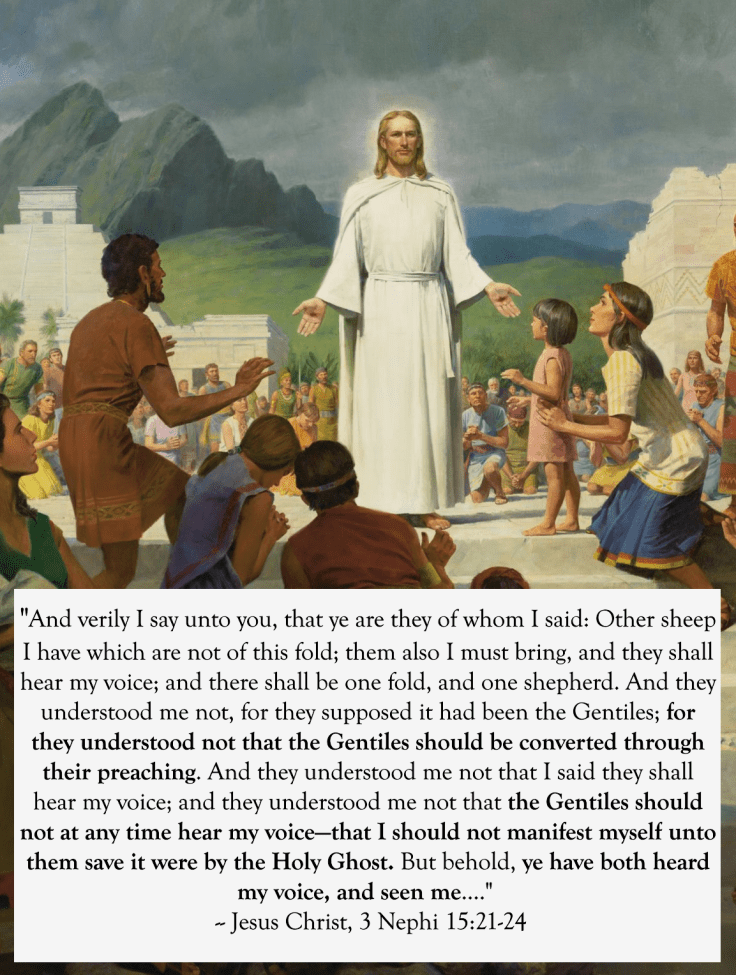
“And verily I say unto you, that ye are they of whom I said: Other sheep I have which are not of this fold; them also I must bring, and they shall hear my voice; and there shall be one fold, and one shepherd. And they understood me not, for they supposed it had been the Gentiles; for they understood not that the Gentiles should be converted through their preaching. And they understood me not that I said they shall hear my voice; and they understood me not that the Gentiles should not at any time hear my voice—that I should not manifest myself unto them save it were by the Holy Ghost. But behold, ye (House of Israel) have both heard my voice, and seen me; and ye are my sheep, and ye are numbered among those whom the Father hath given me. And verily, verily, I say unto you that I have other sheep, which are not of this land, neither of the land of Jerusalem, neither in any parts of that land round about whither I have been to minister. For they of whom I speak are they who have not as yet heard my voice; neither have I at any time manifested myself unto them. But I have received a commandment of the Father that I shall go unto them, and that they shall hear my voice…” (3 Nephi 15:21-24, 16:1-3)
Here we have the affirmation of Israel as Jesus’ witnesses and the refutation of Joseph’s Second Comforter doctrine. I began this series with a discussion on Israel’s calling as “The Servant of the Lord” found in Isaiah. Jesus revealed Himself to Abraham, Isaiah, Lehi, Nephi and Jacob. He went to Jerusalem and the Galilee during His mortal ministry. After His resurrection, He exclusively appeared to various branches of the House of Israel as it is their unique right and privilege as “Servant” to testify of Him. The Jerusalem twelve were to go to the Gentiles. As Moroni wrote in the Book of Mormon, “Behold, this is a choice land, and whatsoever nation shall possess it shall be free from bondage, and from captivity, and from all other nations under heaven, if they will but serve the God of the land, who is Jesus Christ, who hath been manifested by the things which we have written” (Ether 2:12).
With regard to the Second Comforter doctrine, it is paramount that we understand that we belong to the Gentiles mentioned in the Book of Mormon. Snuffer understands this. He writes,
“There are many prophecies that foretell the Gentiles will reject their invitation to have the fullness of the gospel. Christ said that this would happen in 3 Nephi 16:10. (I agree with him here). There have been many signs Christ’s prophecies were fulfilled…The signs include, but are not limited to, the condemnation of the church in 1832, which is in D&C 84:54-58. The expulsion from Missouri that happened and was explained in D&C 101:1-2…”
The title page of the Book of Mormon reads that it would come forth “by way of the Gentile.” We are not lineal Israel. As such, are not privy to be witnesses of Jesus. Our testimony comes through the Holy Spirit. Jesus says in no uncertain terms, “the Gentiles should not at any time hear my voice—that I should not manifest myself unto them save it were by the Holy Ghost.” “Not at any time” and “save by the power of the Holy Ghost” mean exactly that. There is no other interpretation.
Recall that during Jesus’ farewell discourse with his Jerusalem disciples, Judas (not Iscariot) asked, “Lord, how is it that thou wilt manifest thyself unto us (the disciples specifically, not any follower of Christ), and not unto the world (Gentiles)? Jesus answered and said unto him, If a man love me, he will keep my words: and my Father will love him, and we will come unto him, and make our abode with him” (John 14:22-23). At Bountiful Jesus clarifies that “making our abode with him” is synonymous with “the power of the Holy Ghost.” Joseph Smith’s 1839 interpretation of John 14 was wrong, thus the Second Comforter doctrine is necessarily false.
There are other passages in the Book of Mormon that tell us that Jesus will manifest Himself to us, the Gentiles, through the Holy Spirit:
“And it came to pass that after my father had spoken these words, he spake unto my brethren concerning the gospel which should be preached among the Jews, and also concerning the dwindling of the Jews in unbelief. And after that they had slain the Messiah which should come—and after that he had been slain, he should rise from the dead and should make himself manifest by the Holy Ghost unto the Gentiles… (1 Nephi 10:11. Emphasis added.)
“And as I spake concerning the convincing of the Jews, that Jesus is the very Christ, it must needs be that the Gentiles be convinced also that Jesus is the Christ, the Eternal God; And that he manifesteth himself unto all those who believe in him, by the power of the Holy Ghost; yea, unto every nation, kindred, tongue, and people, working mighty miracles, signs, and wonders, among the children of men according to their faith.” (2 Nephi 26:12-13. Emphasis added.)
This is what “taking up His abode” means: manifesting Himself through the Holy Spirit. But He almost manifests Himself through His actions,
“And the time cometh that he shall manifest himself unto all nations, both unto the Jews and also unto the Gentiles; and after he has manifested himself unto the Jews and also unto the Gentiles, then he shall manifest himself unto the Gentiles and also unto the Jews, and the last shall be first, and the first shall be last. And it shall come to pass, that if the Gentiles shall hearken unto the Lamb of God in that day that he shall manifest himself unto them in word, and also in power, in very deed, unto the taking away of their stumbling blocks—And harden not their hearts against the Lamb of God, they shall be numbered among the seed of thy father…” (1 Nephi 13:42, 1 Nephi 14:1-2. Emphasis added.)
I believe “in word, and also in power, in very dead” refers to the Book of Mormon. Unsurprisingly, we also have several instances of Jesus manifesting Himself “in the flesh,” and they are, without exception, references to Israel. Speaking of Jesus’ mortal ministry. Jacob writes that “Holy One of Israel, should manifest himself unto them in the flesh” unto those in Jerusalem (2 Nephi 6:9). Nephi writes of those in Jerusalem that “the Father of heaven and earth— shall manifest himself unto them in the flesh” (2 Nephi 25:12). Second Comforter advocates frequently point to 2 Nephi 32:6 in support of the doctrine. Nephi writes, “there will be no more doctrine given until after that he shall manifest himself unto you in the flesh. And when he shall manifest himself unto you in the flesh, the things which he shall say unto you shall ye observe to do.” Nephi has already written that he’s addressing his brethren and “children” (descendants). This very clearly refers to Jesus’ post-resurrected appearance at Bountiful where He said, “Therefore come unto me and be ye saved, for verily I say unto you that except ye shall keep my commandments, which I have commanded you at this time, ye shall in no case enter into the kingdom of heaven (3 Nephi 12:20. I did a post on this as well). Nephi was previously made aware that Jesus would appear to them,
“I will manifest myself unto thy seed, that they shall write many things which I shall minister unto them, which shall be plain and precious; and after thy seed shall be destroyed, and dwindle in unbelief, and also the seed of thy brethren, behold, shall be hid up, to come forth unto the Gentiles, by the gift and power of the Lamb.” (1 Nephi 13:35. Emphasis added.)
We tend to overlook or forget the fact that the writings of Nephi and Jacob were the Nephite scriptures. They wrote these things to prepare them for the day that Jesus did appear to them. Again, the Book of Mormon’s internal consistency is incredible.
When all of these pieces fell into place, a lot of things made more sense. Jesus’ words at Bountiful resolved for me the inconsistent accounts of the First Vision. They are inconsistent because it didn’t happen. It explained Joseph’s silence after the Kirtland solemn assembly. It explained why no LDS general authorities have ever publicly claimed to see Jesus. It explained why the Jesus of Joseph Smith, Denver Snuffer and others who claim to have seen Him isn’t the Jesus of Nephi, Jacob, Abinadi, Mormon and Moroni. It explains why despite your faith and sincere desires, Jesus hasn’t appeared to you. He said he wasn’t going to. This is ok. If the Second Comforter doctrine were true, and “part of the Gospel” as Snuffer claims, there should be thousands, tens of thousands, hundreds of thousands (?) of people who claim it. Yet only about a dozen people (that I know of), all in post-LDS movements, have done so. I’d like to get all those who consider themselves part of the Remnant in a room and ask them in the 20+ years since Snuffer published his book and the ten years since his lecture series, how many of them have seen Jesus? Discounting those with obvious psychological issues, I’m certain the answer is zero. If there were a few, I’d like to get them in a room individually and ask them what Jesus looks like, I doubt I’d get two that match.
A few years back I started talking about Jesus’ refutation of the Second Comforter. As one might suspect, the reaction was hostile. A fair number of insults were flung my way, which I expected. “But Joseph said…” was a common response. Yet to this day no one has given me a reason why “not at any time” and “save by the power of the holy ghost” mean something other than precisely and exactly what they say. What I do find are various attempts to explain it away. One acquaintance of mine claimed that “the power of the holy ghost IS the personal appearance.” That can’t be because Jesus very clearly differentiated between the two when He told the gathered Nephites, “but ye have both heard my voice, and seen me.” Other attempts have left me bewildered. One day I saw a discussion on Facebook about the Second Comforter, so I brought up the fact that Jesus said he would never appear to the Gentiles. I copied this exchange exactly as it happened:
Person: “The key is, you’re only a gentile until you are baptized by fire and the Holy Ghost after which you become blood Israel, according to Joseph Smith. Then He can manifest Himself unto you.”
Me: “How do you know Joseph Smith was correct?”
Person: “Nothing I can convince you with. Just my own experience and revelation.”
Me: “You’ve had a revelation that what Joseph Smith said about Gentile blood turning into Israelite blood is true?”
Person: “No. I don’t think I’ve actually asked that specific question.”
Joseph Smith did say this in June 1839. That’s Nauvoo. You can throw it out. This exchange was surreal to me. The person made a claim, then claimed revelation to support the claim, then claimed they never asked the question about the claim they were making. This is what happens when we attempt the impossible task of reconciling Joseph Smith with the Book of Mormon. It’s not hyperbole when I say we have to choose between the two.
CONCLUSION
Mormonism is an inherently charismatic religion. Individuals making extraordinary claims are common. The have always been with us. They are here now. They will come again in the future. Some are lying for reputation or clout. Some have very vivid dreams and waking hallucinations. Some are mentally unstable. The human brain is notoriously fragile and malleable. How do we discern the truth and avoid getting entangled in false doctrines and false movements? Thankfully, the Book of Mormon has given us clear instruction. If any Gentile man or woman makes any of the following claims, you may immediately dismiss them:
- They have seen the resurrected Jesus in the flesh
- Jesus has personally ministered to them
- They have seen the “Father” and “the Son” as two distinct beings at the same time (this includes Joseph Smith)
- They claim Jesus became a God through obedience in a pre-mortal existence
- They claim Jesus became a God through “cycles of creation”
- They claim Jesus is anything other than the infinite and eternal God.
We also need a proper understanding of who Jesus is. In the Book of Mormon, we frequently encounter anti-Christs, those individuals who denied His coming: Sherem, Korihor, Nehor. One of the biggest problems we have in Mormonism, particularly in schismatic groups such as the Remnant Movement, is not anti-Christs, but the promotion of a false Christ. Moroni relates the Brother of Jared’s encounter with Jesus,
“And he ministered unto him even as he ministered unto the Nephites; and all this, that this man might know that he was God, because of the many great works which the Lord had showed unto him. And because of the knowledge of this man he could not be kept from beholding within the veil; and he saw the finger of Jesus, which, when he saw, he fell with fear; for he knew that it was the finger of the Lord; and he had faith no longer, for he knew, nothing doubting. Wherefore, having this perfect knowledge of God, he could not be kept from within the veil; therefore he saw Jesus; and he did minister unto him.” (Ether 3:19-20. Emphasis added.)
Snuffer relies heavily on Sidney Rigdon’s Lectures on Faith, which present a different Jesus. Lecture VII reads in part,
“We ask, then, where is the prototype? or where is the saved being? We conclude as to the answer of this question there will be no dispute among those who believe the bible, that it is Christ: all will agree in this that he is the prototype or standard of salvation, or in other words, that he is a saved being. And if we should continue our interrogation, and ask how it is that he is saved, the answer would be, because he is a just and holy being; and if he were any thing different from what he is he would not be saved; for his salvation depends on his being precisely what he is and nothing else; for if it were possible for him to change in the least degree, so sure he would fail of salvation and lose all his dominion, power, authority and glory, which constitutes salvation; for salvation consists in the glory, authority, majesty, power and dominion which Jehovah possesses, and in nothing else; and no being can possess it but himself or one like him.” (Emphasis added).
I don’t know that there’s a more blasphemous and heretical passage in the whole of Mormon scripture than this. Jesus Christ isn’t a “saved being.” He is God Eternal. He is salvation. Salvation does not consist of “being precisely who he is,” but in having faith in His name and enduring to the end. Moroni wrote that the Nephite church “[relied] alone upon the merits of Christ” (Moroni 6:4). Nephit wrote that the Nephites had gotten to where they were through “unshaken faith in him, relying wholly upon the merits of him who is mighty to save (2 Nephi 31:19). Aaron taught the King that “since man had fallen, he could not merit any thing of himself” (Alma 22:14). Nevertheless, in his seventh lecture Snuffer said,
“If you are going to be saved, you must be ‘exactly,’ you must be ‘precisely’ what Christ is and ‘nothing else.’ You! At the moment when you are saved this is what you must be, ‘or else not be saved.’ Christ is the prototype and we must mirror Him. He proved God the Father’s word by doing what the Father asked. This is how Christ identified Himself to the Nephites. He ‘suffered the will of the Father in all things from the beginning.’ (3 Ne. 11: 11.) Or, in other words, Christ was obedient before this world was, and this world started in its creation after Christ was first qualified to redeem it…Your salvation is to be understood as requiring from you exactly what was required of Christ. You cannot be different from Christ and yet be saved, because your salvation depends upon you being precisely what He is and nothing else.”
According to Snuffer, you don’t need Jesus. You need to be Jesus. This including resurrecting your dead. He said, “That is because even when you are resurrected, you will still not have ‘attained to the resurrection of the dead’ nor hold the keys of resurrection until you, like Christ, have gone from exaltation to exaltation, until you likewise attain to the power to resurrect all that depends upon you.” This man is dangerous and a false prophet. There is no question about it. He has no idea who Jesus Christ is. Does the Infinite and Eternal God need to “qualify” to redeem His creation? Abinadi said, “I would that ye should understand that God himself shall come down among the children of men and shall redeem his people” (Mosiah 15:1). On the eve of His birth Jesus spoke to Nephi, son of Helaman,
“Lift up your head and be of good cheer; for behold, the time is at hand, and on this night shall the sign be given, and on the morrow come I into the world, to show unto the world that I will fulfil all that which I have caused to be spoken by the mouth of my holy prophets. Behold, I come unto my own, to fulfil all things which I have made known unto the children of men from the foundation of the world, and to do the will, both of the Father and of the Son—of the Father because of me, and of the Son because of my flesh. And behold, the time is at hand, and this night shall the sign be given.” (3 Nephi 1:13-14. Emphasis added. “Son” designates Christ’s mortal body. It’s not a patrilineal designation.)
Anyone who has truly experienced Jesus knows that He is God. As Nephi wrote, “For if there be no Christ there be no God. And if there be no God we are not, for there could have been no creation. But there is a God and he is Christ,
and he cometh in the fullness of his own time” (2 Nephi 11:7). There was no premortal council in which competing plans were presented. God coming into His creation was always the plan. There was never another plan. Snuffer introduced a new covenant this past April, but you already have one. Wrote Nephi, “As many of the Gentiles as will repent are the covenant people of the Lord” (2 Nephi 30:2) At Bountiful Jesus said, “if the Gentiles will repent and return unto me, saith the Father, behold, they shall be numbered among my people, O house of Israel” (3 Nephi 16:30). Mormon added,
“Hearken, O ye Gentiles (Latter-Day Saints), and hear the words of Jesus Christ, the Son of the living God, which he hath commanded me that I should speak concerning you. For behold, he commandeth me that I should write, saying: Turn, all ye Gentiles, from your wicked ways and repent of your evil doings, of your lyings and deceivings, and of your whoredoms, and of your secret abominations and your idolatries, and of your murders and your priestcrafts and your envyings and your strifes, and from all your wickedness and abominations, and come unto me and be baptized in my name, that ye may receive a remission of your sins and be filled with the Holy Ghost, that ye may be numbered with my people which are of the house of Israel.” (3 Nephi 30)
Jesus Christ is the Eternal God and all those prophets who truly experienced Him in vision or in the flesh know that. Joseph Smith and Denver Snuffer have given you a false Jesus because neither of them has actually been in His presence. You can’t set them both aside. There is nothing they, nor anyone else, can offer you that you don’t already have to access to as follower of Christ. Everything He has to give is freely available to you right now. No church. No new covenant. Just faith and repentance. It’s you and Him. Hold fast to the Book of Mormon. Know it inside and out. I believe we can trust it. I believe it testifies that Jesus is the Eternal God. That’s the fullness of the Gospel, the good news. If you are unsure, ask Him.
I wish all a very Happy Thanksgiving with friends and loved ones.
One last thing, I’m not going to tell anyone what to do, but if you have donated to the temple fund, I’d consider trying to get your money back. You are the temple of God where He dwells. There will no temple in the Rocky Mountains where God dwells.
ADDENDUM
Here are a few of Denver Snuffer’s other statements and doctrines, copied verbatim.
“Frankly, when I tell you the truth, you become accountable for your reaction.”
He claims the all the words in his ten lectures were given to him by Jeus.
“The Lord has said to me in His own voice, ‘I will bless those who bless you, and curse those who curse you.’ Therefore, I want to caution those who disagree with me, to feel free, to feel absolutely free to make the case against what I say. Feel free to disagree, and make your contrary arguments. If you believe I err, then expose the error and denounce it. But take care; take care about what you say concerning me for your sake, not for mine. I live with constant criticism. I can take it. But I do not want you provoking Divine ire by unfortunately chosen words if I can persuade you against it.”
Question Denver Snuffer and risk God’s divine ire.
“…either I am a liar and you ought to forget everything I’ve said, or I have been sent by someone greater than I am. If I have been sent and you reject and quibble over the things I declare to you, it is at your peril! It ought to be that way. I ought to be damned if I’m a pretender, and I ought to be damned and rejected by God if I’m saying things about which I know nothing! But I bear witness to you I know what I’m talking about. I have no reason to lie to you. I have no reason to pay to reserve a place to speak to you, and ask nothing of you but to listen. It requires a sacrifice to do what I am doing. I have no other reason to do this than to tell you the truth. Joseph Smith testified to these things, and I am come as a second witness. Therefore, you now have two proclaiming the same doctrine.”
Two people proclaiming the same doctrine doesn’t make it correct.
“When you ordain someone to serve in these fellowships you should ordain no one to an office, only confer the priesthood. Have no offices. Let everyone be equal. Be without ranks.”
This is an inversion of the Book of Mormon. There is not a single instance of “the priesthood” being conferred on anyone. There is no such thing as a “priesthood holder.” Jacob was under obligation to “ mine office with
“In my disgust and personal preference, I asked the Lord that priesthood get extended beyond the confines of the men who have continually abused and neglected it. I was told that priesthood is confined to men because of the Fall and the conditions ordained by God at that time. Until we reverse things in the Millennium, that is the way it is going to remain, as to the ordinances thus far given in public. I asked the Lord to change that order. It is not going to change. I then asked the Lord that if only men were to hold priesthood for our public ordinances, then could only women vote to sustain them. The saying pleased the Lord, for it was already in His heart. But He said to me: ‘There shall be a minimum of seven women to sustain the man in any vote, and if the man is married, his wife shall be one of them…Therefore when it comes to sustaining me, or any of you, to perform in a priesthood capacity in any renewed community, only women should vote. No man should be allowed to vote to sustain another priesthood holder, period.”
There is no precedent for women-only sustaining votes in the New Testament or Book of Mormon. There is no equality in Snuffer’s movement. Interestingly, in the recent April 2025 conference, Snuffer said, “We have problems. Our group clearly includes people with severe personality disorders” and mentioned the “narcissists, egomaniacs, and aspiring souls who crave recognition because they are hollow inside. There are sexual deviants. At least two men are in prison for sex crimes. I have heard allegations of at least one other man who may also present a sexual threat to children.” He then lamented “that women are no more wise, fair, or just than men have been—and saw the rancor they showed one another —I was discouraged and doubted that we could ever gather together and live in peace with one another.” (Of course there are good people in the group. That goes without saying, but I’ll say it anyway.)
Further, nowhere in the Revelation of John or the Book of Mormon does it read that Jesus will personally reign on earth for 1,000 years. It says that those who were martyred for the testimony of Jesus were raised to reign with Jesus, who already reigns over His creation as Eternal God.
In The Second Comforter he writes,
“As I left the Temple, I was accompanied by the spirits of these 11 brothers who had been permitted to come on the occasion of their baptism to witness their work being done. One of them spoke to me saying: ‘But we have not yet been clothed.’ I replied: ‘Don’t worry, I’m just putting my things in the truck. I intend to return to take care of that.’ They then said: ‘We form a quorum.’ I thought about it for a moment and replied: ‘What do you mean you form a ‘quorum’? There are only 11 of you.’ Came the reply: ‘But with you we are twelve.’…I returned and completed the washings and anointings for these 11 ancestors. As I was preparing to leave the Temple they confronted me and petitioned again: ‘But we have not yet received the robes of righteousness.’ I replied: ‘I’ve been here all day, and can’t stay longer. I’ll take care of it, but can’t do so now.’ They were unhappy, but I could not remain longer that day.”
Proxy baptism is a false doctrine, so this is false story. He later explained in a podcast, “I went to the temple in faith, believing, and I met 11 of my ancestors who were redeemed because of my faith.” He redeemed his ancestors? Where do Jesus and the atonement fit into this?
Snuffer claims that “washing and anointing” in the temple and accepting the Standard Works are imperative to meeting Christ. He then writes, “In most lives it will take many years of development before this process is appropriate for them. Those many years of development can best, perhaps only, be acquired by faithful service within the Church. Church service is the best means for preparation because that is why the Church has been restored. There is an inspired genius behind the programs of the Church.” I don’t know if his position has changed since his excommunication in which he declared God ended all claims of leading the church via the priesthood.”
“In the pride of your heart, blindness of your mind, and in the hardness of your soul, some of you will not receive God. But God is saying to each of you, ‘Ignore the man with a microphone and come to Me.’ Although I speak as He has asked today, I am not important. The message is, because it is not mine. Joseph bore testimony of God. I bear testimony of Joseph. If Joseph was one witness, I am a second. I have used Joseph’s revelations and sermons to teach today. Believe in them, for they are true.”
Every single one of Joseph’s prophecies failed. His revelations are contradictory and inconsistent with Book of Mormon doctrine. Many of his teachings, especially in Nauvoo, are demonstrably false. Snuffer is too enamored with Joseph Smith and can’t objectively consider what Joseph taught.
Like Joseph before him, Snuffer has made significant changes to the Book of Mormon. Our friends over at Uncorrelated Mormonism have documented some of the changes (I recommend reading his blog. He’s doing great work). I want to highlight two of the biggest.
In the account of the Brother of Jared’s theophany we read, “And never hath I shewed myself unto man, whom I have created, for never hath man believed in me as thou hast. Seest thou that ye are created after mine own image?” (Ether 3:15)
Snuffer changed it to read: “And to none of those now living whom I created have I appeared, for none have believed in me as thou hast. Seest thou that ye are created after mine own image?
This is a significant change. My feeling here is that Snuffer is trying to account for Joseph’s teachings that God was in the Garden with Adam and Eve. Eden is very clearly an allegory meant to teach a truth rather than describe an historical event. This is fine. Allegories are not lies or untruths. The Brother of Jared was the first to behold God in bodily form instead of a burnish bush or cloud. It didn’t need to be changed.
In Alma 34:34 we read, “Ye cannot say, when ye are brought to that awful crisis, that I will repent, that I will return to my God. Nay, ye cannot say this; for that same spirit which doth possess your bodies at the time that ye go out of this life, that same spirit will have power to possess your body in that eternal world.” (Alma 34:34)
In context, Alma’s taking about the state of our soul. This is a recurring them is these middle chapters of Alma. He’s saying that our spiritual condition does not change upon death. If we procrastinate the day our repentance, it’s too late.
This was changed to read, “Ye cannot say, when ye are brought to that awful crisis, that I will repent, that I will return to my God. Nay, ye cannot say this; for the same spirit you hearken to obey while living in the flesh shall, upon your death, have the same power to influence you to hearken unto that spirit in the next life.
The “spirit” has been changed from man’s soul to an exterior force, and the “eternal world” to the “next life.” This fundamentally changes the meaning of the text and should not have been changed.
While these changes are not as egregious to the changes made in 1837 to 1 Nephi 13 and 14, they show Snuffer’s willingness to change “the most correct book.”
I don’t know what to make of Denver Snuffer. I don’t think he’s lying. If he is, he needs to come clean and repent I don’t think he’s mental unwell. I think that he was so seduced by the idea of Joseph Smith that he subconsciously became Joseph Smith. The parallels between him and Joseph are hard to miss. I sincerely hope his life doesn’t end the same way Joseph’s did. But I’m fairly certain that when his day comes, the Remnant movement will scatter. Some will try to claim power. But in the end the movement will fizzle away. They always do.
If I’m wrong, then I’m wrong. I’m make a public apology and correction if that day comes.
 BOOK OF MORMONISM
This is an excellent analysis thank you. I think you made a great point that Joseph was really trying to bring the people to God and so he invented the idea of them physically seeing God. After this failed Joseph’s entire system collapsed and had to be reinvented. After that, he pivoted to a much more esoteric system of rites, rituals, and performances.
Another great point is that if seeing Christ is the sum of the whole gospel experience, then why do we not have this as a common experience among the Remnant people? There are numerous who yearn for this, yet it seems to never happen.
Thank you again. I was never caught up with Denver, but was caught up with another Remnant prophet. I am very thankful that I now have a core in Christ who is the very Eternal Father. I completely agree that once we achieve a solid core, then it becomes very easy to see these “prophets” as well-intentioned deceivers.
LikeLike
One other comment that I want to include. At one time, like you, I was firmly convinced in the necessity of the Second Comforter and was actively trying to achieve this as I felt it was a necessary goal post on my path to God. One evening when the wife and kids were gone, I was intensely praying for a very extended amount of time. I had an unmistakable feeling that someone was in the room with me and I had the idea that a visit from God wouldn’t give me anything that I didn’t already have. There was no need for a visit as I was viewing it as just a checklist item. If God wanted me to see a heavenly being then I would, however it was completely unnecessary in my journey back to God.
Since then, I have learned so much and your articles have been very helpful in that process.
Heavenly beings are real and there is a completely foreign spiritual realm just outside our understanding. However, once we accept Christ, who is our God, and do his will, then we need nothing more. This is the covenant we make when we accept Christ as our King.
Christ’s entire message was that we can have God, and consequently Zion, in our hearts right now. God is available, right now, if we just stop complicating things and do his will.
LikeLike
Thanks for sharing this. I agree. “Zion” is a spiritual state, not a place on a map. I believe Jesus set up a system that was deliberately simple. It casts the widest net. For some reason, which I still don’t understand, people seem to believe that there must be more. There must be esoteric doctrines, arcane rituals, forbidden knowledge, etc. Literally the only thing He’s asked is a broken heart and contrite spirit, faith, repentance, love God and man, be a force for good in your sphere of influence and endure the end. It could not be simpler. I can imagine Jesus just rolling His eyes at us. I’ve started collecting notes for the next post: “What is the Gospel of Jesus Christ?” It took all of one chapter in the BOM to outline everything. It doesn’t require nearly as much research, so hopefully I get it out in the next week or two Thanks for taking the time to read. It’s the longest post I’ve published. I didn’t want to break it into three parts, so I made it extra-long! Happy Thanksgiving!
LikeLiked by 1 person
Amen! Well done brother!
FYI… https://ldsfreedomforum.com/viewtopic.php?t=78919
LikeLike
Thanks, John. Happy Thanksgiving!
LikeLike
Matt, thank you for sharing your perspectives and your intensive research, which opened my eyes to more truths and facts. I’ve never heard of the Remnant Movement. I’m still frustrated about Joseph’s grandiosity and fanaticism (super-religiosity) and his claims of ‘visions’, and his promise to the Saints that they could literally be in the presence of Jesus, rather than figuratively (or, at least in their own imagined experiences). I’m still skeptical that all those spirits visited him in the Kirtland temple and supposedly to the men behind the veil, but I can’t really believe any church leader or member ever literally saw Jesus, and none has since that time. I was a Baptist kid. I heard people claim Jesus came to them in dreams. It seemed fanatical. Thanks for your encouragement to hold onto the Book of Mormon. I still study it and I believe, though it was an imperfectly translated record, it was meant to be revealed to us to learn wisdom from. Keep up the great work you do!
LikeLike
Thank you, Jo Lyn! I know this was a very long read, so I appreciate you taking the time. The Remnant Movement seems to have fizzled a little bit in recent year, but it’s still very active. As mentioned, Snuffer doesn’t claim to be a prophet, but he claims to be God’s intermediary. A lot of people in the movement have just replaced the current LDS president for a new one. We, as humans, seem to be hardwired in some way to look to men (and women, in some cases) to act as our bridge to God. That was certainly true in early Mormonism, where some members went to Joseph to seek God’s will instead of approaching Him directly (these are some of the earliest canonized revelations). And, of course, in the LDS church today we’re told to “Follow the prophet, he knows the way!” But the beauty of the Gospel and the Holy Spirit is that God will come to you if you are willing to have Him. Thanks again and I hope all is well on your end!
LikeLike
Hello,
I was wondering why in your ‘Resources’ section (bookofmormonism.com/resources) that so much (nearly all, in fact) of the ‘Scriptures’ subsection is missing. Important texts, like the BOM ca. 1830, are missing. As are the 1837 and 1840 editions, which could be used to compare to the original 1830 (especially the changes that the infernal Jo Smith made to Christology as he transitioned to polytheism and attacking Jesus’s Godhead). The differing D&C editions are likewise missing. So is the Masoretic bible, the Vaticanus and Siniaticus. None of this is available in Resources. Please consider providing these.
I’ve been looking for the original 1830 BOM in print, since it is a sacred text (actually, THE sacred text, since I consider the Hebrew Bible & New Testament to have been so heavily corrupted). Do you know if palmyraedition.com offers the original 1830 edition in print? They offer an edition of the BOM in a replica binding which imitates the original 1830 binding. I can’t tell if this is the current (extremely corrupted) LDS Church edition of the BOM or a replica of the 1830 text, too.Some sites of interest and other resources I wanted to share with you.
mormonr.org (alternate links mormonr.com and mormonr.net)
mormonismexplained.org
mobom.org
fromthedesk.org
josephsmithspolygamy.org
whatdomormonsbelieve.com
ldscleardoctrine.com
analyzingmormonism.com
bookofmormon.com
bookofmormon.tech
ldsdiscussions.com
ldsdiscussions.com/overview
cesletter.org
read.cesletter.org
I pray you find these resources useful. Please continue your work and share your studies and research on this blog. Your site/blog here at bookofmormonism.com may be the most important site on the entire internet. I routinely check to see if you’ve posted anything new.
Cordially,
Josh Loudermilk
LikeLike
Hi, Josh. Thank you for stopping by. The honest truth is that I just forgot to add those you mentioned. I’ll make a note to do that in the next day or two. Thank you for the reminder. I am familiar with most of the links you provided, but there are a few new ones to check out. I also recommend Royal Skousen’s “Earliest Text” edition of the Book of Mormon, which seeks to recover the original manuscript. There are a few editorial changes I disagree with, but overall I believe it’s the most faithful to the original. You can read it here: https://bookofmormoncentral.org/node/376
Thank you again for taking the time to read and comment. I really appreciate it! Have a great day.
LikeLike
I also recommend the Youtube “Restored Gospel Podcast” and restoredgospel.com. I know that Matt is familiar with these sites.
I completely agree with your assessment of Smith.
LikeLike
I second “Restored Gospel Podcast.” I’m a BIG fan of Mike!
LikeLike