
“…wherefore, nothing that is good denieth the Christ,
but acknowledgeth that he is. And ye may know that he is
by the power of the Holy Ghost.”
—Moroni, addressing the Lamanites (Moroni 10:6-7)
[Note: if you haven’t read the previous post on Isaiah’s Servant Songs, I recommend beginning there.]
Have you ever noticed that “Moroni’s Promise” is directed specifically to the Lamanites? Moroni doesn’t address “the ends of the earth” until verse 24. I find that interesting, but for another time. To the topic at hand, I’ve been teasing a post on the Second Comforter for the last six months and the time has finally come. I’ll begin by stating that I understand this is a very sensitive subject and will likely elicit strong opinions and reactions because many people have expectations that Jesus will appear to them. All I ask is that you read the post in its entirety and weigh the evidence presented before coming to a conclusion.
According to Wilford Woodruff’s notes, Joseph Smith spoke on John 14:12-27 in 1839 and declared that the “other comforter” of verse 16, traditionally interpreted as the Holy Spirit who would come in Jesus’ stead, was actually Jesus Christ Himself. “Any man who obtains this last Comforter,” Joseph explained, “will have the personage of Jesus Christ to attend him or appear unto him from time to time.” He later elaborated on verse 23 stating that, “The appearing of the Father and the Son, in that verse, is a personal appearance; and the idea that the Father and the Son dwell in a man’s heart is an old sectarian notion and is false” (Emphasis added). It’s worth noting that Joseph Smith didn’t call this doctrine the “Second Comforter.” That designation came much later, but the phrase wasn’t unknown even before Joseph. For example, the English nonjuror Thomas Brett wrote in 1720, “I proceed now to the third Thing I proposed, viz. to consider the Holy Ghost in his Office, as he is a second Comforter after Jesus Christ..” (“Discourses in the Ever-blessed Trinity,” p. 231.Emphasis in the original). The Swiss theologian and reverend John William Fletcher (1729-1785) wrote to his parishioners in 1777, “If I your poor unworthy shepherd am smitten, be not scattered; but rather be more closely gathered unto Christ, and keep near each other in faith and love, till you all receive our second Comforter and Advocate, in the glory of his fullness. You know I mean the Holy Spirit…He will fill your souls with his light, love, and glory.” In 1815 John Eyton, the Vicar of Wellington, wrote “My Dear Hearers, I trust that there are some among you who are thus longing to be baptized with the spirit of power, and of love, and of a sound mind. You are praying for the coming of that second Comforter, of whom Jesus has said, He shall abide with you for ever.” These where men of faith who understood the Gospel the scriptures. The idea that Gospel was “lost” and had to be “restored” by Joseph Smith simply isn’t true. It has been very much alive and well for the last 2,000 years.
For most of our history, the Second Comforter has been one of Joseph’s more esoteric and relatively unknown doctrines. I graduated from seminary, served a two-year mission in Spain, did a few teaching stints in primary and I didn’t know about it until 2014. I suspect a significant number of mainstream Latter-Day Saints from the various Restoration movements are also unfamiliar with it. Despite its relative obscurity, it is by no means hidden. One can easily find references to it in Bruce R. McConkie’s Mormon Doctrine, the LDS Bible Dictionary, the New Testament Seminary Study Guide, the D&C Study Manual, and the Encyclopedia of Mormonism. The 2023 New Testament Study Guide, however, makes no mention of it in its chapters on The Gospel of John. This was a significant development.
While historically straddling the periphery of Mormon doctrine, over the last two decades the Second Comforter has surged in popularity, becoming perhaps the most dominant feature of the uncorrelated Mormon consciousness, with advocates writing books, giving lectures, making videos and holding conferences about it. Some even offer a step-by-step guide: “Just follow these prescribed steps and you, too, can summon Jesus to your side!” (This sounds more like witchcraft to me.) So pervasive has this doctrine become among some that “Having one’s Second Comforter Experience” has become the brass ring, an idol for the new Mormon millennium. It’s easy to understand why. For the believer, the Second Comforter is the pinnacle of the mortal experience—the moment Jesus Christ personally appears to you to confer exaltation and, according to some, godhood. Some go so far as to suggest you cannot be saved unless Jesus appears to you. (This is a special kind of blasphemy we’ll address in part two.) It’s natural that people would want this experience. I find it self-serving as it puts the focus on oneself rather than others.
The Second Comforter doctrine, however, is emblematic of perhaps the biggest problem within Mormonism. On what grounds do we accept any of Joseph’s doctrines as axiomatic? For all the zeal with which Second Comforter proponents proclaim its truthfulness, to date I have not seen anyone ask if Joseph’s interpretation of John 14 is actually correct. It is simply assumed based on his reputation as a prophet. I don’t know that this issue was ever more eloquently elucidated than by Maurice Draper, who served under Wallace Smith in the RLDS First Presidency from 1958-1978. I’ve used this quote before, but it’s salient to our discussion,
“In the early years of my life I believed that at least the ‘true prophets’ of the Restoration movement were divinely protected in their prophetic role. I have since concluded that my subliminal belief was similar to the Catholic doctrine of infallibility ex cathedra (‘from the chair’), that when speaking in the role of one’s official position in the church a person is divinely protected from error. From my interaction with many people, I am sure that some think of the ministry of Joseph Smith, Jr. in these terms. If there is any truth in the claim of certain critics that Joseph’s followers sometimes worship Joseph Smith rather than the Christ, the criticism is justified to some extent by the exalted position to which the prophet has been elevated in their minds…”
This has also been my experience.
“As with other prophets, we must look at Joseph’s life as a human being. Sometimes he was nobly inspired with significant prophetic insight (as we all are). Sometimes he was distressed by almost intolerable persecution (true). Sometimes he was eager to please his associates and followers (true), and sometimes he was responsive to profound emotional concerns within his family (true). We must also look at his active, speculative imagination as he explored some theological curiosities. In doing this, we retain the right—even the responsibility—to form judgments about these speculative theological curiosities ourselves. Shall we believe them or reject them? We must answer this question on the basis of the reasonableness and fruitfulness of the ideas themselves. Simply because Joseph Smith may or may not have believed them is not a controlling factor.” (Prophets Are Human, Too. The John Whitmer Historical Association Journal, vol. 11, 1991, pp. 3–16. Emphasis added.)
He’s right. “Joseph Smith said” or “Joseph Smith taught” is an appeal to authority rather than an evaluation of doctrine. (We’ll see a few instances of “Joseph said” in regard to the Second Comforter in part two.) In my experience this “exalted position” is even more pronounced among uncorrelated LDS groups. There is no distinction between Jesus and Joseph, and in many cases Joseph’s doctrines usurp Jesus’ doctrines recorded in the Book of Mormon and New Testament.
However, as Brother Draper pointed out, we must judge Joseph’s doctrines and interpretations independent of the man. Do they stand on their own merits? It’s an important question to ask because despite Joseph Smith’s reputation within Mormonism as “the Lord’s prophet,” he was not a very good theologian. In fact, he was astonishingly poor. Joseph Smith’s only calling was the translation of the Book of Mormon. He was never meant to be a “prophet” and this probably explains why all of his prophecies failed; why some of his early revelations and teachings contradict his later revelations and teachings; why his revelations frequently contradict the Book of Mormon; why his interpretations of scripture, which in fairness were sometimes consistent with contemporary Christian beliefs, were often suspect; and why, sometimes, those interpretations were completely wrong. Nowhere is this misinterpretation of scripture more apparent than John 14. (For the record, I don’t believe Joseph’s interpretations were malicious or intended to deceive.)
I deliberately chose the word “heresy” for the title of this post not to be controversial or provocative, but because Joseph’s new interpretation of John 14 was a radical departure from 1800 years of consistent interpretation. Joseph claimed this new doctrine was “perhaps understood by few of this generation,” but it wasn’t understood by literally anyone other than Joseph. I’ve read every commentary I can get my hands on and consulted the writings of various theologians from the past 200 years, and they unanimously agree that the “other comforter” is the Holy Spirit. The editors of the Joseph Smith Papers write,
“Many Christian theologians in the late 1700s and early 1800s agreed that the Holy Ghost, or Holy Spirit, represented the Comforter mentioned in John 14:16, 26. (See, for example, “Christianity,” and “Holy Ghost,” in Buck, Theological Dictionary, 69, 170; Gill, Complete Body of Doctrinal and Practical Divinity, 1:238; Henry, Exposition of the Old and New Testament, 4:864–865; and Hawker, Sermons on the Divinity, 139.)”
I have yet to find a theologian who didn’t agree with this. We have this consensus because that’s the interpretation the text itself demands. Even one of Joseph’s early revelations explicitly refers to the Holy Spirit as “the other comforter.” More on that in part two.
In this post we are going to do what no one else has done (so far as I know): put Joseph Smith’s interpretation of John 14 under the microscope and fully examine the Second Comforter doctrine. In part one, we’ll establish a foundation by reviewing the development and context of John’s Gospel. We’ll then review verses 12-27 line by line. We need to review key aspects of Jesus’ words, including “mansions,” he use of “parakletos” (translated as “comforter”) in the KJV, and how these things relate to the Shekinah, or the “divine presence” in Hebrew Bible. Then in part two we’ll review the introduction of the doctrine in Nauvoo, it’s resurgence over the last two decades, and how the Church correctly removed a reference to the Second Comforter in the footnote to John 14:16 in the 2013 Book of Mormon. Most importantly, we’ll review Jesus’ words at Bountiful which reject Joseph’s notion that “the Father and the Son” will appear to the Gentiles, to whom we belong. Incidentally, have you noticed that not one single time in the Bible or the Book of Mormon do “the Father and the Son” appear as two distinct individuals to anyone…ever?
The Second Comforter, as we’ll see, is a false doctrine for two primary reasons. First, it’s built on Joseph Smith’s faulty interpretation of John 14. Second, Jesus’ plainly refutes the claim in the Book of Mormon. And since Denver Snuffer is largely responsible for the resurgence in the Second Comforter’s popularity (as well as claiming to have spoken with Jesus on multiple occasions), we’ll review some of his statements and purported revelations to show he is a false teacher and false prophet.
THE SOURCE TEXT – THE GOSPEL OF JOHN
The Gospel according to St. John has long been recognized as unique among the four canonized Gospels. (There are nearly three dozen uncanonized gospels, incidentally). Matthew, Mark and Luke, which are anonymously written and not first-hand accounts, are known as the Synoptic Gospels because they tell the same general synopsis of Jesus’ ministry. Textual evidence shows that Matthew and Luke borrowed from Mark, the earliest of the four gospels, as the formers contain some verbatim passages from the latter. But John is in many ways different. Some refer to it as “the spiritual Gospel.” Bart Ehrman noted,
“In Matthew, Mark, and Luke, Jesus is hesitant, afraid even, to speak about himself, his intentions, and his deeds, to anyone. He advises those he heals to tell no one what has happened…In John, however, Jesus not only embraces talk about his divinity, but he also publicly declares it. In the synoptic Gospels, Jesus speaks in parables (code); In John, the parables are absent altogether and in their place is a Jesus who is very direct about who he is and what he has come to do…The use of metaphor and mystical language is rampant in the Gospel of John whereas the Synoptic Gospels tell stories that sound more historical in nature.”
Interestingly, despite being attributed to John, we never read, “I, John,” nor at any point is the author identified by name. It wasn’t until 185 AD that Irenaeus of Lyon declared John the disciple as the author. (The same Irenaeus declared, “It is not possible that the Gospels can be either more or fewer in number than they are. For, since there are four zones of the world in which we live, and four principal winds…it is fitting that [the church] should have four pillars…”) In the very first chapter we read, “There came a man who was sent from God. His name was John.” If John were the author, does it make sense for him to write in the third person? Probably not. John is referenced some twenty times in the Gospel, but never from the first-person perspective. Our only indicator of authorship comes in the book’s final chapter which reads, “This is the disciple which testifieth of these things, and wrote these things: and we know that his testimony is true” (John 21:24). There probably were an original source text and oral tradition passed down by John the disciple and written or transcribed by a Johannine group or school, but the Gospel of John we have today was not written by him. We can know this with certainty if we accept the authority of the Book of Mormon. Nephi wrote of his vision,
“And it came to pass that the angel spake unto me, saying: Look! And I looked and beheld a man, and he was dressed in a white robe. And the angel said unto me: Behold one of the twelve apostles of the Lamb. Behold, he shall see and write the remainder of these things; yea, and also many things which have been. And he shall also write concerning the end of the world…And I, Nephi, heard and bear record, that the name of the apostle of the Lamb was John, according to the word of the angel.” (1 Nephi 14:18-22, 27)
This appears to be a reference to the Revelation. (Just to be sure, I checked with a former missionary companion of mine who currently chairs the Department of Ancient Scripture at BYU and he agrees.) There is near universal agreement that the Gospel of John and the Revelation were not written by the same person. The writer of the Gospel knew and wrote Koine Greek well, something unlikely for a Palestinian Jew like John whose language was Hebrew or Aramaic. The Greek of Revelation, however, is a completely different animal. In his landmark commentary on the Revelation (1920), R.H. Charles wrote,
“The author of [the Revelation] was a Palestinian Jew. He was a great spiritual genius, a man of profound insight and the widest sympathies. His intimate acquaintance with the Hebrew text of the O.T., of which his book contains multitudinous quotations based directly upon it, is best explained by this hypothesis. The fact also, that he thought in Hebrew and translated its idioms literally into Greek, points to Palestine as his original home. Though no doubt he used the Aramaic of his day, in a real sense Hebrew was his mother’s tongue. His Greek also, which is unlike any Greek that was ever penned by mortal man, calls for the same hypothesis. No Greek document exhibits such a vast multitude of solecisms (grammatical errors) and unparalleled idiosyncrasies…Now this fact is a proof that our author never mastered Greek idiomatically—even the Greek of his own day” (p. xliv, emphasis added).
Charles was not alone in his conclusion. Merrill Tenny observed that, “The writer translated a Hebrew title directly and literally into Greek without attempting to conform to the Greek idiom. He thought in Hebrew or Aramaic; he wrote in Greek.” G.K. Beale, one of the most foremost Biblical scholars of our day, likewise added that the literal translations from Hebrew to Greek of the Revelation “stick out like a sore thumb.” The British philosopher and stylometrist Sir Anthony Kenny performed a series of 99 textual analyses on the text of the Revelation and Gospel of John the Revelation and said,
“The things that are most characteristic are not special words that are their favorites, but the frequency with which they use very common words…the word ‘and’ (kai) is twice in frequent in the Book of Revelation as it is in any other book of the New Testament. Whereas the Gospel of John is not particularly fond of ‘and.’ Its use is less than average. On the other hand, the Greek word ‘de’ (but) which is very frequent in any other Greek text I’ve ever met, only occurs seven times in the Book of Revelation…I could by using a simple statistical technique put together these 99 tests into a particular way of discriminating between texts, and it was at the outcome of that that I saw that the fourth Gospel and the Book of Revelation were right apart.” (Quoted in Bible Mysteries: Revelation: The End of the World?, 2004).
So, who wrote the Gospel of John? We just don’t know. Tradition holds that John the disciple wrote the Gospel, therefore a different John, sometimes identified as “John the Elder,” must’ve written the Revelation. But the inverse is true. John the disciple wrote the Revelation, if the Book of Mormon is correct, and the Gospel of John is anonymous. That doesn’t necessarily mean the Gospel of John is unreliable, but we should be familiar with its composition and history and at least be open to the idea that the words of Jesus may not be recorded with perfect accuracy. Jesus didn’t write anything down, at least so far as we know, so perfection shouldn’t be expected. This is fine.
One of the interesting aspects of John is that it has two endings. The original book ends with the conclusion of chapter 20. Chapter 21 is known as the “second ending” added at a later date, likely by members of the aforementioned Johannine community. It’s not the only interpolation into the text. The prologue (John 1:1-18) may also be an interpolation, or at least an expansion of an original prologue comprising verses 1-5. The well-known story of the woman caught in adultery, or the “pericope adulterae,” (John 7:53-8:11) isn’t found it in the oldest and best manuscripts, including the Codex Sinaiticus (~325 AD) and the Codex Vaticanus (~325-350 A.D.), meaning it likely wasn’t added until after 350 AD. The account of the angel stirring the waters of Bethesda (John 5:3b-4) is a gloss, likely by Byzantine scribes, as it is also missing from the earliest manuscripts. Again, none of this is to suggest that we should discard the Gospel of John, but just as we saw in the previous post on Isaiah, the scriptures are not static. They are written, developed and shaped over very long periods of time. The Gospel of John didn’t reach its final form until some 60-90 years after Jesus’ mortal ministry. With that background in mind, let’s turn our attention to John 14.
THE FAREWELL DISCOURSE: MANSIONS, SHEKINAH AND THE PARACLETE
Joseph derived the Second Comforter doctrine from John 14:12-27. In context, John 14 is part of Jesus’ “Farewell Discourse” (chapters 14-17) given to the eleven disciples (Judas Iscariot had already left) after the Last Supper and immediately before His arrest and crucifixion. In these chapters Jesus prepares the disciples for their ministry after He leaves them. I think this is a partially misunderstood chapter, not only within Mormonism but Christianity generally. Jesus begins by saying, “Let not your hearts be troubled…In my Father’s house are many mansions: if it were not so, I would have told you. I go to prepare a place for you” (14:2, emphasis added). “Mansion” is an evocative word that conjures images of luxurious palatial estates, flowing fountains and immaculately manicured gardens. “Mansions” in the KJV, however, is a difficult translation for modern readers. The original Greek is moné, which simply means a “dwelling” or “abode.” As the Bible was transmitted from Greek to Latin, Jerome appropriately translated moné as “mansiones,” also meaning a “dwelling” or “abode,” in the Vulgate. The KJV translators apparently retained “mansiones” just as they retained “lucifer” for Venus/Morning Star in Isaiah 14:12. Most people understandably interpret “mansions” as our eternal reward in heaven, but I’m not convinced that’s the case. Understanding “mansions” in verse 2, a word deep in symbolism and significance in this context, is important to understanding what Jesus taught later in the chapter, especially verse 23, as it relates to the Holy Spirit. Buckle up because things get very interesting.
Earlier in the Gospel account we read that Jesus drove the money changers out of the temple, stating, “Take these things hence; make not my Father’s house (referring to the temple) an house of merchandise” (John 2:13-16, emphasis added). At the time, tradition held that the Shekhinah, or the “divine presence,” dwelled in the Holy of Holies or Most Holy Place, the inner sanctuary of the Jerusalem temple, which was separated from the Holy Place by a veil. (The image below shows the temple after Herod’s renovations.)

This inner sanctuary, measuring 30x30x30 feet, was the axis mundi, the meeting place of heaven and earth. Once a year on Yom Kippur (The Day of Atonement) the high priest would offer a sacrifice and then enter the Holy of Holies and place the blood on the altar. Incidentally, the Salt Lake City temple has a Holy of Holies—the only one that does—in which the current president of the church can enter as the presiding high priest. (The post-resurrection churches in Jerusalem and Bountiful had no high priests or church president.) According to Boyd K. Packer, the Holy of Holies “is where the president of the Church may retire when burdened down with heavy decisions to seek an interview with Him whose Church it is. The prophet holds the keys, the spiritual keys and the very literal key to this one door in that sacred edifice.” (Claims that Joseph Smith restored ancient Judaism are warranted.) I’m not familiar with any LDS church president claiming he has had an interview with Jesus in the Holy of Holies.
The Shekhinah is an important concept in the Hebrew Bible. According to the text, after leaving Egypt God said to Moses, “And let them make me a sanctuary (miqdash, or “holy place”), that I may dwell (shakan, or “abide, reside, or inhabit”) in their midst” (Exodus 25:8-9, ESV). Since a permanent temple or tabernacle would be impractical for a nomadic people, the Israelites constructed a portable version, sometimes called “The Tent of Meeting,” which reportedly housed the Ark of the Covenant. The sanctuary symbolized God’s presence or Shekhinah. As we later read, God said, “I will dwell [w-shakahn’ti] among the sons of Israel and will be their God. They shall know that I am YHWH their God who brought them out of the land of Egypt, that I might dwell [l-shak’ni] among them; I am YHWH their God” (Exodus 29:45-46). In Isaiah 57:15, likely written after the Exile, we read, “For thus saith the high and lofty One that inhabiteth eternity, whose name is Holy; I dwell (shaken) in the high and holy place, with him also that is of a contrite and humble spirit, to revive the spirit of the humble, and to revive the heart of the contrite ones.” Bible Hub’s entry for “dwell” reads,
“The concept of ‘dwelling’ in the Bible is rich with theological significance, reflecting both the physical and spiritual presence of God among His people. The term ‘dwells’ is used to describe God’s relationship with His creation, His people, and His chosen places of habitation…In the Old Testament, the Hebrew word often translated as ‘dwells’ is “שָׁכַן” (shakan), which conveys the idea of residing or settling. One of the most significant uses of this term is in relation to the Tabernacle and the Temple, where God’s presence was said to dwell among the Israelites…This dwelling was a sign of God’s covenantal relationship with Israel, indicating His desire to be near His people…”
After the Israelites settled in Jerusalem, David wanted to build a permanent temple to replace the mobile tabernacle: “Now it came to pass, as David sat in his house, that David said to Nathan the prophet, Lo, I dwell in an house of cedars, but the ark of the covenant of the Lord remaineth under curtains…” (1 Chronicles 17:1). David summoned Nathan who encouraged him to build the temple, but that night Nathan was instructed by God that David was not to build the temple because of his warmongering ways. Instead, the responsibility fell on his son, Solomon, who completed the temple around 961 BC. That temple was destroyed during the Babylonian siege around 597-596 BC. This naturally created a theological crisis among the Israelites. How could an invading army destroy God’s dwelling place? We know from both the Hebrew Bible and the Book of Mormon that Israel had become a wicked people, so much so that God led Lehi and Ishmael’s families out of Jerusalem to preserve a righteous branch.
Prior to the Exile, the prophet Ezekiel had a vision in which he saw that the “glory of the Lord departed from over the threshold of the temple,” (10:8) signifying God’s presence leaving the temple in anticipation of its destruction. While in Babylon, the Israelites were without their sanctuary, yet the covenantal promises remained. Ezekiel saw in another vision the valley of dry bones, symbolizing wicked Israel. The bones come to life, both the northern kingdom of Israel, also called Ephraim, and the southern kingdom of Judah, to become one. In this chapter we find the imagery of “two sticks” becoming one in the hand of Ezekiel, symbolizing a reunified Israel. (This has literally nothing to do with the Book of Mormon.) In describing the restoration of Israel and the new peace covenant, YHWH says, “My tabernacle (“dwelling” in the NIV, ESV, BSB, NRSV, signifying “presence”) also shall be with them: yea, I will be their God, and they shall be my people. And the heathen shall know that I the LORD do sanctify Israel, when my sanctuary shall be in the midst of them for evermore” (Ezekiel 37: 28).
In 539 BC, the Achaemenid Empire under the leadership of Cyrus the Great conquered Babylon. This same Cyrus is mentioned in Isaiah 45:1 as YHWH’s “messiah” (anointed one) of Israel. The “Edict of Cyrus” allowed the Hebrews to return to Jerusalem and rebuild the temple, though the authenticity of the edict is debated. Whatever the case, the exiles returned to Jerusalem and Judah became an autonomous province of the Achaemenid Empire. Construction on the temple began under Zerubbabel (“Seed of Babylon”) and was completed in 516 BC, marking the beginning of the Second Temple period. Over the next several centuries the temple was alternately broken down and rebuilt before Herod began extensive renovations. Judah then became a province of Rome in 6 BC. The temple stood until 70 AD, when it was destroyed during the Roman siege of Jerusalem.
For nearly 1,000 years minus the Exile, the temple was the focal point of Israelite cultic worship. These traditions ran deep were engrained into Israelite spiritual and cultural life. Shortly after Jesus kicked out the money changers, He began teaching a new vision of the temple. When the Jews questioned Jesus’ authority to kick out the money changers, the text reads that “Jesus answered and said unto them, Destroy this temple, and in three days I will raise it up. Then said the Jews, Forty and six years was this temple in building, and wilt thou rear it up in three days? But he spake of the temple of his body.” (John 2:19-21).
In John 14 Jesus elaborates on this principle and prepares the disciples for His departure by contrasting God’s old symbolic dwelling, a singular room in the temple, with God’s new symbolic dwelling, the human heart or temple of man. As each new believer is converted to Christ, he or she becomes another room or dwelling place (“mansion”) in the household of God, the figurative body of Christ, the new temple. In other words, “many mansions” refers to the members of the church as originally conceived: the ecclesia, or “called out ones.” As Paul wrote to the church at Corinth, “Know ye not that ye are the temple of God, and that the Spirit of God dwelleth in you?” (1 Corinthians 3:16, emphasis added). In Ephesians we read, “Now therefore ye are no more strangers and foreigners, but fellow citizens with the saints, and of the household of God…In whom all the building fitly framed together groweth unto an holy temple in the Lord: In whom ye also are builded together for an habitation (abode) of God through the Spirit.” (2:19, 21). It may be appropriately summed up with the old adage that we don’t find God in heaven, but we find heaven when we find God.
The idea of God dwelling in the heart of man was surely a radical new idea for many, but it was not unknown in Jesus’ time. Philo, a Hellenistic Jew living in Alexandria during the New Testament period, wrote in his treatise De Cherubim, “Since therefore [God] thus invisibly enters into the region of the soul, let us prepare that place, in the best way the case admits of, to be an abode worthy of God; for if we do not, He, without our being aware of it, will quit us and migrate to some other habitation which shall appear to Him to be more excellently provided” (Emphasis added).
Jesus, being the master teacher, may have also drawn from contemporary architecture to illustrate the point of “many mansions.” Roman society had living quarters known as insulae. These were multi-level apartment-style buildings with an interior courtyard, shops and businesses on the bottom floor and living quarters above. Insulae, common among middle- and lower-class society, were multi-family and multi-generational, a stark contrast from the American practice of families spreading outwards instead of consolidating together. A version of the Roman insula has been found in Samaria, Capernaum, Meiron, Arbel, in the Negev. David Fiensy writes in The Galilean House in the Late Second Temple and Mishnaic Periods that,
“…consisted of central courtyards with rooms on all sides…living rooms and other rooms…’ (p. 221). In Jesus’ hometown of Capernaum, there were ‘[s]mall house-rooms (in insula fashion) surrounding large courtyards…’ (p. 198). When the need arose, the insula was ‘simply gradually enlarged by adding more and more buildings to the compound’…The courtyard still dominate[d] the domestic space. But multiple rooms [were] added over the years to the courtyard until the floor space of the rooms [was] more than the space of the courtyard” (p. 219). He continues, ‘Each nuclear family would have lived in a single room and shared the courtyard with other…families or perhaps with other kin. This architectural style was typical for most of the houses in first-century Capernaum’ (p. 224). Authorities have estimated that the home of Peter in Capernaum consisted of at least 15 rooms and could accommodate at least 100 people (Jerome Murphy-O’Connor. The Holy Land: An Oxford Archeological Guide from Earliest Times to 1700. Oxford: Oxford University Press, 2008, p. 254). In some instances, such as the insula at Chorazin, more than 150 people inhabited the same home.’ (Quoted here.)
Just as living quarters were expanded to accommodate growth, the church likewise accommodates new believers by adding new “dwellings” or “rooms” to the body of Christ. If we understand this, we’ll have a better vision of what Jesus taught in verses 15-27 regarding the Holy Spirit, which is the main focus of these verses. According to the text Jesus said,
“(15) If ye love me, keep my commandments. (16) And I will pray the Father, and he shall give you another Comforter (paraklēton), that he may abide with you forever; (17) Even the Spirit (pneuma) of truth; whom the world cannot receive, because it seeth him not, neither knoweth him: but ye know him; for he dwelleth with you and shall be in you.” (Emphasis added.)
Jesus, while with His disciples, was the “first comforter.” “Another comforter,” the parakletos, which Jesus calls “the spirit (pnuema) of truth,” was to come in His stead. He obviously couldn’t stay with them in perpetuity. We can trace the use of “comforter” in this verse directly to Wycliffe’s 1380 Early Middle English translation of the Bible made from the Latin Vulgate. (Wycliffe’s direct involvement in the project has come under scrutiny in recent years, but for our purposes we’ll call it the Wycliffe Bible.) I queried “comfort” in the University of Michigan’s Middle English dictionary and discovered that it primarily conveys the sense of “(a) Encouragement; (b) courage, assurance, trust.” (Even Webster’s 1832 Dictionary lists “To strengthen” as the primary definition. Section 3, Clause 1 of the United States Constitution defines treason as “giving aid and comfort to the enemy.” Today it would probably be written as “aid and encouragement or support.”) Many subsequent translators, including the those under the employ of King James, retained “comforter.” The Book of Mormon likewise carries this translation for the benefit of an 1830’s audience steeped in the KJV tradition: “And the remission of sins bringeth meekness, and lowliness of heart; and because of meekness and lowliness of heart cometh the visitation of the Holy Ghost, which Comforter filleth with hope and perfect love, which love endureth by diligence unto prayer, until the end shall come” (Moroni 8:26). That’s the only instance of “comforter” in the Book of Mormon.
Parakletos and pneuma are Greek words important to understand in context of the Farewell Discourse. Parakletos is a legal term, a combination of para (beside/alongside) and kalien (to call), used to describe one who comes to aid in court. René Kieffler explains,
“The word parakletos is a verbal adjective, often used of one called to help in a lawcourt. In the Jewish tradition the word was transcribed with Hebrew letters and used for angels, prophets, and the just as advocates before God’s court…It is probably wrong to explain the Johannine parakletos on the basis of only one religious background. The word is filled with a complex meaning: the Spirit replaces Jesus, is an advocate and a witness, but also consoles the disciples.” (Emphasis added.)
I find the use of parakletos fascinating. As you’ll recall from the previous post, the ha-satan (literally “the accuser”) first encountered in the Book of Job (which dates to 540–330 BC), was a member of the Divine Council and acted as God’s roving prosecuting attorney of Israel, testing man’s faithfulness to Yahweh. During the Intertestamental Period (400 BC-30 AD), ha-satan, perhaps influenced by the Zoroastrian entity Angra Mainyu, developed into the malevolent figure we know today. In the Revelation, Michael, who waged battle against the gods of rival kings and nations, defeats Satan not in the “pre-existence,” but at the time of Christ’s birth which ushers in the Messianic age and victory over death. The parakletos, on the other hand, is sent by God at Pentecost as the defense attorney—the advocate, counselor, and helper—to strengthen the fledging church and remind it of Christ’s teachings. I love the dualism of prosecutor and defender, evil and good. I don’t know if this was intentional on the writer’s part, but it’s provocative and insightful.
Pneuma, or “breath/wind,” is a word used over 250 times in the New Testament to refer to the Holy Spirit or Spirit of God. In classical Greek philosophy pneuma refers to “the breath of life” or the animating force of life. The Routledge Encyclopedia of Philosophy writes,
“Since breathing is necessary for life and consciousness, pneuma came to denote not only wind and breath but various vital functions, including sensation and thought, and was understood by some philosophers as a cosmological principle. It became especially important in Stoicism, which explained the world in terms of matter and the rational structure exhibited in all its forms; this is established by rhythmical variations in the tonos or ‘tension’ of the pneuma.
“In Hebrew tradition, where Greek was used, pneuma stood for life, consciousness, and for invisible conscious agents, angels or demons. In Christian thought it denotes divine inspiration, in particular the Holy Spirit acknowledged as a divine Person. At John 4:24 it is used, unusually, to describe God himself.” (Emphasis added.)
John 4:24 is a notoriously controversial verse. The KJV reads, “God is a Spirit (pneuma), and those who worship Him must worship in spirit and truth.” That’s an unfortunate translation as it gives the impression that God is immaterial and unseeable. (Christian critics of Joseph Smith have longed used this verse to delegitimize the First Vision. The First Vision never happened, but not because John 4:24 disproves it. Christians also claim God doesn’t have a “face,” or that “no man can see the face of God and live,” yet the Brother of Jared plainly saw God and that His spirit body was identical in form to His future mortal body.) The NKJV and modern translations correct the original KJV text to read, “God is spirit (pneuma).” According to Strong’s Lexicon, “In a theological context, ‘pneuma’ often signifies the immaterial, life-giving force or presence of God. It is a key term in discussions of spiritual life, regeneration, and divine inspiration” (Emphasis added). The Christian belief that God is invisible or immaterial isn’t true. How does one worship something that effectively doesn’t exist, anyway? Jesus continues,
“(18) I will not leave you comfortless (orphanous): I will come to you.”
Here we encounter our first major hurdle in understanding Jesus’ words. “Comfortless” in v. 18 is yet another difficult translation for modern readers. The original Greek, “ὀρφανούς” (orphanous), appears only twice in the New Testament: John 14:18 and James 1:27. The latter is translated as “fatherless” in the KJV (“…pure religion is to visit the fatherless”). Our old friend John Wycliffe, who produced the first (mostly) complete English translation of the Bible in 1382, retained Jerome’s use “fadirles” in the Vulgate, which obviously conveys the same meaning as “orphans.” The Tyndale Bible (1524), however, uses “comfortlesse” in place of “orphans.” I don’t know why Tyndale deviated from Wycliffe, but I suspect that since “comfort” signified “to strengthen” in Early Middle English, Tyndale perhaps saw “fatherless” and “comfortless” as synonymous terms, but that’s just a guess. (If anyone knows the answer, please let me know.) The Matthew Bible (1537) and Great Bible (1539), used as source texts by the King James translators, also use “comfortlesse.” However, as Ellicot’s Bible Commentary notes, “‘Comfortless’ is unfortunate, as it suggests a connection with ‘Comforter’ which does not exist in the original.” (Emphasis added.) The Cambridge Bible for Schools and Colleges likewise writes, “The inaccurate rendering ‘comfortless’ gives unreal support to the inaccurate rendering ‘Comforter.’ In the Greek there is no connexion between orphans and Paraclete” (Emphasis added). Consequently, almost all modern translations used “orphans” or “fatherless.”
(19) Yet a little while, and the world seeth me no more; but ye see (theóreó) me: because I live, ye shall live also. (20) At that day ye shall know that I am in my Father, and ye in me, and I in you…”
Theóreó is one of those very context-dependent words. In this verse it simply refers to act of seeing. The disciples would visually see Jesus after His resurrection. As we discussed in the previous post, it is the unique right and privilege of the House of Israel to stand as witnesses of the pre-mortal Jesus (Yhwh), the mortal Jesus in Jerusalem, and the resurrected Jesus in Jerusalem and Bountiful (as well as the branches of Israel split off from the main body). I’m of the opinion that Jesus’ primary purpose in choosing the Jerusalem twelve was to allow them the become acquainted with Him more intimately than the masses so that when He was resurrected, they would know with complete certainty that it was Him. I should mention that there’s no consensus what “on that day” means. Some suggest it was Pentecost, others the beginning of the Christian era, and still others that it was the resurrection. Obviously, I fall in the latter. After Jesus’ ascension, the disciples then served as primary witnesses and ambassadors of that fact just as the Nephite twelve did. Jesus continues,
(21) He that hath my commandments, and keepeth them, he it is that loveth me: and he that loveth me shall be loved of my Father, and I will love him, and will manifest (emphanisō) myself to him. (22) Judas saith unto him, not Iscariot, Lord, how is it that thou wilt manifest (emphanizein) thyself unto us (the disciples), and not unto the world?” (or “Gentiles.” Emphasis added.)
Emphanisō, from which we derive the English word “emphasis,” is significant. While most English bibles translate emphanisō as “manifest” in John’s Gospel, the more appropriate word is “disclose,” in the sense of revealing something that was previously hidden or unknown. But even then, “disclose” doesn’t convey the whole meaning. Frederick Willian Danker writes of emphanisō in verse 21,”Fig. extension: of matters that transcend physical sight or mere verbal statement reveal, make known… ἐμφανίσω αὐτῷ ἐμαυτόν I will reveal myself to that person. John 14:21.” (A Greek-English Lexicon of the New Testament and Other Early Christian Literature, p. 288. Emphasis added.). The Pulpit Commentary adds,
“‘I will love him, and will manifest myself in him’ (not ἀποκαλύψω or φανερώσω), not merely ‘disclose an undiscovered presence’ or make evident a hidden glory, but I will take special means to disclose my Person and nature and goodness to him. Christ will do this to those who have and keep his commandments of self-forgetting love and perfect consecration. This remarkable word, ἐμφανίσω (emphanisō), implies that the scene and place of the higher manifestation will be “in” (ἐν) the consciousness of the soul. ‘The Kingdom of God is within men. John 14:21.”(Emphasis added.)
Strong’s entry reads,
“The verb ’emphanizó’ is used in the New Testament to convey the act of making something known or visible. It often implies a revelation or a clear demonstration of something that was previously hidden or not fully understood. This term can refer to both physical manifestations and the revelation of spiritual truths…In the Greco-Roman world, the concept of revelation was significant, both in religious and philosophical contexts. The act of making something known was often associated with divine or authoritative disclosure. In the Jewish tradition, revelation was central to understanding God’s will and purpose, as seen in the Law and the Prophets. The New Testament usage of ’emphanizó’ reflects this background, emphasizing the revelation of God’s truth through Jesus Christ and the apostles.” (Emphasis added.)
I opened this post with Moroni’s admonition to the Lamanites that they would Jesus is by the power of the Holy Ghost. I believe that’s what I believe is meant by emphanizó. It’s a little bit confusing, but here’s how I understand what Jesus is saying. Recall that earlier in this chapter Phillip asked Jesus to “show [them] the Father,” to which Jesus said, “Have I been so long time with you, and yet hast thou not known me, Philip? he that hath seen me hath seen the Father” (v. 8-9). Jesus tells the disciples that they will visually see Him after the resurrection, and they would know who He truly was: that He was in the Father and the Father was in Him, essentially that He is the Eternal God. The disciples’ concern was how Jesus would manifest Himself to the rest of the world. Most remarkably, Jesus specifically comments on verse 22 at Bountiful, indicating that the Jerusalem disciples didn’t fully understand what He was saying, and perhaps why verse 22 isn’t exactly accurate. (We’ll deep dive into this in part two). Jesus then explains how he will reveal Himself to the Gentiles,
“(23) Jesus answered and said unto him, If a man love me, he will keep my words: and my Father will love him, and we will come unto him, and make our abode (moné) with him. (24) He that loveth me not keepeth not my sayings: and the word which ye hear is not mine, but the Father’s which sent me” (Emphasis added).
In this context, “abode” carries rich and profound symbolism. Moné primarily means “a state of remaining in an area, staying, tarrying” and secondarily “a place in which one stays, dwelling(-place) room, abode” (Danker, p. 583). It’s the same word used in John 14:2 for “mansions,” or “dwellings” in the father’s house. Danker writes that in 14:2, moné is “understood in the transcendent sense.” In14:23, Meyer’s NT commentary notes the “genuinely Greek expression” to “make an abode” (moné) and compares it to “the unio mystica, into which God and Christ enter with man by means of the Paraclete.” The Cambridge Bible for Schools and Colleges adds of verse 23,
“The thought of God dwelling among His people was familiar to every Jew (Exodus 25:8; Exodus 29:45; Zechariah 2:10; &c.). This is a thought far beyond that,—God dwelling in the heart of the individual; and later Jewish philosophy had attained to this also. But the united indwelling of the Father and the Son by means of the Spirit is purely Christian” (Emphasis added.)
The Encyclopedia of the Bible notes, “The concept of ‘abiding’ was very significant to John. ‘Abode’ was a technical term among the rabbis for the presence of God.” There is no real distinction between the Jesus and the Holy Spirit. The Holy Spirit is the presence of Jesus. The Second Comforter doctrine is predicated on Joseph’s interpretation of verse 23, which he claimed was a personal appearance, but that’s just not the case. Jesus continues,
(25) These things have I spoken unto you, being yet present with you. (26) But the Comforter (parakletos), which is the Holy Ghost, whom the Father will send in my name, he shall teach you all things, and bring all things to your remembrance, whatsoever I have said unto you” (Emphasis added).
In 15:4 Jesus continues, “Abide in me, and I in you. As the branch cannot bear fruit by itself, unless it abides in the vine, neither can you, unless you abide in me” (ESV). Then later in the discourse He again mentions the Comforter, “But when the Comforter (parakletos) is come, whom I will send unto you from the Father, even the Spirit (pneuma) of truth, which proceedeth from the Father, he shall testify of me” (15:26) and then again, “Nevertheless I tell you the truth; It is expedient for you that I go away: for if I go not away, the Comforter (parakletos) will not come unto you; but if I depart, I will send him unto you” (16:7, emphasis added).
At the heart of Jesus’ discourse to the disciples, and by extension to us, is the concept of the divine presence through the Holy Spirit, the New Testament parallel of the Shekinah. The Jewish Encyclopedia writes,
“Since the Shekinah is light, those passages of the Apocrypha and New Testament which mention radiance, and in which the Greek text reads δόξα (glory) refer to the Shekinah, there being no other Greek equivalent for the word…and it is supposed that in John 1:14 and Rev. 21:3 the words σκηνοῦν (dwell) and σκηνή (tabernacle) were expressly selected as implying the Shekinah. The idea that God dwells in man and that man is His temple (e.g., Col. 2. 9; II Cor. 6. 16; John 14. 23) is merely a more realistic conception of the resting of the Shekinah on man.” (Emphasis added.)
When Jesus died on the cross, He “cried out again with a loud voice and yielded up his spirit. And behold, the curtain of the temple was torn in two, from top to bottom” (Matthew 27:50-51). The veil, which symbolized man’s separation from God, a concept first introduced in the Garden of Eden allegory, was eliminated. God was no longer confined to a singular location but freely accessible to all. I believe this really did happen and Paul taught the implications of it. He wrote in his letter to the Corinthians, “Do you not know that you are God’s temple and that God’s Spirit (pneuma) dwells in you?” (3:16, emphasis added). To the Romans, “You, however, are not in the realm of the flesh but are in the realm of the Spirit, if indeed the Spirit (Pneuma) of God lives in you…But if Christ is in you, though the body is dead because of sin, the spirit is life because of righteousness” (8:9-10). To the Galatians, “I am crucified with Christ; and it is no longer I who live, but it is Christ who lives in me” (2:20, emphasis added). In Ephesians 3:17, “That Christ may make His home in your hearts through faith, that you, being rooted and grounded in love” (Emphasis added).
John the Revelator wrote, “And I heard a loud voice from the throne saying, ‘Behold, the dwelling place of God is with man. He will dwell with them, and they will be his people, and God himself will be with them…” (21:3, “as their God” in that verse should be deleted). In his commentary on Revelation, G.K. Beale writes, “Only Jews were allowed to enter the old tabernacle, and among them only the priests. However, now in [Revelation 21:3] the divine presence is not limited by the physical boundaries of an Israelite sanctuary, since not only all believing Israelites, but all peoples experience God’s intimate tabernacling presence.” Everyone. You. Me. All of us have ready access to Jesus’ presence. Later in that same chapter, John writes of the New Jerusalem, “And I saw no temple therein: for the Lord God Almighty and the Lamb are the temple of it.” (21:23). It makes one wonder why Joseph Smith tried to build a temple in Independence, which his revelations claimed was the place for the city Zion (D&C 57:3) and the city of New Jerusalem (D&C 84:2-3).
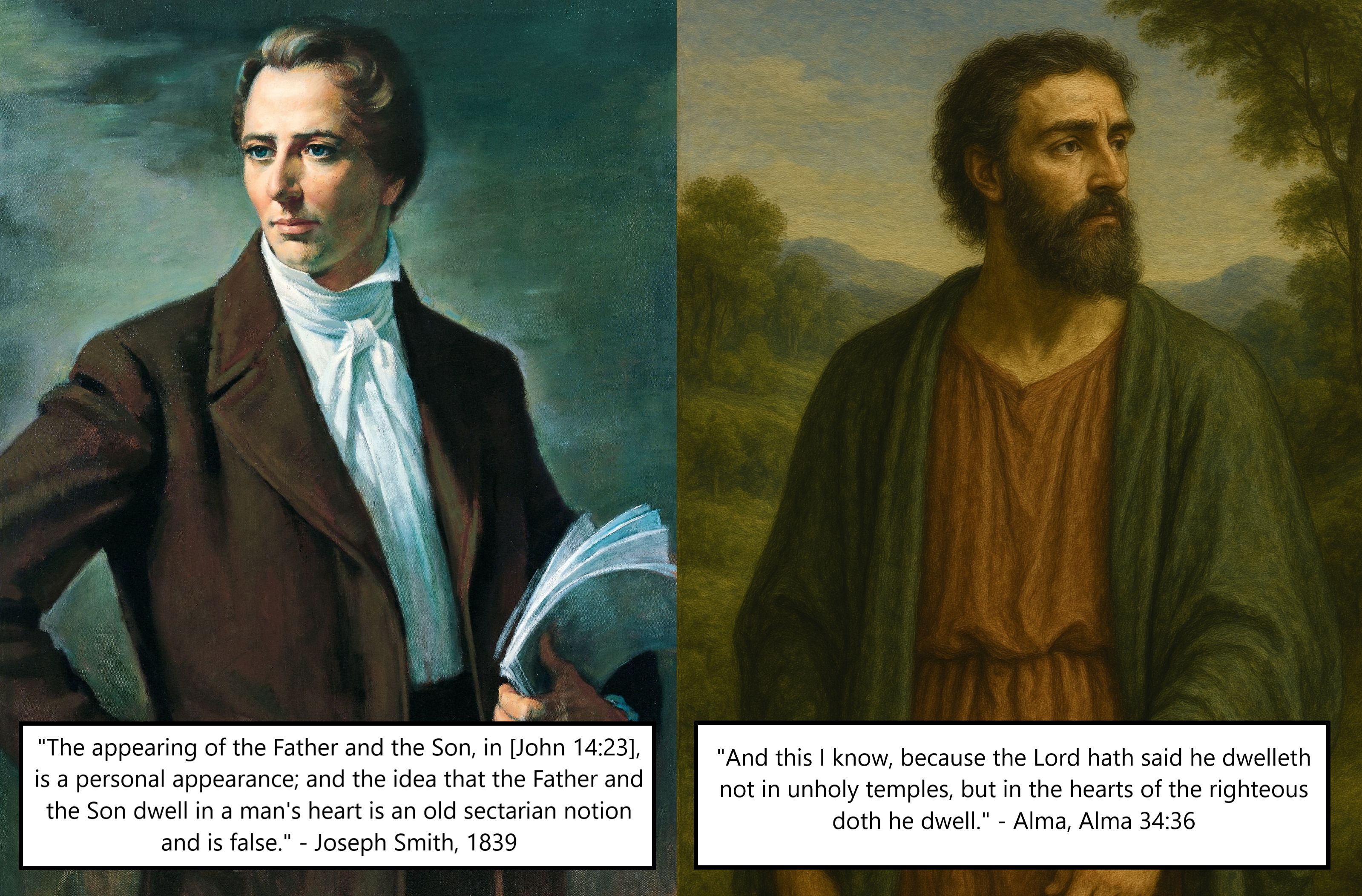
The Book of Mormon’s pneumatology is perfectly consistent with the New Testament. Nephi recounted that Jesus said, “And are they who shall seek to bring forth my at that day (the Book of Mormon came forth), for they shall have the and the of the Holy Ghost” (1 Nephi 13:37). This isn’t a physical Zion or a location on the map. Jesus’ Zion, the true New Jerusalem, is a representation of those sanctified through the Holy Spirit. We read that Alma said, “And this I know, because the Lord hath said he dwelleth not in unholy temples, but in the hearts of the righteous doth he dwell…” (Alma 34:36, emphasis added.) While at Bountiful Jesus said, “And behold, this people will I establish in this land, unto the fulfilling of the covenant which I made with your father Jacob; and it shall be a New Jerusalem (a righteous people). And the powers of heaven shall be in the midst of this people; yea, even I will be in the midst of you” (3 Nephi 20:22). Again, we should not read this literally. The “powers of heaven,” or the gifts of the Holy Spirit, are synonymous with Jesus Himself. Recall that Jesus said, “For where two or three are gathered together in my name, there am I in the midst of them” (Matthew 18:20). Jesus can’t physically appear in person to tens, thousands or tens of thousands of people simultaneously, but He is with us through the Holy Spirit. Mormon writes the twelve Nephite disciples “did pray for that which they most desired; and they desired that the Holy Ghost should be given unto them” (3 Nephi 19:9). And what happens when a people have been truly converted and truly possess the Holy Spirit? “And it came to pass that there was no contention in the land, because of the love of God which did dwell in the hearts of the people” (4 Nephi 1:14). In one of his final letters, Mormon wrote, “Wherefore, I would speak unto you that are of the church, that are the peaceable followers of Christ, and that have obtained a sufficient hope by which ye can enter into the rest of the Lord, from this time henceforth until ye shall rest with him in heaven” (Moroni 7:3. Emphasis added). “Entering God’s rest” or “entering the Lord’s rest” symbolizes “both a physical and spiritual state of peace, fulfillment, and divine presence,” not a personal appearance as some Second Comforter proponents claim. Moroni wrote that in the Nephite church “their meetings were conducted by the church after the manner of the workings of the Spirit, and by the power of the Holy Ghost; for as the power of the Holy Ghost led them whether to preach, or to exhort, or to pray, or to supplicate, or to sing, even so it was done.” (Moroni 6:9). Compare that to modern LDS service meetings which have adopted the “program” model. You go to church, sing a song, have a prayer, listen to pre-determined speakers, sing another song and have closing prayer. All spontaneity has been removed from the equation, and we have confused silence for reverence. The most vital portion of any group meeting is the sacrament, or Lord’s Supper. Contrary to current LDS teachings, the sacrament is not to “renew our baptismal covenants,” but to remind us of Jesus’ sacrifice “that we may always have His spirit (presence) to be with us.” Moroni added that “they did meet together oft (not once a week on Sunday) to partake of bread and wine, in remembrance of the Lord Jesus” (Moroni 6:6, emphasis.).
CONCLUSION
Joseph Smith claimed that “the father and the son dwelling in the heart of man is an old sectarian notion and is false” and that the father and son making their abode with man was a personal appearance. He couldn’t have been more wrong. God dwelling in the heart of man is Christianity distilled down to its primal, core essence. It is the symbolic return to Eden, the return to divine presence of the Lord. He doesn’t dwell on Mt. Olympus like the Greek gods. He doesn’t inhabit the sky, the Duat, or the special temple like the Egyptian gods. He condescended from His Eternal Thone into mortality and died for you. He comes to you. He makes His abode in you. You are his temple. In Revelation 3:20 we read, “Behold, I stand at the door, and knock: if any man hear my voice, and open the door, I will come in to him, and will sup with him, and he with me.” He doesn’t break the door down. He doesn’t demand. He knocks and waits for you to answer. At Bountiful He said,
“And ye shall offer for a sacrifice unto me a broken heart and a contrite spirit. And whoso cometh unto me with a broken heart and a contrite spirit, him will I baptize with fire and with the Holy Ghost, even as the Lamanites, because of their faith in me at the time of their conversion, were baptized with fire and with the Holy Ghost, and they knew it not. Behold, I have come unto the world to bring redemption unto the world, to save the world from sin. Therefore, whoso repenteth and cometh unto me as a little child, him will I receive, for of such is the kingdom of God. (3 Nephi 9:20-22).
Everything He has to give is freely available to you right now. The Kingdom of God is here and now. His Zion is available right now. We have so overly complicated things. It need not be. The Gospel is easy by design. You don’t need ordinances. You don’t need priesthood. You don’t need a new covenant as Denver Snuffer has offered. You already have one. We’ll talk about that in part two, along with the introduction of the Second Comforter in Nauvoo, its place in current LDS theology, its resurgence in the early 2010s, and what Jesus had to say on the subject. And He made some very definitive statements on the subject. If you’ve read my post on why the First Vision never happened, you’ll have an idea of what’s coming. I also will offer an opinion on how I believe Joseph Smith came up with the Second Comforter doctrine. Lastly, we’ll address Denver Snuffer’s claims and doctrines. As always, my door is open. You can comment here, message me on Facebook, or email me directly at matt_lohrke@yahoo.com. And I promise it won’t be another six months before part two comes out.
 BOOK OF MORMONISM
Thanks for the gospel teachings
LikeLike
thank you for dropping by.
LikeLike
It’s nice having you back, Matt. Yet another thought provoking article. I often wonder how the Mormon church reconciles its diversion from the doctrines taught in The Book of Mormon. Is there a more damning, anti Mormon book in existence? Looking forward to part two!
LikeLike
Thanks, Greg! Nope, there is no more anti-Mormon book than the Book of Mormon. Just a teaser for part two: the footnote for John 14:16 (“another comforter”) in the 1981 New Testament says “Jesus Christ, Second Comforter.” That was removed in 2013. It now reads, “Holy Ghost, Comforter.” So, someone on the scripture committee knows Joseph was wrong and made the necessary correction, much to the chagrin of the Second Comforter crowd. It’s a positive step. I’m hopeful there will be more, but I don’t expect massive changes like an end to baptisms for the dead any time soon, if ever. It’s so disappointing because if the BOM is what it claims, getting the Brother of Jared’s revelation is dependent upon the church’s repentance. These doctrines, beliefs and practices (priesthood, eternal marriage/spiritual polygamy, proxy baptism, etc) are so entrenched that any significant changes are many generations away. It takes time.
LikeLike
Thank you for this. I am astounded by how much blind faith we have put into Joseph and his opinion on things. You showed numerous different ways that he was wrong about this, and it all makes perfect sense. Why wouldn’t God dwell in our hearts? The veil of the temple was broken signifying the separation between God and man was no longer present. This was quite significant.
I also loved the sharp contrast between Joseph and Alma. There clearly is a disconnect there.
Lastly, I just finished going over the pre-existence and Job 38 is another scripture that Joseph got completely wrong. Joseph concluded God’s question implied that Job pre-existed, which makes absolutely no sense in context. There is such a huge danger in proof-texting the scriptures like this.
LikeLike
You’re welcome. Thanks for dropping by. It’s especially strange because Joseph frequently quoted Paul yet somehow missed all those verses. I think in some ways we’re the same. We start with beliefs or assumptions, and we subconsciously filter out those things that don’t conform or align. And if someone presents subjective data that we’re wrong, we’ll most likely reject it double down. I suspect that there are people who will read this and reject it because holding on to the Second Comforter is more important than its actual truthfulness.
I can’t tell you how many times I was reading the Book of Mormon after my “faith crisis” and said, “wait…what?” I was reading it through the LDS worldview, so I missed a good chunk of it. Humans are funny that way.
LikeLike
Yes, so many people hold on to their ideas or even the idea that Joseph can’t be wrong and then feel the need to justify it. The complication also is that Joseph said or did a lot of different things. Therefore, there are a lot of bits and pieces of things that can be used as justification.
It seems to me that Joseph was kind of like Trump. He would float several ideas and just let them sit there for a while and see what works and what doesn’t. Those that work would become doctrine and maybe change later, however nothing was static.
I did start a discussion about this on LDSFF. I know you don’t participate in those, because I do agree they are largely a waste of time. However, it can be fun to engage or even see others thought processes. It is early in the discussion. Maybe check in a few days. I love and hate LDSFF at the same time. 😊
LikeLike
The Trump/Smith analogy is probably pretty fair. And funny. It’s been a hot decade or more since I stepped foot into the LDSFF. I don’t know if I dare dip my toe into those waters again. Haha.
LikeLike
Your insight and in-depth research inspires me to study more, Matt. I appreciate your translations of Hebrew, Latin, and Greek terms. Thank you for all your good work! True, the concept of God being in the human heart was not a Christian teaching, but it is taught in Mahayana Buddhism and in several Native American tribal spiritual teachings. My own understanding about the ‘Godhead’, from my Sumerian and Babylonian studies, is that the original version goes back to the Sumerian supreme god An and his 2 sons Enlil (later known as Marduk) and Enki. (There were 7 gods and goddesses in the Sumerian pantheon.) Enki and his consort Ninhursag (believed to be Adam and Eve) lived in the paradise called Dilmun (Bahrain in the Persian Gulf). I have wondered who was the god or goddess who became known as “the Holy Ghost”, or “the Comforter”, but I didn’t understand who a Second Comforter could be. Was it Yahweh’s consort Asherah? Was this deity a male or a female? Now that you’ve explained that Jesus is the Second Comforter, I’m confused, but I will try to understand it as the LDS version of the ‘Godhead’.
LikeLike
Nice to hear from you, as always. As is usually the case, there’s a very distinct difference between the Book of Mormon and Joseph Smith. According to Joseph Smith, the Second Comforter is the personal appearance of Jesus, but neither the text of John 14 nor the Book of Mormon support that claim. Joseph’s doctrine is uniquely his own. I think it’s important to remember that this doctrine was introduced in 1839, when Joseph, I believe, had already succumbed to his mental illness (I have since found additional voices, even in LDS circles, questioning Joseph’s mental state). The Nauvoo period is notoriously difficult with regards to doctrine. It’s when all the weird stuff emerges.
The LDS godhead, according to Joseph, is that God the Father, Jesus Christ the Son, the Holy Spirit are three distinct beings. The Father (God, “Elohim”) has a body of flesh and blood. The Son (Jesus) is a resurrected being. The Holy Spirit is a personage of spirit, who, allegedly, will someday take up a corporeal form. The LDS godhead is completely nonsensical and contradictory in many ways. According to the BOM, Jesus is Eternal God, YHWH of the Hebrew Bible. He is “the Son” by virtue of his mortality, not because he’s literally “God’s son.” The closest historical parallels would be Sabellianism, Modalism or Binitarianism.
It’s gets very messy in the Book of Abraham and Book of Moses. In the former, we read that Jehovah oversees the Divine Council and in attendance are “One Like Unto the Son of Man” (Jesus) and “One Like Unto God (Michael) are in attendance. This contradicts the Book of Mormon in which Jesus is YHWH. The Book of Abraham paints Jesus and Michael as subordinate to Jehovah, with Michael and Jesus co-equals, or Michael even outranking Jesus. The Book of Moses likewise paints Jesus as a distinct being from Jehovah.
The Lectures on Faith, the “Doctrine” of the “Doctrine and Covenants” (1835) were penned by Sidney Rigdon, who correctly identified Jesus as Jehovah, but incorrectly described as a “saved being” (how is God saved?) and created a big mess when he declared that unless one is exactly like Jesus, he or she cannot be saved. So, rather than relying wholly on merits of Jesus, as the BOM and NT explain, in Mormonism you must literally be a Jesus.
Right before the Kirtland Temple dedication, Joseph reportedly had a vision in which he saw his brother Alvin in the Celestial kingdom, along with Adam and Michael (January 1836). This is a problem because in the revised D&C 27 (published in 1835) we read of “Michael, or Adam, the father of all, the prince of all, the ancient of days.” When Joseph’s January 1836 vision was added to the D&C, “Michael” was removed for obvious reasons. Further, the “Ancient of Days” from Daniel isn’t Adam/Michael. It’s God. We can thank Sidney Rigdon for that interpretation which Joseph codified via “revelation.”
It’s impossible to make sense of the LDS godhead because it’s inherently nonsensical. Aren’t you glad you brought it up? Haha. 🙂 Thanks for dropping by!
LikeLike