
I know I said the Second Comforter post was coming next. I’m still working on it, but it’s proven to be more difficult than I originally anticipated. I think part of it is burn out from the series on Joseph Smith. I was pretty demoralized by the end, and it’s been tough to get back in the saddle. I also want to make the post sure it’s airtight, sufficiently sourced and clearly explained because it’s become the most dominant feature of post-LDS thought. Some people hinge their salvation on Jesus appearing to them. It’s a big deal. While I was doing research for the Second Comforter the other day, I stumbled across a passage from Cumorah and the final battle between the Nephites and Lamanites that piqued my curiosity. There are few things I love more than Book of Mormon geography, so I was grateful for the diversion.
For the last fifteen years, I’ve been operating under the assumption that the drumlin near Manchester, New York identified in LDS tradition as the Hill Cumorah was the same Hill Cumorah from the Book of Mormon. As such, all models must necessarily begin there, or at least be included. When I wrote a post on the Christopher Columbus Myth, I included a map with a circle around Manchester are and labeled it “BOM lands.” I’ve spent more hours than I’m willing to admit staring at maps and satellite images of Western New York and the Great Lakes area trying to identify geographical landmarks. But no matter how I approached it, I could never make it work. The biggest problem was identifying the Book of Mormon’s most well-known geographical feature: the narrow neck of land. Where is it? There were other problems, too. Where are the Sea East and Sea West divided by the narrow neck? How can Hagoth launch into the Sea West and head north in New York? How did King Benjamin manage to gather all the people of Zarahemla to the temple “on the morrow” to speak to them when according to the Heartland Model, Zarahemla covers several states? Why did the surviving Nephites flee south after the final battle at Cumorah when there are infinite escape routes? How can the “plains of the Nephites” be some 875 miles away in western Illinois, as Joseph wrote to Emma during Zion’s Camp in 1834? None of this fits a Western New York, Great Lakes or Heartland Model. (I was going to include a section on the “Zelph Mound,” but I’ll refer you to Kenneth Godfrey’s excellent article instead.)
In a previous post, I suggested the Land Southward (the land of Nephi and Zarahemla), being “nearly surround by water” (Alma 22:32), was a peninsula and therefore waterlocked. The dictionary definition of “waterlocked” is “nearly surrounded by water.” Only a peninsula or enclosed area allowed the Jaredites to “preserve the land southward for a wilderness to get game” (Ether 10: 21). This is why the Nephites found the land southward full of wild animals when the arrived. It was the Jaredite wildlife preserve before their destruction. Moroni writes that the Jaredite “flocks began to flee before the poisonous serpents, towards the land southward, which was called by the Nephites Zarahemla…And it came to pass that the Lord did cause the serpents that they should pursue them no more, but that they should hedge up the way that the people could not pass” (Ether 9:32, 34). Mormon writes that the Nephites “hemmed in the Lamanites on the south, that thereby they should have no more possession on the north, that they might not overrun the land northward” (Alma 22:33). Only because the land southward was a peninsula were the Nephites able to restrict access to the land northward via the narrow neck, otherwise the Lamanites could simply go around. “Hemmed in” and “hedged up” mean what they suggest. We also can say with reasonable certainty that Book of Mormon lands cover a very small area. Paraphrasing Daniel Peterson of BYU, you can add up all the travel times in the Book of Mormon and it’s clear no one is going very far in any direction. Zarahemla is probably a few square miles, if that. The narrow neck is probably a hundred yards wide, give or take, unless you want to believe a 30 to 60-mile wall of snakes prevented passage to the land southward required by the Mesoamerican setting. Again, none of these features fit Manchester, NY. The “Two-Cumorah Theory,” favored by most LDS archeologists, is so absurd I’m not even going to talk about it. There’s only one Cumorah.
At the heart of the issue is that we’re all making a lot of assumptions about the Book of Mormon based on tradition when we should be wholly reliant on the text itself. As someone with an English degree, I can feel like I can make the informed claim that the text is king, especially when it comes to scripture. For those of us who grew up in the LDS church, Mormonism influences how we read the text. This is how we ended up believing that Alma 13 talks about a premortal existence. It absolutely does not. We need to read the Book of Mormon (and the Bible) on its terms and that is very difficult. It doesn’t matter what Joseph Smith said about Book of Mormon geography. Despite what anyone tells you, Joseph Smith was mostly ignorant of the Book of Mormon’s actual content. His role as translator, if in fact he was (I have questions!), does not necessarily make him an expert on the text, or on anything for that matter. We have to remove him from the equation. It also doesn’t matter what Wayne May, Rod Meldrum, Johnathan Neville, John Sorensen, Oliver Cowdery, Russell M. Nelson, BYU academics and scholars, or anyone else says. I appreciate their work, but they don’t matter. The only people who do matter are Mormon and Moroni. And here’s the thing: Moroni, the last custodian of the Nephite record, never claims he buried it in the Hill Cumorah. That’s what we’re going to discuss in this post. We’re fast approaching the 200th anniversary of the Book of Mormon’s publication and I feel that if these people existed, we probably should know by now where the events took place. Hopefully this post sheds some light on the subject. As always, I will not claim to know where these events took place because I don’t. Mormon, however, has given us a lot of information of what we should be looking for and what we can exclude. We’re going to look at are BYU’s map, the development of the Cumorah tradition in early LDS documents, and finally, and most importantly, we’ll trace custodianship of the plates in the Book of Mormon text. By the end maybe we can reconsider some of our assumptions and who knows, maybe solve this puzzle.
THE MAP
Many a geography enthusiast has produced a map of Book of Mormon lands. The most dominant are the Mesoamerican and Heartland models. Others include the Great Lakes, Baja California, even Malaysia. Most models begin with an internal map, meaning all the major geographical features are placed in general relationship to each other. They’re not meant to be perfect. Other maps are more detailed or conceptual. Others make specific claims, such as some Heartland maps that claim Zarahemla was in modern day Iowa. Of all the maps I’ve seen to date, and I’ve seen a lot, the map produced by BYU, which they call “relational,” is the most accurate based on Mormon’s descriptions in the text. I circled Cumorah,
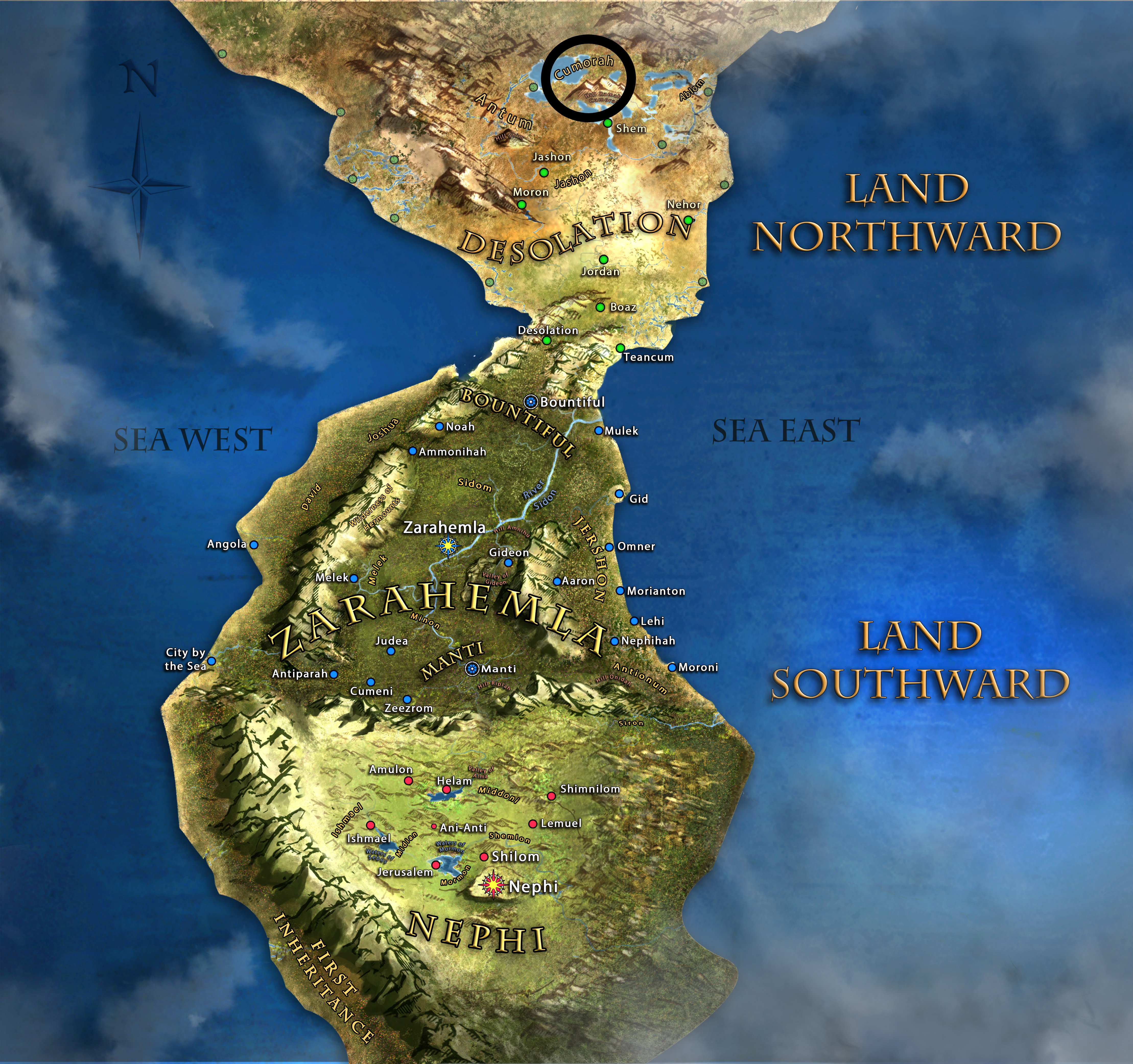
This hourglass shape, which Heartlanders vehemently reject, is more or less what Mormon describes. The only changes I would make would be to show the land southward “nearly surrounded by water,” and extend and narrow the west side of Bountiful and Desolation so the “sea can divide the land” (Ether 10:20). Other than that, it’s an excellent map and obviously bears no resemblance western New York. Try not to be dazzled by my MS Paint skills:
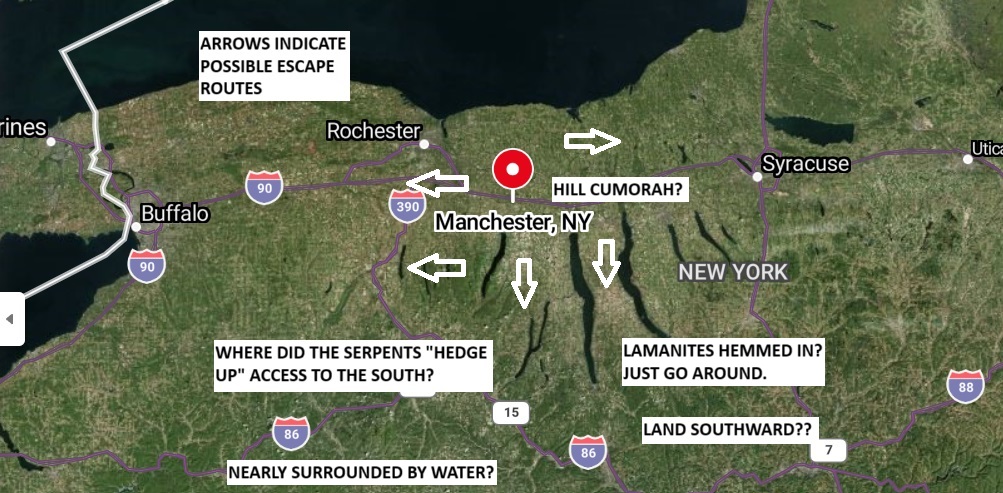
The two maps obviously can’t co-exist. I have heard it suggested that Joseph Smith wrote the Book of Mormon as a myth to explain known geographical features, particular the mounds in the East and Midwest. If he did, he did a pretty poor job of it. I have no idea why he claimed western Illinois was “the plains of the Nephites.” Maybe he believed it but given Joseph’s profound ignorance of the Book of Mormon, it’s not surprising that he did. He was offering a demonstrably false opinion. That’s why we throw him out.
Since I am a visual learner, we’ll revisit the BYU map when we get tracking Mormon and Moroni’s movements during those final years of the Nephite people and then develop a hypothesis about Moroni’s movements. But before we get to that, let’s look at the origins of the Cumorah in the LDS tradition.
THE HILL CUMORAH IN EARLY LDS DOCUMENTS
The biggest surprise in this entire study was how infrequently Cumorah was mentioned by name in the early days of the Church. I queried the Joseph Smith Papers and got less than a dozen hits, not including duplicates. The only instances Cumorah is mentioned by name outside the Book of Mormon are D&C 128:20, “And again, what do we hear? Glad tidings from Cumorah! Moroni, an angel from heaven, declaring the fulfilment of the prophets—the book to be revealed”; an 1835 hymn; Orson Pratt’s A Interesting Account of Several Remarkable Visions (1840) reads that Moroni “hid up the records in the hill Cumorah.” Lucy Mack Smith’s Biographical Sketches of Joseph Smith the Prophet and His Progenitors for Many Generations, which was clearly influenced by intervening events, reads that Joseph said to his father, “as I passed by the hill of Cumorah, where the plates are, the angel met me, and said that I had not been engaged enough in the work of the Lord (p. 99); and that’s about it. Neither of Joseph’s histories mention Cumorah by name. His 1832 history reads that the angel Moroni told him “…that in the Town of Manchester Ontario County N.Y. there was plates of gold upon which there was engravings,” but doesn’t mention a hill. His 1838 history mentions a “hill of considerable size” near Manchester. I then searched The Words of Joseph Smith: Deluxe Study Edition, which includes Teachings of the Prophet Joseph Smith, Lectures on Faith, History of the Church, etc., and again there wasn’t much. The only mention of Cumorah that can be traced directly to Joseph Smith is D&C 128, a September 7, 1842 letter to the Church Joseph reportedly penned while in hiding from the authorities looking to extradite him to Missouri for his alleged role in Governor Boggs’ assassination attempt.

Richard Bushman wrote in Rough Stone Rolling that the hill was “a few hundred feet to the east of main road between Palmyra and Canandaigua. Later it was called ‘Cumorah’…” (p. 45. Emphasis added). So, when did the Cumorah tradition begin? Best I can tell, the source is an 1834 letter from Oliver Cowdery to W.W. Phelps, who was then overseeing church affairs in Independence. Cowdery wrote eight letters to Phelps detailing the origins and the rise of the Church. According to Scripture Central, these letters represent “the earliest public history of Joseph Smith, the coming forth of the Book of Mormon, and several other related topics.” (Joseph’s 1832 history was not yet public.) It was in these letters that we first learned of the alleged appearance of John the Baptist to confer “Aaronic Priesthood.” Oliver’s account of what John reportedly said differs from what we read in Joseph’s 1838 history (click here for a side-by-side comparison). In 1835 Cowdery, as editor, published these letters in the Messenger and Advocate. Of interest to this post is Letter VII, which reads in part,
“You are acquainted with the mail road from Palmyra, Wayne Co. to Canandaigua, Ontario Co. N. Y. and also, as you pass from the former to the latter place, before arriving at the little village of Manchester, say from three to four, or about four miles from Palmyra, you pass a large hill on the east side of the road. Why I say large, is, because it is as large perhaps, as any in that country. To a person acquainted with this road, a description would be unnecessary, as it is the largest and rises the highest of any on that route. The north end rises quite sudden until it assumes a level with the more southerly extremity, and I think I may say an elevation higher than at the south a short distance, say half or three fourths of a mile. As you pass toward Canandaigua it lessens gradually until the surface assumes its common level, or is broken by other smaller hills or ridges, water courses and ravines. I think I am justified in saying that this is the highest hill for some distance round, and I am certain that its appearance, as it rises so suddenly from a plain on the north, must attract the notice of the traveller as he passes by.
“At about one mile west rises another ridge of less height, running parallel with the former, leaving a beautiful vale between. The soil is of the first quality for the country, and under a state of cultivation, which gives a prospect at once imposing, when one reflects on the fact, that here, between these hills, the entire power and national strength of both the Jaredites and Nephites were destroyed. By turning to the 529th and 530th pages of the book of Mormon you will read Mormon’s account of the last great struggle of his people, as they were encamped round this hill Cumorah. In this valley fell the remaining strength and pride of a once powerful people, the Nephites once so highly favored of the Lord, but at that time in darkness, doomed to suffer extermination by the hand of their barbarous and uncivilized
brethren. From the top of this hill, Mormon, with a few others, after the battle, gazed with horror upon the mangled remains of those who, the day before, were filled with anxiety, hope, or doubt. A few had fled to the South, who were hunted down by the victorious party, and all who would not deny the Savior and his religion, were put to death. Mormon himself, according to the record of his son Moroni, was also slain.”
Letter VII is held sacrosanct by proponents of the Heartland model. Given Cowdery’s proximity to Joseph Smith as Book of Mormon scribe and second elder of the church, they understandably assume Cowdery was uniquely qualified to identify the Manchester drumlin as the Hill Cumorah, which he did again in Letter VIII,
“I have now given sufficient on the subject of the hill Cumorah—it has a singular and imposing appearance for that country, and must excite the curious enquiry of every lover of the Book of Mormon…
“You will have wondered, perhaps, that the mind of our brother should be so occupied with the thoughts of the good of this world, at the time of arriving at Cumorah, on the morning of the 22nd of September, 1823, after having been rapt in the visions of heaven during the night, and also seeing and hearing in open day; but the mind of man is easily turned, if it is not held by the power of God through the prayer of faith, and you will remember that I have said that two invisible powers were operating upon his mind during his walk from his residence to Cumorah, and that the one urging the certainly of wealth and ease in this life, had so powerfully wrought upon him, that the great object so carefully and impressively named by the angel, had entirely gone from his recollection that only a fixed determination to obtain now urged him forward.”
These letters are interesting to me because Cowdery strikes me as a man of high morals and principles. He was one of the few to openly challenge and question Joseph. I don’t know why he would participate in telling a story about John the Baptist restoring priesthood authority, if in fact he did, when such an event obviously never happened. Priesthood was Sidney Rigdon’s baby and isn’t found in any LDS documents until after his arrival in December 1830, so I can’t help but wonder if Rigdon exercised some of his considerable influence on these letters or wrote the letters himself. He probably didn’t, but it’s a very strange situation. Whether or not Cowdery received the Cumorah information from Joseph or used his own powers of deduction, the Manchester/Cumorah tradition is fully entrenched in LDS literature. The entry for Hill Cumorah on LDS.org reads, “A small hill located in western New York, United States of America. Here an ancient prophet named Moroni hid the gold plates containing some of the records of the Nephite and Jaredite nations.” Did he? Another entry reads, “In A.D. 421, Moroni buried a set of gold plates in the Hill Cumorah containing the sacred history of his people (W of M 1:1–11; Morm. 6:6; Moro. 10:1–2). This same Moroni told Joseph Smith where to find the plates on the hill.” There’s no shortage of Conference talks and study manuals that reference Cumorah in New York. Most are harmless and simply restate what has become part of our cultural tradition. Others, like this from a primary manual, give me the creeps: “Invite the children to pretend to be Joseph Smith at various points in the story by folding their arms like they are praying, pretending to climb the Hill Cumorah, and so on.” Yikes. No one should be LARPing as Joseph Smith. We have to stop doing this kind of stuff and instead reintroduce The Cumorah Pageant, which ran from 1937-2019. I wish it hadn’t ended. Some traditions are worth preserving, even if the clothing, sets and setting of the pageant were wrong.
The adoption of the Manchester drumlin as the Hill Cumorah was part of the larger mythologization of Mormonism that began in 1832. That summer Joseph wrote the first known account of the First Vision, which only mentions “The Lord.” (The First Vision never happened.) In September priesthood is more fully fleshed out (D&C 84). Over the next year or two the Nephite Interpreters became the Biblical “Urim and Thummim” (they aren’t). A breastplate, never mentioned in the Book of Mormon, entered the narrative to help establish Joseph’s “modern-day Moses” bona fides. The Book of Mormon became the “Stick of Ephraim” (it isn’t). The Latter-Day Saint Gentiles became the literal House of Israel (we aren’t), the “sons of Moses and Aaron” (D&C 84:23). Jesus and ancient Hebrews prophets appeared in the Kirtland Temple (they didn’t). Brigham Young transfigured into Joseph Smith in order to resolve the succession crisis (he didn’t). There are ten secondhand accounts, including “visions,” of a loot cave in Cumorah containing the sword of Laban, a breastplate, the Liahona, piles of plates. For the record, there is no loot cave. Yet these myths create group cohesion through shared history. Myth made the Mormons a chosen people and Joseph Smith their founding prophet. The difficulty is distinguishing between myth and history. Faith is falsehoods isn’t faith at all. While I don’t believe the bulk of “faith-promoting” traditions, I have no problem with Joseph retrieving the plates from the Manchester drumlin (maybe the joke’s on me), but that hill isn’t Cumorah.
CUSTODY OF THE PLATES / MORMON AND MORONI’S MOVEMENTS
One of the remarkable things about the Book of Mormon is that we have a clear custodial record of the plates from Nephi to Moroni. (Click here for a flowchart.) This differs considerably from the Bible. Most of the Hebrew Bible (including the Torah), all the Gospels and Epistle to the Hebrews were anonymously written. Have you ever read “I, Moses” or “I, David” in the Hebrew Bible? What about “I, Matthew,” “I, Mark,” “I, Luke,” or “I, John” in the New Testament? You won’t find it. In the Book of Mormon, every custodian of the large plates of Nephi identified himself and wrote something “to preserve our genealogy” (Omni 1:1). Amaleki, the last to write on the large plates of Nephi, writes at the end of Omni,
“And now I would speak somewhat concerning a certain a number who went up into the wilderness to return to the land of Nephi (Zeniff and his company, Mosiah 9-22); for there was a large number who were desirous to possess the land of their inheritance. And I, Amaleki, had a brother, who also went with them; and I have not since known concerning them. And I am about to lie down in my grave; and these plates are full. And I make an end of my speaking” (Omni 1:27).
I’m pretty sure Amaleki’s brother was Abinadi. Amaleki’s father was named Abinadom (Omni 1:12), so it stands to reason that Abinadom had another son named Abinadi. I love these little details. After a brief introduction in Words of Mormon (~385 BC), Mormon begins his narration of the Nephite history with Mosiah 1, roughly 130 BC, after Mosiah 1 and his people fled the land of Nephi and united with the people of Zarahemla. The events of early Mosiah predate Mormon by some 515 years. That’s a very long time. For comparison, “Columbus sailed the ocean blue” 532 years ago. I don’t know about you, but it’s really hard to comprehend just how much time that is. Once the Nephites united with the Zarahemlaites, Mormon writes,
“Wherefore, it came to pass that after Amaleki had delivered up these plates into the hands of king Benjamin, he took them and put them with the other plates, which contained records which had been handed down by the kings, from generation to generation until the days of king Benjamin. And they were handed down from king Benjamin, from generation to generation until they have fallen into my hands.” (Words of Mormon 1:10-11)
As Mormon ended compiling the Nephites history, he gives us custodianship of the plates from the time of Christ to the time Ammaron buried them,
“And it came to pass that Nephi, he that kept this last record, (and he kept it upon the plates of Nephi) died, and his son Amos kept it in his stead; and he kept it upon the plates of Nephi also. And he kept it eighty and four years…And it came to pass that Amos died also, (and it was an hundred and ninety and four years from the coming of Christ) and his son Amos kept the record in his stead; and he also kept it upon the plates of Nephi; and it was also written in the book of Nephi, which is this book…And it came to pass that after three hundred and five years had passed away, (and the people did still remain in wickedness) Amos died; and his brother, Ammaron, did keep the record in his stead. And it came to pass that when three hundred and twenty years had passed away, Ammaron, being constrained by the Holy Ghost, did hide up the records which were sacred—yea, even all the sacred records which had been handed down from generation to generation, which were sacred—even until the three hundred and twentieth year from the coming of Christ.” (4 Nephi)
And that brings us to 385 AD and looming destruction of the Nephite dynasty. With his historical work complete, Mormon writes, “And now I, Mormon, make a record of the things which I have both seen and heard, and call it the Book of Mormon.” (Mormon 1:1) He begins by giving a brief history of his early years and how he gained custody of the plates. About the time the aforementioned Ammaron buried the plates he came to the then ten-year-old Mormon and said,
“…I perceive that thou art a sober child, and art quick to observe. Therefore, when ye are about twenty and four years old I would that ye should remember the things that ye have observed concerning this people; and when ye are of that age go to the , unto a hill which shall be called ; and there have I deposited unto the Lord all the sacred engravings concerning this people. And behold, ye shall take the unto yourself, and the remainder shall ye leave in the place where they are; and ye shall engrave on the plates of Nephi all the things that ye have observed concerning this people. (Mormon 1:3-4)
At age of 11 Mormon moves to the Land Southward, or Bountiful/Zarahemla. He’s so easily able to describe all these places because he’s personally familiar with them. The journey from Desolation into Bountiful through the narrow neck probably took no more than an hour or two. The “line Bountiful” from the Sea West to the Sea East was either a day’s journey (Helaman 4:7) or a day and half’s journey (Alma 22:32). If we account for variable terrain, it’s probably no more than 25 miles wide at the northern end of the peninsula. At age 16 Mormon becomes a military commander. He writes about the conflicts between the Nephites and Lamanites, and how the Nephites were gradually pushed into the land northward, or Desolation. First, they were driven to Angola, then to David, then to Joshua. They then retreated across the narrow neck to the land of Jashon, then to Shem, which they fortified.
“And it came to pass that in the three hundred and forty and fifth year the Nephites did begin to flee before the Lamanites; and they were pursued until they came even to the land of Jashon, before it was possible to stop them in their retreat. And now, the city of Jashon was near the land where Ammaron had deposited the records unto the Lord, that they might not be destroyed. And behold I had gone according to the word of Ammaron, and taken the plates of Nephi, and did make a record according to the words of Ammaron…And it came to pass that in this year (345 AD) the people of Nephi again were hunted and driven. And it came to pass that we were driven forth until we had come northward to the land which was called Shem.” (Mormon 2:16-17, 20)

Eventually the Lamanite army cross into the land northward and gave battle to the Nephites, but the Nephites fended off the attack and forged a truce with the Lamanites,
“And in the three hundred and fiftieth year we made a treaty with the Lamanites and the robbers of Gadianton, in which we did get the lands of our inheritance divided. And the Lamanites did give unto us the land , yea, even to the which led into the land southward. And we did give unto the Lamanites all the land southward.” (Mormon 2:28-29)
After 10 years of preparation, the Nephites travelled south to the city of Desolation to establish a defensive bulwark,
“And it came to pass that I did cause my people that they should gather themselves together at the land Desolation, to a city which was in the borders, by the narrow pass which led into the land southward. And there we did place our armies, that we might stop the armies of the Lamanites, that they might not get possession of any of our lands; therefore we did fortify against them with all our force. (Mormon 3:5-7. Again, the narrow neck is the only access point to the land northward.)
In both the 361st and 362nd years, the Nephites prevented the Lamanites from passing into the land northward. It was then that the Nephite armies, buoyed by their pride after successive victories, vowed to cut the Lamanites off the face of the earth. Mormon then refused to serve as their military commander. In the 363rd year, the Nephites moved into the land southward, but were immediately pushed back to Desolation, which they eventually lost, and fled to Teancum.
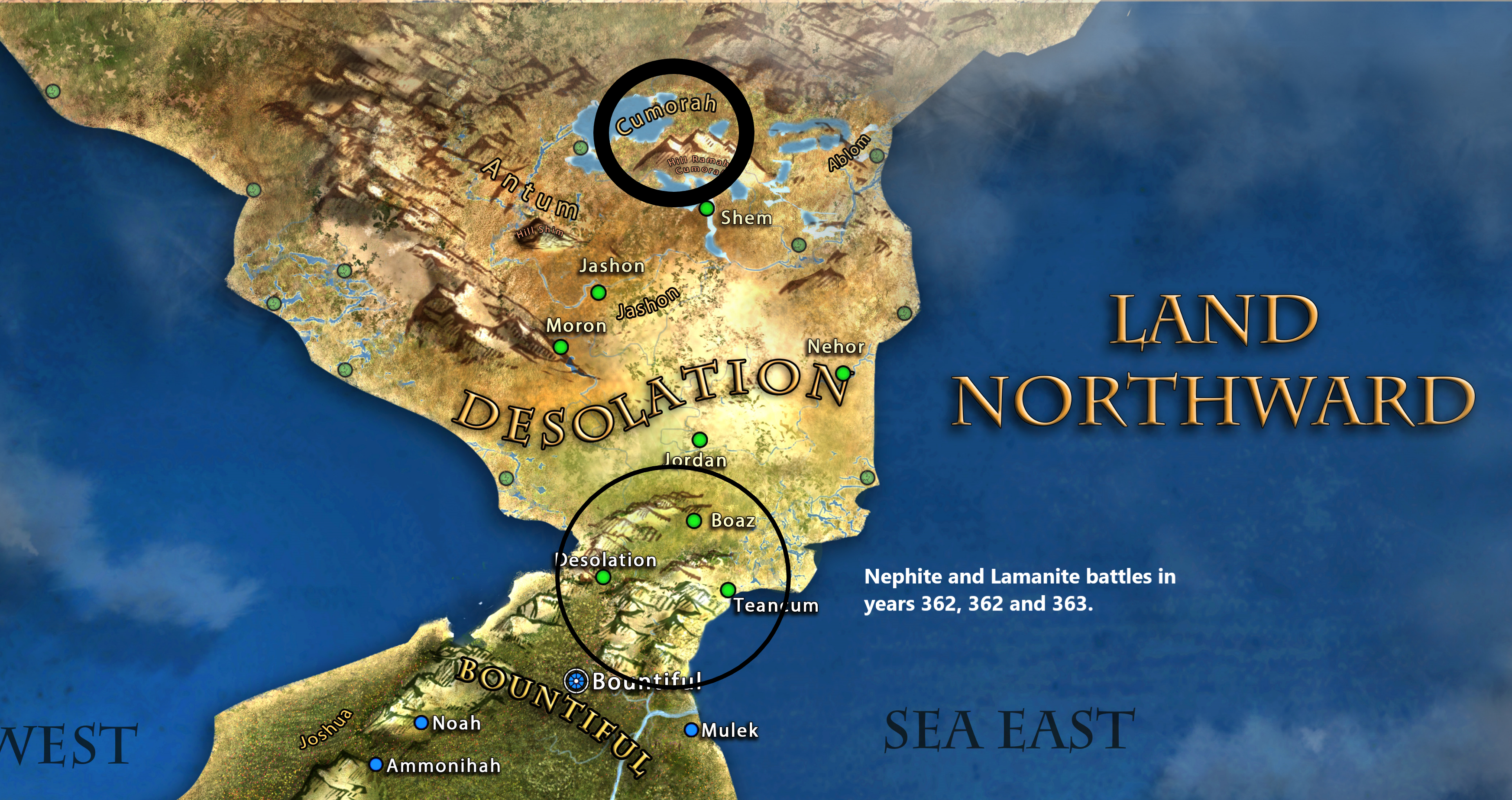
The Lamanites came to Teancum, but the Nephites repelled the attack. That victory again caused them to boast of the own strength. The Nephites then retook Desolation. Over the next several years these battles continue, with Mormon writing that the scene of bloodshed and carnage was so severe that he was unable to perfectly describe it. Eventually the Lamanites again took possession of Desolation and then Teancum, which caused the Nephites to retreat to Boaz. The Nephites repelled the first attack at Boaz, but then second ended in defeat with “an exceedingly great slaughter” (Mormon 4:21). This was the beginning of the end of the Nephites. Mormon then writes, “And now I, Mormon, seeing that the Lamanites were about to overthrow the land, therefore I did go to the hill Shim, and did take up all the records which Ammaron had hid up unto the Lord.” (Mormon 4:3) This suggests to me that the Hill Shim wasn’t that far away from Boaz. I doubt it was more than a few hours walk. We now know that Mormon had all the Nephite records in his possession. The Nephites continued their attempts to repel the Lamanites. Some Nephite strongholds were successful, but eventually fell. Mormon, again in command of the Nephite armies, writes,
“And I, Mormon, wrote an epistle unto the king of the Lamanites, and desired of him that he would grant unto us that we might gather together our people unto the land of Cumorah, by a hill which was called Cumorah, and there we could give them battle. And it came to pass that the king of the Lamanites did grant unto me the thing which I desired. And it came to pass that we did march forth to the land of Cumorah, and we did pitch our tents around about the hill Cumorah; and it was in a land of many waters, rivers, and fountains (natural springs); and here we had hope to gain advantage over the Lamanites….And it came to pass that when we had gathered in all our people in one to the land of Cumorah, behold I, Mormon, began to be old; and knowing it to be the last struggle of my people, and having been commanded of the Lord that I should not suffer the records which had been handed down by our fathers, which were sacred, to fall into the hands of the Lamanites, (for the Lamanites would destroy them) therefore I made this record out of the plates of Nephi, and hid up in the hill Cumorah all the records which had been entrusted to me by the hand of the Lord, save it were these few plates which I gave unto my son Moroni” (Mormon 6:4, 6. See also Moroni 9:24, in which Mormon writes to Moroni about the “sacred records” he desired to entrust him with).
Here we see that Mormon buried the plates in the Hill Cumorah but gave the plates that became the Book of Mormon to Moroni. He also had the interpreters. You know how the story ends. The Nephites are wiped out, but not fully destroyed. Jesus prophesied a “remnant” of the Nephites would remain until the Gentiles arrived some 1,200 years later, which Mormon reiterated in Mormon 5:9. But Moroni is on his own. Around 400 AD he writes,
“I even remain alone to write the sad tale of the destruction of my people. But behold, they are gone, and I fulfil the commandment of my father. And whether they will slay me, I know not. Therefore I will write and hide up the records in the earth; and whither I go it mattereth not…Behold, I make an end of speaking concerning this people. I am the son of Mormon, and my father was a descendant of Nephi. And I am the same who hideth up this record unto the Lord” (Mormon 8:3-4, 13-14).
The Nephite record was originally supposed to end with Mormon 9. I doubt very much that Moroni ever returned to Cumorah. The face of the land northward was “one continual round of murder and bloodshed” (Mormon 8:8), so I imagine returning to the scene of the slaughter was too risky. Almost as an addendum to the Book of Mormon, Moroni include an abridged history of the Jaredites with the Book of Ether. He writes some interesting things in the opening chapter,
“…I take mine account from the and four plates which were found by the people of Limhi, which is called the Book of Ether…Therefore I do not write those things which transpired from the days of Adam until that time; but they are had upon the plates; and whoso findeth them, the same will have power that he may get the full account.” (Ether 1:2, 4)
I think we can infer from that statement that the Jaredite record was still buried in Cumorah at the time Moroni made the abridgement, meaning he made it from memory, as we’ll see momentarily. Moroni later explains that he wrote the Brother of Jared’s vision onto the plates,
“Behold, I have written upon these plates the very things which the brother of Jared saw; and there never were greater things made manifest than those which were made manifest unto the brother of Jared. Wherefore the Lord hath commanded me to write them; and I have written them. And he commanded me that I should seal them up; and he also hath commanded that I should seal up the interpretation thereof; wherefore I have sealed up the interpreters, according to the commandment of the Lord.” (Ether 4:4-5)
We now arrive at Ether 5, which is one of the strangest chapters in the Book of Mormon: “And now I, Moroni, have written the words which were commanded me, according to my memory;” (Ether 5:1) This chapter, to my eyes, seems like a much later insertion into the text, like an 1829 insertion. You can remove chapter 5 and not interrupt the narrative between chapters 4 and 6. In chapter 5 Moroni directly addresses the translator, presumably Joseph Smith, as if he’s in the room with him: “…and I have told you the things which I have sealed up; therefore touch them not in order that ye may translate; for that thing is forbidden you, except by and by it shall be wisdom in God. And behold, ye may be privileged that ye may show the plates unto those who shall assist to bring forth this work” (Ether 5:1-2). I have really struggled to untangle Ether 13 and the concept of a New Jerusalem. Maybe it’s because Moroni was writing Ether’s prophecies from memory and not recalling them in perfect chronological order. I could be wrong, but that might explain some of the textual difficulties. The Book of Mormon is an inspired, but imperfect, book. Man’s involvement ensures that. So don’t worry about errors in the Book of Mormon. Of course there are errors. Moroni, however, warns the reader to not reject it “because of the imperfections” (Mormon 8:12).
The Book of Ether was meant to end to record, but Moroni lived longer than he apparently anticipated,
“Now I, Moroni, after having made an end of abridging the account of the people of Jared, I had supposed not to have written more, but I have not as yet perished; and I make not myself known to the Lamanites lest they should destroy me. And I, Moroni, will not deny the Christ; wherefore, I wander whithersoever I can for the safety of mine own life” (Moroni 1:1,3).
Now, I don’t know if Moroni leaves his ancestral lands now or after he’s completed his book, but he does leave. As I said in the beginning, I don’t know where the Book of Mormon events took place, but given the information we have, the Delmarva Peninsula is the most obvious candidate: it’s a peninsula connected to the mainland by narrow neck; it’s about 20 miles from the east coast to the west coast where the “line Bountiful” would be, easily a “day’s journey”; it’s 50 miles from the narrow neck to Philadelphia, home of the Declaration of Independence. Recall that Christ said at Bountiful that the Gentiles “should be established in this land, and be set up as a free people by the power of the Father, that these things might come forth from them unto a remnant of your seed” (3 Nephi 21:4). Delaware, Maryland, and Virginia (DelMarVa) were three of the original colonies. It makes sense, but it’s not without difficulties.
Here’s my hypothesis. It might be wrong, so take it with a grain of salt. After the battle of Cumorah Moroni spent the next several weeks or months in hiding. He never returned to the Hill Cumorah. Too dangerous. The Nephite records that Mormon buried, including the Jaredite plates, in the Hill Cumorah in the land Desolation are still there. Eventually, Moroni knew he had to leave for his own safety. He took with him the Nephite plates his father gave him and the interpreters. If he were near the Delmarva Peninsula, he could have followed the Susquehanna River all the way to southern New York. It was then a fairly short distance to Manchester. This is probably a month-long journey:

Whatever path he took, he eventually ended up in Manchester and wrote his book. He begins the final chapter of the Book of Mormon,
“Now I, Moroni, write somewhat as seemeth me good; and I write unto my brethren, the Lamanites; and I would that they should know that more than four hundred and twenty years have passed away since the sign was given of the coming of Christ. And I seal up these records, after I have spoken a few words by way of exhortation unto you” (Moroni 10:1-2).
He then buried the plates in the Manchester drumlin. If Joseph Smith was telling the truth about retrieving the plates from the Manchester drumlin, then that’s where Moroni buried them. And that drumlin is not the Book of Mormon Hill Cumorah. The geographical information provided by both Mormon and Moroni doesn’t match the geography of Western New York, so it cannot be the place of the Hill Cumorah and by extension it cannot be Book of Mormon lands. This eliminates the Western New York and Great Lakes Models from consideration.
For the Mesoamerican Model to work, we have to assume that Moroni walked 3,200 miles from the Guatemala City area to Manchester, NY to bury the plates there. Sure, I guess? For the “Two Cumorah” hypothesis to work, we have to assume that God magically transported the plates from the Hill Cumorah in Guatemala to the Hill Cumorah in New York so Joseph could find them. I can’t take that theory seriously. The Mesoamerican Model can’t account for many multitudes of white gentiles established as a free people in Central America nor can it demonstrate where it may have happened. We can therefore throw out that model.
The Heartland Model is simply too big. Some Heartland models put the land of Nephi in Louisiana and Desolation in Michigan. Hearlant models can’t account for the narrow neck connecting the land southward and the land northward, nor for the land southward being “nearly surrounded by water.” Other models cover half the United States, while others put Zarahemla east of Bountiful rather than south of Bountiful because they believe a purported Joseph Smith revelation from March 1841 that instructed the Saints to rename Montrose, IA “Zarahemla” (D&C 125:3) because it’s the site of the original Zarahemla (it’s not). Heartland models also have to account for the “Hill Cumorah” in Manchester, New York, so Heartland Models usually end up covering well over a million square miles. I go into much more detail in my post on Book of Mormon geography if you are interested in this subject. As I said in that post, I’m not going to tell you how to spend your money, but don’t go on any “Book of Mormon Lands” tours. Yes, you’ll see interesting architecture and beautiful vistas, but none of them are Book of Mormon lands because the Hill Cumorah isn’t in New York.
It’s amazing that the false Cumorah tradition began with a letter from Oliver Cowdery to W.W. Phelps. I don’t necessarily blame Oliver. His claim that the final Jaredite and Nephite battles took place near Manchester, whether or not it came from Joseph Smith or Sidney Rigdon, is understandable. So much of Mormonism is based on such myths and claims. When people jump into the rabbit hole the shock is nearly enough to knock them off their feet. Learning the truth about our history can be a painful, harrowing experience, especially when salvation and eternity are on the line. I know there are many of you going through this right now. It will get better. My humble advice is to take Joseph Smith, put him in a box, and slide him under the bed. He’s irrelevant. But I believe we can trust the Book of Mormon. I believe I have had a solemn witness to its truthfulness as a record of a real people and of Christ’s resurrection. The latter is what it’s really all about. Like I said, it’s not perfect, but its writers never claimed it was. This is fine. These were real people. Good people. Noble and inspired people, but still people. My hope is that Book of Mormon lands are found in my lifetime. If that day comes, it won’t prove Joseph Smith was a prophet or that any of the LDS restoration branches are “true.” If anything, it will show how wrong Joseph Smith was about a lot of things. And that’s ok.
Anyway, I hope you enjoyed my diversion into Hill Cumorah. I’m toying with the idea of writing a book on Book of Mormon geography. Do I know anyone with good graphic design skills? Wink, wink. As for the Second Comforter post, right now it’s coming in around 20,000 words. That’s too long. Part of the post discusses Isaiah’s “Servant Songs.” I think I will spin that part off into its own post first, which I originally planned to do, because its crucial to understanding why the Second Comforter is a false doctrine. Of everything I’ve learned over the last dozen or so years, the Servant Songs are probably my absolute favorite. Their inclusion and usage in the Book of Mormon was enough to persuade me that Joseph Smith didn’t invent the Book of Mormon. So, look for that next.
Also, just a quick thank you to those who have contacted me via Facebook or e-mail with questions and comments. I love hearing from you. My door is always open, so please don’t hesitate to reach out. Also, you’ll notice I added a Twitch link to the menu. Please come by and say hello.
 BOOK OF MORMONISM
Thanks for the research and postings.I learn much from you. In Christ, James
LikeLike
Welcome. Thanks for reading.
LikeLike
A very compelling post! I hope the wise and learned will wake up, and realized JS was deceitful and/or overpowered by his vain imaginations. I think you are closer to the truth here than anything else that has been proffered about Book of Mormon lands.
The Book of Mormon IS THE WORD OF GOD!
LikeLike
Great post. The more I think about it then the Book of Mormon really had to be in a very small geographical area. Nothing else makes sense.
It would be interesting to see geographical features of the Delmarva Peninsula and see possible hill Cumorahs.
If the records were not moved, then they have to exist somewhere. This means there has to be a cave with a bunch of metal engraved records somewhere.
The whole Book of Mormon origin though is shrouded in so much mystery that doesn’t need to be there. The translation process is such a mystery that I don’t know why Joseph couldn’t have spoken about. Joseph also supposedly saw the ancient inhabitants so why couldn’t he have spoken more about them.
I don’t want to lose my faith in the Book of Mormon however the more I actually look at things the less coherent they become. This seems to be the same with every aspect of Mormonism.
LikeLiked by 1 person
Don’t let the priestcraft and idolatry of the LDS Church weigh you down. The function of the branches of the great and abominable is to “slayeth the saints of God, yea, and tortureth them and bindeth them down, and yoketh them with a yoke of iron, and bringeth them down into captivity”.
There is no worth in anything Smith did or said after the BoM was published.
Best Regards,
John (aka CaptainM)
LikeLike
I am beginning to agree that the Book of Mormon was to be Joseph’s only work.
However, what do you make of the parallels between the Book of Mormon and Pilgrim’s Progress or View of the Hebrews. The Abinadi story is highly similar to one in PP and VH is overall very similar to the Book of Mormon.
Could it be that others were inspired with truth? Scripture is much more general than we think? Maybe Joseph “translated” the Book of Mormon which involved some of his own knowledge?
LikeLike
I recommend a few of the explorative episodes on Restored Gospel Podcast. The subject of View of the Hebrews is covered there as well as in Bookofmormonissm.com. The Lord doesn’t lie. Think back to the Holy Ghost validating the Book of Mormon. Satan always tries to countermand true commandments. He also tries to get us to believe it was just our emotions.
I have left LDSFF a long time ago. It breeds contention which King Benjamin tells us makes us “list to obey the evil spirit”. I am always open to cordial friendship and discussions.
LikeLiked by 1 person
Thanks for taking the time to read and comment. I agree, obviously, that the Land Southward and Land Northward covered relatively small areas of land. And I also agree with you on the foggy translation issues. It is really very odd. I don’t know why he was so cagey about it, nor why he so dramatically deviated from the Book of Mormon. JS and the Book of Mormon are completely incompatible. I have long questioned to what extent Joseph was involved with the translation. I am 99.9% sure he didn’t invent it. It is far too sophisticated, both theologically and structurally, for him to have whipped it out in three months. But since I don’t have a better hypothesis, I’m currently sticking with the official story…for now. I’m pretty sure that story about JS seeing the ancient inhabitants was part of the broader mythologization I mentioned in the post. If he did, in fact, talk about it, he was making it up. Unfortunately, that was one of Joseph’s bad habits.
LikeLiked by 1 person
Do you see the translation as the literal word of God or filtered through Joseph somehow?
I agree that the Book of Mormon is too sophisticated for it to be made up. Even if a team did it, then it would be complicated. There are far too many moving pieces in the narrative, and they all seem to align rather well.
LikeLike
Honestly, I see it as a cultural translation. I don’t think JS had an ounce of control. He simply read whatever was given him. I think it’s incorrect to call JS the “translator,” in this regard. He was the “reader.”
My view is that scripture is an act of communication, and that communication has to be understood by the target audience. One of the side projects I have going is collecting words, phrases and idioms in the Book of Mormon that were common in early 1800s publications. I’ve probably gone through about 1/4 of the text and I have upwards of 200 examples. I have found these phrases in various books and magazines–but not in the Bible–between 1600-1850:
Wanderers in a strange land
Whence no traveller can return
Hiss and byword / Byword and hissing
One eternal round
Tears water my pillow
Much of my gospel
Cry/Crying from the dust
Narrow neck of land
Beginning of days or end of years
After all we can do
By the power of him
Visionary man (this is actually a derogatory term. Sariah was insulting Lehi when she called him a “visionary man.”)
Eternity to all eternity
Our awful situation
Arraigned before the bar
By the power of their arms
Quake and tremble exceedingly
Devoured by wild beasts
Point the finger of scorn
Dark and loathsome
Whiteness of the driven snow
The eye of faith
Some of the phrases, as well as the grammar, were obsolete by the early 19th century. It’s one of the reasons I have questions. At any rate, to me the Book of Mormon is presented in the language of the original primary audience. It had to make sense to them in ways they would understand. Is it a literal translation? No. But that’s not to say Joseph played fast and loose with the text. The original text, whatever it said, was conveyedin a way English readers would understand.
Anyway, just some thoughts on that. 😉
LikeLiked by 1 person
This is great research and reasoning! Thanks johnrmetallo for sending me this link.
LikeLike
Thank you for stopping by.
LikeLike
Great job, Matt, on one of my favorite topics. I agree with you that the drumlin is not the Cumorah that the Church always claimed it to be. It is not the Jaredite’s Ramah, either. I think Meldrum, Neville, May and other Heartland theorists are wrong about where Cumorah and other geographical sites are located. l have read “Letter VII” that Neville compiled. I think, like you do, that Oliver Cowdery was a man of integrity and at first I believed what he testified about Cumorah. Now I think he convinced himself to believe Joseph Smith’s opinion (not divinely inspired) that the hill is the actual Cumorah. I also don’t believe the plates, sword, breastplate, interpreters, etc. are in a cave there, or the teaching that they “will be brought forth in God’s time”, or else God would have revealed them by now. Most Adena and Hopewell “Indian” mounds that were dug into in the 19th to early 20th centuries that had metal items among human cremains revealed mostly corroded copper. I believe the Jaredites were connected with the Archaic/pre-Adena and Adena culture, but the Adena did not leave behind war weapons, like projectile points, knives, armor, and not on a huge scale like in the final Jaredite battle. If you ever do write a book about Book of Mormon geography, keep in mind the Jaredite and Adena migrations down the St. Lawrence River and their influences on the early Iroquois settlements in the Lakes Erie and Ontario area. I’m writing a book “Before Corn Woman” about that. Keep up the good work you’re doing.
LikeLiked by 1 person
Thanks, Jo Lynne. I always appreciate your comments and taking to the time to read these posts.
LikeLike
You had my attention before, but this blog post was truly great– I am an ardent Delmarvan. As for placing JS in a box, there is a branch of the restoration that more-or-less does this as a practice, with an impeccable succession lineage, which I left The Church to join, called the Community of Christ. Many have argued that too few of us really believe in the Book of Mormon, but there is a solution for that, if you, and others, are willing to consider joining with us!
LikeLike
Hi, Adam. Thanks for dropping by. Appreciate you taking the time. I’m content right now being a church of one, but I’m always open to dialogue about the Book of Mormon because I agree there are very, very few people who actually believe what it teaches. Most everyone I know believes in the Book of Mormon as an idea, or as a symbol, or a witness of Joseph’s “prophetic calling,” but just about everyone ignores the actual content.
Thanks again!
LikeLiked by 1 person